Why Do Mantras Affect the Mind and Body
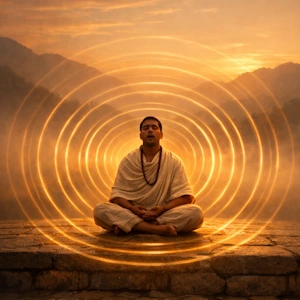
You repeat a simple set of syllables. The same sounds, over and over. Within minutes, your breathing slows and your thoughts quieten. This happens consistently, across cultures and centuries. There is a clear reason why.
What a Mantra Actually Is
First understand the context. The word mantra comes from two Sanskrit roots. Manas means mind. Tra means tool. A mantra is literally a tool for the mind.
It is not a prayer directed outward. It is a specific sequence of sounds chosen for the way those sounds behave inside the body and mind when repeated. Ancient practitioners tested thousands of syllable combinations over generations and kept the ones that produced reliable inner effects.
Sound Vibrates Structures Inside the Head
When you chant, you are not just producing sound outward. You are vibrating the structures inside your own head.
The tongue, palate, nasal cavity, and skull all vibrate when you produce sound. Sanskrit mantras use sounds that activate specific pressure points on the upper palate. These points are directly connected to the hypothalamus, the part of the brain that regulates hormones, sleep, and emotional response. Precise sound patterns send signals directly into the brain's regulatory centre.
Repetition Shifts the Brain into a Calmer State
Now look at what repetition does to the brain.
In ordinary waking life your brain runs on beta waves. These govern active thinking, worry, and mental chatter. When you repeat a mantra steadily, the analytical mind has nothing new to process. It cannot argue with the sound. It cannot solve it. So it gradually steps back.
As this happens, the brain moves from beta waves toward alpha waves. Alpha state is calm and open. With deeper practice it moves further into theta waves, the state of deep meditation and creative insight. This is measurable on an EEG machine.
The Mantra Regulates the Breath
There is another important detail. Chanting naturally regulates breathing without any deliberate effort.
Most mantras chanted aloud require a slow controlled exhale. The inhale happens naturally between repetitions. This creates a slow rhythmic breathing pattern automatically.
Slow rhythmic breathing activates the parasympathetic nervous system. This is your rest and recovery system. It lowers heart rate, reduces cortisol, and relaxes muscle tension. The mantra organises the breath, and the breath calms the body. Both happen together.
Chanting Stimulates the Vagus Nerve
The vagus nerve is the longest nerve in the body. It runs from the brainstem through the throat, heart, and abdomen. It is the main channel through which the brain and body communicate.
When you chant, the vibration in the throat and chest directly stimulates the vagus nerve. Research shows this reduces anxiety, lowers inflammation, and creates a measurable state of calm. This is why chanting feels different from thinking the mantra silently. The physical vibration adds a direct body level effect.
Focused Attention Quietens Mental Noise
Here is what focused repetition does to scattered thinking.
The mind cannot fully focus on two things at once. When attention is anchored to the mantra, the background stream of anxious thoughts loses its grip. The thoughts are not being fought. They are simply crowded out by one steady point of focus.
Over time this trains the mind to return to a chosen point rather than follow every passing thought. This is precisely what meditation is. The mantra is the training tool.
Long Practice Builds a Conditioned Response
Every time you sit with a mantra and reach a calm state, your brain records that association. Over weeks and months the association becomes stronger and faster.
Eventually beginning the mantra triggers calm almost immediately. The nervous system recognises the signal and responds before the analytical mind has even settled. You have trained your own nervous system to shift states on cue.
The Takeaway
A mantra works on the human system at several levels at once. It vibrates structures inside the skull. It shifts the brain from scattered alertness to focused calm. It regulates the breath without effort. And it trains the mind over time to return to stillness with increasing ease.
Ancient practitioners understood all of this not through laboratories but through disciplined observation across generations. They built a technology of sound that works with remarkable precision. The fact that modern neuroscience keeps arriving at the same conclusions is not a coincidence. It is confirmation.
Q1. Why did ancient practitioners choose sound as a tool for the mind rather than any other method?
Sound is the one force that is both external and internal at the same time. You can see a flower and remain unmoved. You can smell incense and stay distracted. But sound enters the body whether you invite it or not. It bypasses conscious choice. The ear never closes the way the eye can.
Ancient practitioners understood this. They realised that if you could control the sound entering the system, you could directly influence the state of the mind and body. Sound was not chosen arbitrarily. It was chosen because it is the most direct route into human consciousness.
Q2. What makes Sanskrit syllables different from words in other languages?
First understand the context. Most languages evolved to communicate meaning between people. Sanskrit was developed with a different goal entirely.
It was refined as a vibrational language. The sounds were chosen and arranged based on where they are produced in the mouth and throat, and what effect that production has on the nervous system and the skull cavities.
Each Sanskrit syllable corresponds to a precise point of articulation inside the mouth. These points map directly onto pressure points on the upper palate connected to the hypothalamus. Other languages carry meaning. Sanskrit was engineered to carry effect. This is why the same mantra chanted in Sanskrit produces different results from a translation chanted in another language.
Q3. Why does the mind become quiet during mantra repetition when it resists quieting through ordinary effort?
This is one of the most important insights in the entire tradition.
When you try to force the mind to be quiet, you create a second mental activity, which is the effort of forcing. The mind is now doing two things. It is chattering and it is trying to stop the chattering. This makes the problem worse.
The mantra works differently. It gives the mind something simple and rhythmic to do. The analytical mind is occupied, not suppressed. It is redirected. Because the mantra offers no new information and no problem to solve, the mind gradually loses momentum. The chatter does not get fought. It simply runs out of fuel. This is far more sophisticated than any method that relies on willpower.
Q4. Is there a connection between the frequency of a mantra and the frequency of matter itself?
Here is a deeper point that modern physics has begun to confirm.
At the subatomic level, matter is not solid. It is vibration. Every atom is a pattern of oscillating energy. What appears solid is actually a stable wave of frequency.
Ancient Vedic understanding held that the universe itself arose from sound. The concept of Nada Brahma means the universe is sound. This was not poetic language. It was a statement about the fundamental nature of reality.
When you produce a mantra with precision and sustained attention, you are introducing a coherent vibrational pattern into a system that is itself made of vibration. Modern physics calls coherent vibrational influence resonance. Ancient practitioners called it mantra. They were describing the same phenomenon from different directions.
Q5. Why do some mantras need to be given by a teacher rather than simply read from a book?
There is another important detail that most people overlook.
A mantra is not just a sequence of syllables. It is a precise vibrational tool. Like a surgical instrument, its effect depends entirely on how it is used. The pitch, the rhythm, the breath pattern, the point of focus in the body, all of these variables determine the outcome.
A teacher who has worked with a mantra for years carries the correct vibrational pattern in their own system. When they transmit the mantra directly, they are not just passing on information. They are passing on a living pattern of use. A mantra read from a book is like reading sheet music without ever having heard the instrument. The notes are correct but the living quality is absent.
Q6. What happens in the brain during long term mantra practice that does not happen in short term practice?
Here is what most people miss about sustained practice.
In the short term, mantra repetition produces a temporary shift in brainwave frequency. The mind calms down for the duration of the session and for some time afterward.
In the long term, something more fundamental changes. The neural pathways associated with calm, focus, and emotional stability become physically thicker and more efficient. This is called neuroplasticity. The brain rewires itself around the patterns you repeat most consistently.
Long term practitioners show measurable increases in grey matter density in the prefrontal cortex, the part of the brain responsible for emotional regulation and clear decision making. The mantra does not just calm the mind temporarily. It rebuilds the structure of the brain over time.
Q7. Why are some mantras kept secret and not shared publicly?
First understand what a mantra is at its deepest level.
A mantra given to a specific person by a teacher is calibrated to that person's temperament, nervous system, and stage of inner development. It is essentially a prescription. Just as a strong medical compound is right for one patient and harmful for another, a powerful mantra given without proper assessment can produce effects the recipient is not prepared to handle.
There is also a second reason. The more exclusively a mantra is used by one person, the more that person's entire nervous system becomes tuned to it. Sharing it dilutes that exclusive resonance. The secrecy is not mysticism. It is practical precision.
Q8. Why do group chanting and collective mantra repetition produce stronger effects than solo practice?
Now look at what happens when many people produce the same sound together.
Sound waves from multiple sources combine. When they are in phase with each other, meaning they are producing the same frequency at the same time, they amplify each other. This is called constructive interference in physics.
A single person chanting produces a measurable effect on their own nervous system. A group chanting the same mantra in unison produces a sound field that is orders of magnitude more powerful. Every person in that field receives the amplified vibration both through their ears and through their body.
This is why temple chanting, group meditation, and collective prayer have been central to every major tradition in human history. The ancients understood acoustic amplification long before science named it.
Q9. What is the relationship between mantra and the autonomic nervous system that makes it a health tool and not just a spiritual one?
Here is what makes mantras genuinely remarkable from a medical standpoint.
The autonomic nervous system controls everything the body does without conscious instruction. Heart rate, digestion, immune response, inflammation, hormone secretion. It has two modes. The sympathetic mode is fight or flight. The parasympathetic mode is rest and repair.
Modern life keeps most people locked in low level sympathetic activation. The body is always slightly on alert. Over time this produces chronic inflammation, poor digestion, disrupted sleep, and weakened immunity.
Mantra practice, through breath regulation and vagus nerve stimulation, directly and reliably shifts the system into parasympathetic mode. The body enters repair mode. Inflammation reduces. Digestion improves. Immunity strengthens. This is why sustained mantra practice shows measurable health benefits entirely independent of any spiritual belief.
Q10. What is the deepest secret that the mantra tradition points toward that science has not yet fully explained?
Here is the most profound point of all.
Every scientific explanation of mantra so far describes what happens to the person chanting. Brainwaves shift. The nervous system calms. The body repairs. All of this is about the effect on the individual.
But the oldest layer of the tradition points to something beyond this. It holds that sustained, precise, devoted mantra practice does not just change the person. It changes the field around the person. The idea is that consciousness itself is not confined inside the skull. It extends outward. A mind made coherent through years of practice begins to influence the environment, other people, and events in ways that do not follow ordinary cause and effect logic.
Science does not yet have instruments sensitive enough to measure this reliably. But the consistent reports across thousands of years and dozens of independent traditions are too convergent to dismiss. This remains the open frontier. The honest position is that we are at the edge of what current science can explain, and the tradition is pointing beyond that edge.
Objection 1. Mantras are just repetitive mumbling. Any repetitive activity would produce the same calming effect.
This objection is partly right and entirely misses the point.
Yes, repetition itself has a calming effect. But the claim of the mantra tradition is not only that repetition calms. It is that specific sounds, produced at specific points of articulation, stimulate specific neural and physiological pathways that random repetition does not reach.
The difference between chanting Om and repeating the word cup three hundred times is not just one of intention. It is a difference in the physical structures being activated inside the skull and the precise vibrational frequencies being introduced into the system. Research comparing structured mantra with random repetition confirms measurable differences in outcome.
Objection 2. The calming effect is just the placebo effect. If you believe it will work, it works.
The placebo effect is real and it is powerful. But it cannot explain everything observed in mantra research.
Infants and animals cannot hold beliefs about whether a practice will work. Yet low frequency rhythmic sound consistently calms infants and reduces stress markers in animals. The vagus nerve does not require belief to be stimulated. The parasympathetic nervous system does not require faith to activate. Physiological changes in heart rate variability, cortisol levels, and brainwave frequency have been measured in subjects who were skeptical about the practice before beginning it. The belief accelerates the effect. It does not create it.
Objection 3. All meditation produces the same results. There is nothing special about mantras specifically.
Different meditation methods produce overlapping but distinct neurological signatures.
Mantra meditation specifically activates the auditory cortex, the speech production areas of the brain, and the vagus nerve through throat vibration simultaneously. Breath based meditation activates different pathways. Visualisation based meditation activates yet another set. The overlap in calm and focus is real. But the specific physiological mechanisms engaged by mantra are distinct, and the documented health outcomes differ in measurable ways from other methods.
Objection 4. Sanskrit is a dead language with no special properties. It is ordinary human speech given religious importance.
Sanskrit is not special because it is sacred. It is structured differently from languages that evolved primarily for communication.
Its phonetic system, called Vedic phonetics, classifies every sound by the precise point in the mouth and throat where it is produced and the airflow pattern it requires. This level of anatomical precision in language design is unique. The question is not whether Sanskrit is holy. The question is whether its sounds, when produced correctly, engage neural and physiological pathways that loosely articulated speech does not. The evidence suggests they do.
Objection 5. Mantra practice is a tool of religious control used to keep people passive and compliant.
This objection confuses the tool with the use of the tool.
A kitchen knife can feed a family or cause harm. The knife itself is neither. Mantra practice, examined on its own terms, produces measurable increases in emotional regulation, reduced reactivity, and improved clarity of thinking. These are not the qualities of a passive, compliant person. They are the qualities of a more capable and self-directed one. Whether any institution has misused the practice is a separate question from whether the practice itself is valid and beneficial.
Objection 6. If mantras truly worked, everyone who practised them would be healthy, calm, and wise. Clearly that is not the case.
Here is what this objection gets wrong.
A scalpel in the hands of a surgeon saves lives. A scalpel used incorrectly causes damage. A scalpel left in a drawer does nothing. Mantra practice requires correct technique, consistent application, and appropriate guidance. Most people who try mantras do so casually, inconsistently, and without proper instruction. The tool is not failing. It is not being used correctly. The research evidence consistently shows that correct, sustained practice produces the documented benefits. Irregular or superficial practice produces partial or no results.
Objection 7. The health benefits attributed to mantras are simply the result of sitting quietly for a few minutes each day. The mantra itself adds nothing.
This is a testable claim and it has been tested.
Studies comparing passive sitting in silence with active mantra repetition consistently show greater reductions in stress hormones, greater improvements in heart rate variability, and greater shifts in brainwave frequency in the mantra group. Sitting quietly is beneficial. Adding structured sound repetition produces distinct additional effects. The mantra is not interchangeable with simply resting.
Objection 8. Ancient people invented mantras out of superstition and fear of the unknown. We should not base modern practice on pre-scientific thinking.
Ancient people did not have laboratories. They had something else. Thousands of years of direct, disciplined, systematic inner observation conducted by large numbers of highly trained practitioners.
The results of that observation were recorded, tested across generations, refined, and passed forward only when they proved consistently reliable. This is a different method from modern science but it is not the absence of method. Many things that began as ancient observation, including the properties of medicinal plants, the behaviour of the stars, the mathematics of proportion, have been confirmed by modern investigation. Mantra is following the same path.
Objection 9. Neuroplasticity and vagus nerve stimulation can be achieved through many modern methods. We do not need mantras when we have better tools.
This objection assumes that modern methods are superior because they are newer.
Mantra practice is simultaneously a sound tool, a breath regulation tool, a focused attention tool, a vagus nerve stimulation tool, and a neuroplasticity training tool, all operating at the same time through a single simple practice requiring no equipment, no electricity, no cost, and no professional supervision once learned correctly.
No single modern clinical method combines all of these mechanisms simultaneously. The integration is the advantage. The simplicity is the advantage. Newer does not mean more complete.
Objection 10. There is no scientific evidence that mantras affect anything beyond the person chanting. Claims about influencing the environment or other people are pure mysticism.
This is the honest boundary of current scientific knowledge and it should be stated clearly.
You are correct that science has not yet reliably measured the influence of mantra practice beyond the individual. The instruments and experimental frameworks for measuring such effects do not yet exist in a form that satisfies scientific standards.
What exists is consistent testimony across thousands of years, dozens of independent cultures, and large numbers of serious practitioners pointing toward the same phenomenon. Science once lacked instruments to measure electromagnetic fields, bacterial infection, and quantum behaviour. Their absence from measurement did not mean their absence from reality. The appropriate position is not confident dismissal. It is honest acknowledgment that we are at the current edge of what can be measured, and that the edge keeps moving.






English
Mantra Shastra
Click on any topic to open
7
30
Astrology
Bhagavad Gita
Bhagavatam
Bharat Matha
Devi
Devi Mahatmyam
Ganapathy
Garuda Puranam
Glory of Venkatesha
Hanuman
Kathopanishad
Mahabharatam
Mantra Shastra
Mystique
Practical Wisdom
Purana Stories
Radhe Radhe
Ramayana
Rare Topics
Rigveda Explained
Rituals
Sages and Saints
Shiva
Spiritual books
Sri Suktam
Story of Sri Yantra
Temples
Vedas
Vishnu Sahasranama
Yoga Vasishta
26
17
10
0


