Why Did Krishna Die From a Hunter’s Arrow?
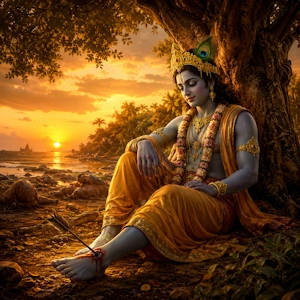
The departure of Krishna is one of the most misunderstood moments in Hindu tradition.At first glance, it feels strangely ordinary.
A hunter.
A mistaken arrow.
A wound in the foot.
And Krishna leaving the world.
People naturally ask:
'How can Bhagavan die like this?'
But the scriptures are pointing toward something much deeper.
Krishna's departure was not an accident.
It was the deliberate closing of an age.
The main account comes from the Mahabharata and the Bhagavata Purana.
After the Kurukshetra war, the Yadavas became arrogant.
Internal conflict began.
A curse unfolded.
The Yadava clan destroyed itself near Prabhasa.
Krishna watched it happen calmly.
Why?
Because his mission was complete.
Adharma had been reduced.
The great dynasties had fallen.
Dvapara Yuga was ending.
Kali Yuga was beginning.
Then Krishna went alone into the forest.
He sat beneath a tree in deep yogic stillness.
A hunter named Jara saw Krishna's foot from a distance.
It resembled a deer.
He released an arrow.
When he came closer, he was horrified.
But Krishna showed no anger.
No fear.
No helplessness.
Instead, he comforted the hunter.
That itself reveals the truth.
This was not ordinary death.
This was conscious withdrawal.
In Sanatana Dharma, great beings do not die helplessly.
They can consciously withdraw prana.
The outer event becomes only a visible excuse.
The arrow was symbolic.
Why the foot?
Because Krishna's feet symbolize the final presence of Dharma on earth.
The strike to the foot represents the withdrawal of divine presence at the beginning of Kali Yuga.
There is also a karmic layer in later traditions.
In the Ramayana, Rama kills Vali from concealment.
Some traditions say Jara was Vali reborn.
The arrow incident is then seen as karmic balancing across avataras.
But this is secondary.
The deeper point is different.
Krishna chose a simple ending.
No cosmic drama.
No terrifying display of power.
No grand declaration.
Just silence.
A tree.
A forest.
And peaceful withdrawal.
That simplicity itself is the teaching.
Krishna's entire life followed this pattern.
He moved among ordinary people.
Some saw only a cowherd.
Some saw a strategist.
Some saw a friend.
Some saw Bhagavan Himself.
Even his departure continued that mystery.
Q: Why did Krishna allow the Yadavas to destroy themselves?
A: Because Dharma is above family attachment.
Krishna protected them for years.
But power created arrogance.
Arrogance created downfall.
Bhagavan does not support adharma forever.
Even if it comes from his own clan.
This is a terrifying principle.
Divine grace is not blind favoritism.
Q: Why was Krishna's departure so quiet?
A: Because Krishna always hid greatness behind simplicity.
Born in a prison.
Raised among cowherds.
Worked as a charioteer.
Lived among ordinary people.
Even his final moment was quiet.
No grand display.
No cosmic drama.
This was intentional.
The divine does not always arrive with noise.
Q: Why is the wound on the foot considered symbolic?
A: Krishna's feet represent refuge.
They represent Dharma on earth.
Devotees surrender at his feet.
The strike on the foot carries deep meaning.
It symbolizes the withdrawal of visible Dharma.
Dvapara Yuga was ending.
Kali Yuga was beginning.
The event was not merely physical.
It marked a cosmic transition.
Objection:
'If Krishna was Bhagavan, how could an arrow harm him?'
Reply:
Krishna was not shown as helpless.
He remained calm.
He comforted the hunter.
There was no fear.
No panic.
No struggle.
The scriptures present it as conscious withdrawal.
Not forced death.
The body was part of the avatara.
The mission was complete.
So Krishna left peacefully.





English
Bhagavatam
Click on any topic to open
7
30
Astrology
Bhagavad Gita
Bhagavatam
Bharat Matha
Devi
Devi Mahatmyam
Ganapathy
Garuda Puranam
Glory of Venkatesha
Hanuman
Kathopanishad
Mahabharatam
Mantra Shastra
Mystique
Practical Wisdom
Purana Stories
Radhe Radhe
Ramayana
Rare Topics
Rigveda Explained
Rituals
Sages and Saints
Shiva
Spiritual books
Sri Suktam
Story of Sri Yantra
Temples
Vedas
Vishnu Sahasranama
Yoga Vasishta
26
17
10
0


