Why Clarity Always Begins with Crisis
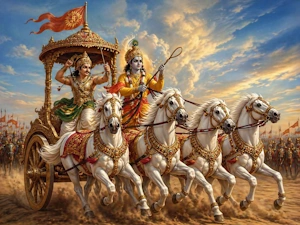
Arjuna was not weak.
He was one of the greatest warriors of his time.
He had skill.
He had training.
He had experience.
Yet, at the most critical moment, he collapses.
This is where the Gita begins.
Not in strength.
In breakdown.
Understand this carefully.
Clarity does not begin when you are strong.
It begins when your current understanding fails.
Arjuna stands on the battlefield.
Everything looks familiar.
The ground.
The army.
The duty.
But suddenly, something shifts.
He sees not enemies, but his own people.
Teachers.
Grandfather.
Friends.
Now the same situation looks completely different.
This is the first trigger of crisis.
When perception changes, stability breaks.
His mind starts racing.
What is right?
What is wrong?
Should I fight?
Should I withdraw?
He is not confused because he lacks knowledge.
He is confused because he has too many viewpoints.
Emotion pulls one way.
Duty pulls another.
Fear pulls a third way.
This is not lack of intelligence.
This is overload.
Now comes the deeper layer.
Arjuna is not just thinking.
He is imagining outcomes.
Death.
Destruction.
Loss of family.
Collapse of order.
The mind jumps into the future.
It creates fear based on possibilities, not reality.
This is where anxiety begins.
Not in the present moment.
In imagined consequences.
His body reacts.
Hands tremble.
Bow slips.
Energy drops.
This is important.
Mental conflict always becomes physical.
You cannot carry contradiction inside and remain steady outside.
The body reflects the mind.
Then comes rationalization.
Arjuna starts giving arguments.
Why war is wrong.
Why killing is sinful.
Why withdrawal is better.
These sound like moral positions.
But look closely.
They arise after emotional disturbance.
This is what the mind does.
First it gets disturbed.
Then it creates logic to justify that disturbance.
Now the key point.
Arjuna’s breakdown is not failure.
It is exposure.
All his hidden attachments come to the surface.
His identity.
His relationships.
His fears.
Everything he never questioned is now in front of him.
This is what crisis does.
It removes illusion.
Until this moment, Arjuna was functioning on borrowed clarity.
From training.
From tradition.
From role.
Now that borrowed clarity is gone.
He cannot act on autopilot anymore.
He is forced to see.
And this is painful.
This is why Krishna does not stop the breakdown.
He allows it.
Because without collapse, there is no space for real understanding.
If Arjuna had remained confident, he would have acted without clarity.
Crisis interrupts that.
It forces pause.
Now Arjuna does something crucial.
He stops pretending.
He admits confusion.
He puts down his bow.
He asks for guidance.
This is the turning point.
Not the breakdown.
The acceptance of breakdown.
Most people never reach clarity because they avoid this step.
They distract themselves.
They suppress doubt.
They rush into action.
Arjuna does the opposite.
He stays with the confusion.
He seeks direction.
That is why the Gita happens.
Understand the pattern.
Crisis → confusion → collapse → questioning → clarity.
Skip any step, and clarity becomes shallow.
Go through it fully, and clarity becomes unshakable.
This is not about war.
This is about life.
Every major decision brings this moment.
Career.
Relationships.
Responsibility.
When your old thinking stops working, you feel lost.
That is not a problem.
That is the beginning.
So the next time confusion hits, do not panic.
Do not rush to escape it.
Look at it properly.
What is breaking?
What are you holding on to?
What are you afraid of?
That is where your answer is hidden.
Arjuna did not break because he was weak.
He broke because he was ready to see deeper.
And once he saw clearly, he did not hesitate.
That is the real lesson.
Breakdown is not the end.
It is the doorway.
Vedadhara is working to bring this kind of clarity into everyday life.
If this made you think, share it. Let this understanding reach someone who needs it.
Q1: Why does clarity come only after a breakdown and not before?
A: Because as long as the mind is comfortable, it keeps repeating old patterns. Breakdown forces those patterns to fail. It exposes hidden assumptions, attachments, and fears. Only when the old structure collapses does the mind become open to real clarity.
Q2: What exactly triggered Arjuna’s crisis on the battlefield?
A: Not the war itself, but a shift in perception. The same people he saw as opponents were suddenly seen as family. This emotional re-framing created conflict between duty and attachment. The situation did not change. His seeing changed.
Q3: Why does the mind create strong arguments during confusion?
A: Because the mind wants to protect its emotional state. First it gets disturbed. Then it builds logic to justify that disturbance. This is why confusion often sounds intelligent. But it is driven by emotion, not clarity.
Q4: What is the hidden role of imagination in creating crisis?
A: The mind jumps into the future and builds scenarios of loss, failure, and destruction. These imagined outcomes feel real and create fear. The crisis is not in the present moment. It is in the mind’s projection of what might happen.
Q5: Why did Arjuna’s acceptance of confusion become the turning point?
A: Because clarity begins only when false certainty ends. By admitting he does not know what to do, Arjuna stops acting from ego and becomes ready to receive guidance. Without that surrender, deeper understanding is not possible.
Objection 1: This is just emotional weakness. A strong person should act without breaking down.
Reply: Acting without clarity creates long-term damage. Breakdown is not weakness. It is the mind recognizing that its current understanding is insufficient. Ignoring it leads to wrong decisions, not strength.
Objection 2: This overanalyzes a simple situation. It was just fear of war.
Reply: If it were just fear, Arjuna would have run away. Instead, he stayed and questioned deeply. His crisis was not about danger, but about meaning, duty, and consequence. That is a higher level conflict.
Objection 3: Real life does not allow time for such reflection. Decisions must be quick.
Reply: Quick decisions are useful only when clarity already exists. When the mind is confused, speed increases error. Even a short pause to see clearly can prevent major mistakes.
Objection 4: Emotions should be suppressed to function effectively.
Reply: Suppressed emotions do not disappear. They influence decisions from the background. Arjuna’s example shows that facing emotions directly leads to clarity. Suppression leads to hidden instability.
Objection 5: This approach makes people dependent on guidance instead of thinking for themselves.
Reply: Seeking guidance is not dependency when it arises from genuine questioning. Arjuna did not stop thinking. He refined his thinking by aligning it with a higher clarity. That leads to independence, not dependence.





English
Bhagavad Gita
Click on any topic to open
17


