Why Bhagavan Is Woken, Bathed, Dressed, And Fed
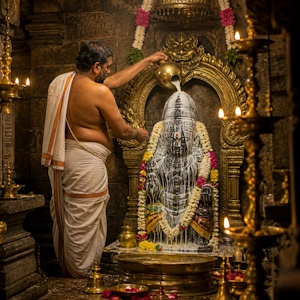
In Sanatana Dharma, the deity is not treated as a stone object.
The deity is treated as a living presence.
That is why worship has a daily rhythm.
The deity is awakened.
The deity is bathed.
The deity is dressed.
The deity is offered food.
The deity is allowed to rest.
To an outsider, this may look like ritual.
To a devotee, this is relationship.
Not A Display Piece
A murti is not kept only for decoration.
After proper installation, the deity becomes the center of divine presence.
The temple behaves as though Bhagavan is truly present.
That is why there is care.
Morning worship.
Bathing.
Alankara.
Naivedya.
Arati.
Rest.
Festival decoration.
Special offerings.
Everything has meaning.
Everything is done with attention.
When Bhagavan is present, casualness is not right.
Waking Up The Deity
Many temples begin by waking the deity.
Bhagavan does not need sleep like us.
But devotion speaks through loving service.
The devotee says:
'You are here with us.'
'We begin our day with You.'
'Before the world becomes noisy, we attend to You.'
This gives life a sacred order.
Before work, Bhagavan.
Before food, Bhagavan.
Before comfort, Bhagavan.
This slowly removes self-centeredness.
Bathing The Deity
The bathing of the deity is called abhisheka or snana.
Water, milk, curd, ghee, honey, sandal paste, and other sacred items are offered.
This is not only cleaning.
It is reverence.
A mother bathes her child with care.
A host honors a guest with respect.
A devotee bathes the deity with surrender.
The hands perform the act.
The heart offers love.
Dressing And Decoration
After bathing, the deity is dressed.
Fresh clothes are offered.
Ornaments are placed.
Flowers are arranged.
Sandal paste is applied.
Garlands are offered.
This is not vanity.
This is honoring Bhagavan beautifully.
When someone dear comes home, we arrange things with care.
We do not say, 'Love is enough. Care is not needed.'
Real love expresses itself.
Alankara is love made visible.
Feeding The Deity
Food is offered as naivedya.
The devotee does not eat first.
Bhagavan receives first.
The feeling is simple.
'This food came by Your grace.'
'This home runs by Your grace.'
'This body lives by Your grace.'
'You receive first.'
After offering, the food becomes prasada.
It is no longer ordinary food.
It carries the blessing of offering.
Food becomes gratitude.
Eating becomes sacred.
Letting The Deity Rest
In many temples, the deity is put to rest at night.
The doors close.
Lullabies may be sung.
A bed may be arranged.
Night offerings may be made.
Bhagavan does not become tired like us.
But devotion is intimate.
A devotee does not approach Bhagavan only during problems.
A devotee lives with Bhagavan.
Morning to night.
Joy to difficulty.
Beginning to end.
This is relationship.
Not transaction.
Not Mere Symbolism
Some people say, 'All this is only symbolic.'
That is too shallow.
Symbolism is there.
But temple worship is not merely symbolic.
It is a living relationship.
It is supported by mantra.
It is protected by tradition.
It is strengthened by discipline.
It is filled with bhakti.
The deity is not treated as an idea.
The deity is served as presence.
That is why carelessness matters.
Wrong timing matters.
Impure handling matters.
Improper offering matters.
Neglect matters.
When presence is accepted, conduct changes.
Love With Discipline
Personal care of the deity teaches a deep lesson.
Love without discipline becomes casual.
Discipline without love becomes dry.
Temple worship brings both together.
There is strictness.
There is timing.
There is procedure.
There is tenderness.
This is why temple traditions are careful.
Who enters the inner sanctum matters.
How offerings are prepared matters.
How the deity is touched matters.
How the daily schedule is followed matters.
This is not rigidity.
This is reverence.
What This Teaches Us
This worship changes the devotee.
Slowly, the mind learns to see Bhagavan as real.
Not distant.
Not abstract.
Not only philosophical.
Present.
Close.
Lovingly accessible.
When we wake the deity, we learn sacred order.
When we bathe the deity, we learn purity.
When we dress the deity, we learn care.
When we feed the deity, we learn gratitude.
When we let the deity rest, we learn tenderness.
The whole routine becomes training in bhakti.
Straight Understanding
The deity is treated like a living presence.
Because devotion is not just thought.
It is service.
It is relationship.
It is responsibility.
Bhagavan is not remembered only during crisis.
Bhagavan is honored in every part of life.
Waking.
Bathing.
Dressing.
Feeding.
Resting.
All these are forms of intimate devotion.
This is not empty ritual.
This is love becoming disciplined action.
At Vedadhara, we bring out the living meaning behind temple practices.
Share this with someone who thinks worship is only symbolism.
What looks like ritual from outside can be the deepest love from inside.
-
Why does temple worship treat the deity like a living presence instead of treating the murti as only a sacred symbol?
Because Sanatana Dharma does not stop at abstract belief.
It trains the devotee to experience Bhagavan as present.
A symbol can be remembered and then forgotten.
A living presence has to be served.
This changes the whole relationship.
When the deity is awakened, bathed, dressed, fed, praised, and put to rest, the devotee’s mind slowly stops treating Bhagavan as a distant concept.
Bhagavan becomes part of the daily rhythm.
This is the greatness of the principle.
It makes devotion practical.
It makes love disciplined.
It makes remembrance continuous.
The mystery here is that the ritual is not only for the deity.
It is also a deep re-training of the devotee’s inner world.
The hands serve the murti.
But the heart is being reshaped.
-
Why are even small details like timing, cleanliness, food, dress, and rest taken so seriously?
Because love becomes real through detail.
Casualness shows distance.
Care shows intimacy.
When a temple follows strict timings, pure preparation, proper offerings, and careful handling, it is saying one thing very clearly:
Bhagavan is not an idea kept for convenience.
Bhagavan is the honored presence around whom life is arranged.
This is a very powerful principle.
In ordinary life, what we respect, we protect.
What we love, we attend to.
What we value, we do not handle carelessly.
Temple worship applies this same truth to Bhagavan.
The hidden side is this:
Every small act builds inner sensitivity.
The devotee begins to notice purity.
Food becomes sacred.
Time becomes sacred.
Clothing becomes sacred.
Speech becomes sacred.
The temple routine slowly teaches that nothing in life is spiritually neutral.
Everything can become an offering.
-
What is the deeper secret behind offering food to the deity before eating?
Naivedya teaches that the first right over life belongs to Bhagavan.
Food is not treated as mere consumption.
It is treated as grace.
Before the devotee eats, the food is placed before the deity.
This reverses ego.
Normally the mind says:
'I earned this.'
'I cooked this.'
'I deserve this.'
But naivedya says:
'This came through Bhagavan’s order.'
'This body lives by Bhagavan’s support.'
'Let Bhagavan receive first.'
After that, the food becomes prasada.
This is not just a change of name.
The attitude has changed.
The ownership has changed.
The food has passed through surrender.
The secret is that naivedya transforms both food and the one who eats.
The food becomes prasada.
The eater becomes more grateful.
This is why offering food is not a small ritual.
It is a daily correction of ego.
Objection:
Non-believers may say that bathing, dressing, feeding, and putting a deity to rest is childish imagination. They may say the stone image cannot eat, sleep, or feel anything.
Reply:
This objection comes from looking only at the outer act.
Temple worship is not based on the idea that stone has ordinary biological needs.
The point is not that Bhagavan needs food or clothes.
The point is that the devotee needs seva.
After prana pratishtha and continuous worship, the murti is treated as the seat of divine presence.
So the devotee does not behave casually before it.
The bathing expresses purity.
The dressing expresses honor.
The food offering expresses gratitude.
The resting expresses intimacy.
A flag is cloth, but people stand in respect before it.
A photograph is paper, but a person may hold it with love because of the presence it carries in the heart.
In the same way, the consecrated deity is approached with reverence.
But temple worship goes even deeper than memory or emotion.
It is supported by mantra, tradition, discipline, and bhakti.
The non-believer sees stone.
The devotee sees presence.
The difference is not in the eyes alone.
It is in the depth of relationship.





English
Temples
Click on any topic to open
7
30
Astrology
Bhagavad Gita
Bhagavatam
Bharat Matha
Devi
Devi Mahatmyam
Ganapathy
Garuda Puranam
Glory of Venkatesha
Hanuman
Kathopanishad
Mahabharatam
Mantra Shastra
Mystique
Practical Wisdom
Purana Stories
Radhe Radhe
Ramayana
Rare Topics
Rigveda Explained
Rituals
Sages and Saints
Shiva
Spiritual books
Sri Suktam
Story of Sri Yantra
Temples
Vedas
Vishnu Sahasranama
Yoga Vasishta
26
17
10
0


