Why Are Samskaras Performed?
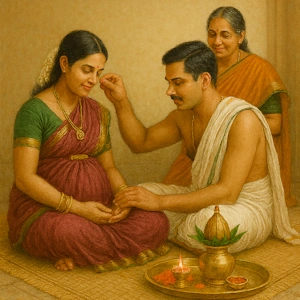
We eat rice, right? We consume cooked rice.
We don’t just go to the field, pick up some paddy, and chew them. We make the raw paddy fit for consumption.
How do we do that? First, the harvesting is done — the ripe and ready paddy plants are cut. Then the plants and the paddy seeds are separated. This is called threshing. Then the paddy is dried. Then it is hulled and milled to remove the husk. Then they are cleaned.
Then they come to the shop. We buy them, bring them home. Sometimes stones are there — we have to remove them. Then it is washed a few times, cooked, and then consumed.
See how many steps are there before the rice is made fit for consumption?
In Sanatana Dharma, the ultimate goal is moksha, or to become one with Paramatma. We don’t settle for anything less than this. We want to become God — in totality, 100%.
In this path, there are some secondary goals also, which, if properly followed, will help in attaining the primary and final goal of moksha.
They are:
-
Adherence to righteous living — dharma
-
Generation of wealth — so that life can be lived in a righteous way
-
To work towards attainment of desires — so that there is action in the world and everything in the world gets connected to each other, interlinked
In the absence of desire, there is no action. There is nothing that you have to do. But the world has to run.
So, if your thoughts are not completely self-centred, you also have to act in the world. You also have a certain role to play in the world.
It is because somebody acted that even the knowledge about moksha has come to us. It is because some farmers, some shopkeepers, your own mother, wife, are in action that you are maintaining your body — which can eventually take you towards moksha.
So, action cannot be done away with. Action is your contribution — your payback to society. Action needs resources — artha is generation of resources.
So, just like how the paddy in the field becomes fit for consumption through a number of steps — purificatory processes — in the same way, this body also has to be put through (body includes mind also). This body is also purified through a number of processes so that it becomes pure and eligible for becoming one with Paramatma.
Samskaras may not give you moksha by themselves, but they can take you up to the last step. The cooked rice will not enter your mouth on its own. But then, all the earlier processes are required to make it fit for consumption.
Are samskaras the only way to attain purity? It may not be so — because the scriptures talk about many other methods also.
But samskaras, as part of the Vedic system, were intricately merged into day-to-day life.
You didn’t have to go somewhere else to attain purity. You didn’t have to go to the Himalayas to attain purity. You didn’t have to move away from your family, leaving behind your responsibilities towards your wife, children, parents, and sit and do asana and pranayama for hours to attain the state fit for moksha.
You didn’t have to do panchagni sadhana or tapas to burn away all the impurities associated with your body and mind.
Samskaras were incorporated into the day-to-day life of a family living as per Vedic dharma.
It is very easy. You only have to go on performing samskaras at the right times. At the end of it, you attain purity and become fit for moksha or mukti.
This is the whole idea of samskaras — they are easily incorporated into day-to-day life.
Samskaras not only purify you, they also add certain qualities in you which make spiritual progress even faster and certain.
It is like how we see these labels — fortified with vitamins, fortified with minerals — which are supposed to improve upon the original quality or nature of the product.
So, samskaras help in two ways — they purify you, they add qualities in you.
What is the source of samskara procedures or rituals?
Vedas. But you will not find chapters written on samskaras as it is in the Vedas. The mantras are scattered all over the Vedas.
From there, our sages gathered them and assembled them systematically into books called Grihya Sutras.
Grihya Sutras give the procedures in a very condensed form. Unless a commentary explains them to you, you won’t be able to understand.
Sutras serve more like a step-by-step checklist — just pointers to the various events in a ritual in the correct sequence so that you don’t miss out on anything.
The commentaries elaborate on how something should be performed — sometimes why also — and the dos and don'ts.
From these, we also have books written by acharyas where the pertinent portions of one or many samskaras are given in a more concise way for practical purposes. They may not have all the explanations, but the procedures are given in these kinds of books. One book on Vivaha Samskara, another on Upanayana — like that.
These books are generally what are followed by your purohita.
Samskara procedures are more or less identical, but not exactly the same also.
If your branch of Veda is Rigveda, then your samskaras will have Rigveda mantras. If your branch is Yajurveda, it will have Yajurveda mantras.
There are some variations in the procedures also — but not radically different from each other.
So, like this, we have the Ashwalayana Grihya Sutra for Rigvedis, Apastamba Grihya Sutra for Krishna Yajurvedis.
Even within a particular branch of Vedam, there could be different Grihya Sutras.
For example, in Krishna Yajurveda, there are two often followed:
-
Apastamba – procedures in Apastamba are generally short
-
Baudhayana – Baudhayana rituals are more elaborate
But essentially, they all have the same purpose — purification, adding qualities, making the person progress in the spiritual path and attain moksha finally.





English
Rituals
Click on any topic to open
7
30
Astrology
Bhagavad Gita
Bhagavatam
Bharat Matha
Devi
Devi Mahatmyam
Ganapathy
Garuda Puranam
Glory of Venkatesha
Hanuman
Kathopanishad
Mahabharatam
Mantra Shastra
Mystique
Practical Wisdom
Purana Stories
Radhe Radhe
Ramayana
Rare Topics
Rigveda Explained
Rituals
Sages and Saints
Shiva
Spiritual books
Sri Suktam
Story of Sri Yantra
Temples
Vedas
Vishnu Sahasranama
Yoga Vasishta
26
17
10
0


