Who are you, when everything is stripped away?
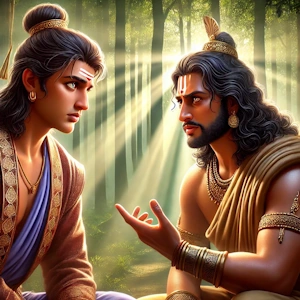
After the Kurukshetra War, Yudhishthira—haunted by guilt, grief, and the futility of bloodshed—finds no glory in victory. Shanti Parva, Chapter 7 lays bare his inner collapse: a warrior shattered by the moral cost of dharma pursued through war. He denounces kingship, condemns the Kshatriya code, and seeks refuge in renunciation. But as we move into Chapter 8, Arjuna rises to confront this crisis. With fierce conviction, he rebukes despair and defends righteous leadership. Power, he argues, is not to be abandoned—but wielded with integrity. A king’s duty is not to escape, but to restore, protect, and uphold dharma.
In Shanti Parva, Chapter 9, Yudhishthira's voice is no longer marked by hesitation. It is sharp, deliberate, and resolute. He does not plead for understanding—he commands it. He tells Arjuna: Do not try to bring me back. I am done with palaces soaked in blood and victories that taste like ash. I will walk away—alone—into the forest, toward silence, toward truth.
What does he choose in place of kingship? The fiercest path imaginable. He vows to shed not just his crown, but his very sense of self. No more silk, no more servants—he will wear rags and animal skins. He will let his hair mat, live off roots and fruits, bear the cold and heat, and wander with beasts. He will perform harsh austerities—tapasyā—not as ritual, but as penance, as purification.
Why would a man abandon all comforts and subject himself to hunger, thirst, exhaustion, and exposure? Because Yudhishthira is no longer seeking approval. He is seeking freedom. Not political freedom—existential freedom. He wants to destroy the desires that bind the soul to this cycle of action, consequence, and endless rebirth.
He says: I will live without possessions. I will show no delight, no sorrow. If one arm is chopped off and another smeared with sandalwood, I will not favor one over the other. Can a man live that way? Can he erase the self that craves, reacts, remembers? Yudhishthira believes he can—and must.
He will no longer ask anyone for directions. Why? Because he does not seek destinations. No country, no path, no purpose remains. He will walk where the wind takes him, cause no harm, frighten no soul. He will not seek food when there is smoke in kitchens or sound of pestles—he will go after others have eaten, when no one is looking. Not out of shame, but out of discipline.
He says, I will behave like I am already dead. I will not long for life, nor will I fear death. Is that detachment—or is it enlightenment?
He confesses: Greed and ignorance drove me to war. Our deeds, however noble they seemed, were laced with selfishness. But he will atone, not by words, not by ruling wisely—but by erasing the ego that performed those deeds. He has understood what most kings never grasp: that even the smallest act, done with a sense of 'I' and 'mine', can bind one like a chain.
He looks beyond dharma, beyond duty, beyond ritual. Even gods fall from heaven, even sages fall from grace—so what, then, is worth clinging to? Nothing, says Yudhishthira. Not fame. Not glory. Not even righteousness, if it is rooted in identity.
He has tasted the nectar of truth—amrita—and now, nothing else satisfies. The kingdom? A distraction. The throne? A trap. The only kingdom he seeks is the one that lies beyond death and rebirth. The only rule he desires is mastery over the self.
Who are you, when everything is stripped away? That is the question he now seeks to answer—not in debate, not in battle, but in silence, solitude, and surrender.
This is not weakness. This is not escape. This is a declaration of war—against illusion, ego, and desire. And this time, Yudhishthira doesn’t need an army. He only needs himself.





English
Mahabharatam
Click on any topic to open
7
30
Astrology
Bhagavad Gita
Bhagavatam
Bharat Matha
Devi
Devi Mahatmyam
Ganapathy
Garuda Puranam
Glory of Venkatesha
Hanuman
Kathopanishad
Mahabharatam
Mantra Shastra
Mystique
Practical Wisdom
Purana Stories
Radhe Radhe
Ramayana
Rare Topics
Rigveda Explained
Rituals
Sages and Saints
Shiva
Spiritual books
Sri Suktam
Story of Sri Yantra
Temples
Vedas
Vishnu Sahasranama
Yoga Vasishta
26
17
10
0


