Which Is the Best Spiritual Path in the Materialistic World?
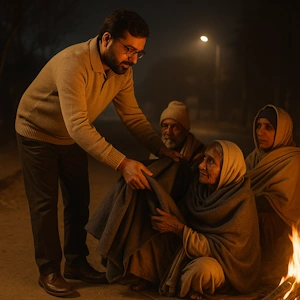
We have seen that money earned through fair means itself can purify you as you enjoy with it, as you put it to use. This money will not allow you to put it to wrong use.
Take the case of a boy who has taken to drugs, who has become addicted to drugs. If he is finding money for this himself, then he must be doing some crime to get that money. If it is the parents' money, then the parents definitely have to retrospect how they have earned the money.
There will be some element of cheating, short-changing, snatching someone's right — maybe sibling's right, money earned through bribe, money retained through evasion of tax — some such defect will be there in their wealth. Only such wealth will make children take to wrong paths such as drug addiction. Pure wealth will only make one do pure things.
What is the use of doing austerities such as fasting? It will help to increase the divine content of your body.
What is the use of reducing desires? It will purify the mind. When the mind becomes purer, cleaner, then in that mind, knowledge will rise spontaneously. Shiva Purana is telling all these.
We are living in a materialistic world, there is no doubt about it. That is the nature of Kaliyuga. That is how Kaliyuga is.
Then what is the kind of spirituality that works most in the materialistic world? Spirituality based on materials.
Shiva Purana says:
कृतादौ हि तपःश्लाघ्यं द्रव्यधर्मः कलौ युगे
What is dravya dharma? Dharma performed through materials.
Feed the hungry. Give medicines to the needy. Give clothes. Give books. Pay for a child's education. Get a poor girl married. Get drinking water into a village. Dig a well, dig a pond.
These methods work better in the present age. Because the tendency and opportunity to amass is predominant in the present age, which is called lobha. This can only be countered by giving away. Counter the tendency to amass materials by giving away materials.
There are those who say that idol worship is inferior, it is for the beginners. This point is also clarified and settled in Shiva Puranas:
कृते ध्यानात् ज्ञानसिद्धिः त्रेतायां तपसा तथा
द्वापरे यजनात् ज्ञानं प्रतिमापूजया कलौ
If you were born before 5000 years, then performing yajnas would have given you faster results. If you were born 869,000 years before, then tapas would have given you faster results. If you were born 2,165,000 years before, then dhyana (meditation) would have given faster results.
It is not a question of which method is superior. It is a question of time. You are now in the 21st century, 5000 odd years into Kaliyuga. It is idol worship that would give you faster results.
न तस्य प्रतिमा अस्ति यस्य नाम महद यशः ।
This is from Veda. People grossly misinterpret this to say that in Sanatana Dharma there is no idol worship. Absolutely wrong.
What Veda speaks about here is Parabrahma, Paramatma. People are saying this completely out of context, to confuse us. Either they don't understand, or they are doing this deliberately to take advantage of our own ignorance about our Dharma.
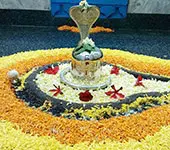
Shiva Purana is very clear — it is pratima puja that works best in Kaliyuga.
Many people have the wrong notion that Brahmins are there only to receive, because that is what you see mostly — they come and take from you. This is wrong.
Taking is for your benefit. But for their own benefit, they have to give. It is called shatkarmas — three pairs of prescribed duties of Brahmins:
Adhyana – Adhyapana
Learn Veda and teach Veda. You shouldn't just gain knowledge and use it to earn livelihood. You should also teach others. This is a duty. This is not voluntary. You should learn only if you are committed to teach.
I was recently talking to a Vedic scholar. His target is to prepare one hundred Vedic scholars. He has already done thirty-five. There are people with such commitment.
Then Yajana and Yaajana
You should become acharya in yajnas for the benefit of others. Then you receive dakshina. But at the same time, you should also perform yajnas in which you are the yajamana — you give dakshina. This is the second pair.
Pratigraha and Daana
Receive charity and give charity. Dakshina is a fee given against services rendered during yajna. In daanam, it is just giving away. You get something because you are noble. You get benefit out of giving away only if you give it to a qualified recipient — satpatra.
Pratigraha means what you receive. Daana means what you give. They are in pairs.
A Brahmin who learns but doesn't teach, a Brahmin who performs yajna for others but doesn't do it for himself, a Brahmin who receives gifts but doesn't give himself — he is failing in his duties. The result of which he will have to undergo.
So even purohitas — they have to give for their own benefit. What they receive is a liability for them, which is cleared when they give to others.





English
Shiva
Click on any topic to open


