Which Brahma? Krishna Asked
Remember the days of childhood summer vacations? When the electricity would suddenly go out at night, the whole family would carry woven mats up to the roof. Lying on the cool terrace, you would look up at the dark sky filled with thousands of stars. Have you ever stared at that endless blanket of twinkling lights and suddenly felt very, very small? You wonder: 'Where does it all end? Is there anyone else out there?'
Thousands of years ago, our ancestors sat under that exact same sky and asked the same questions. But the answers they found were truly mind-bending.
There is a beautiful story in the 'Bhagavata Purana'. One day, Lord Brahma, the creator of our universe, went to visit Lord Krishna in the great city of Dwarka. Brahma was a little proud. After all, he was the supreme architect! When he reached the palace gate, he told the guard, 'Go tell Krishna that Brahma, the creator with four heads, has arrived.'
The guard went in and returned with a strange question. 'Lord Krishna asks: 'Which' Brahma?'
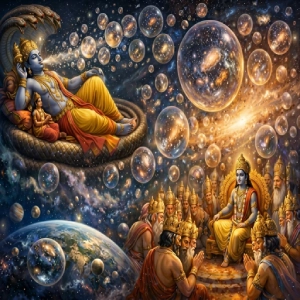
Brahma was confused. 'Which Brahma? Is there another one?' He walked into the grand hall, and what he saw left him completely speechless. Surrounding Krishna were millions of other Brahmas. Some had eight heads, some had a hundred, some had a million. They were all bowing down in devotion. Suddenly, our four-headed Brahma realized a shocking truth: he was just the creator of 'one' universe. And his universe was just a single drop in an endless cosmic ocean.
We usually think of the universe as one giant, single room holding all the stars, planets, and galaxies. But the Puranas describe reality very differently. They talk about 'Brahmandas', which literally translates to 'cosmic eggs.'
The ancient texts describe Maha Vishnu, the supreme cosmic being, resting in a state of deep, eternal sleep. As he exhales, millions of tiny bubbles come out of the pores of his skin. Each bubble is a complete universe. Each has its own galaxies, its own Earth, its own creator, and its own timeline. And when he inhales, these billions of universes gracefully dissolve back into him.
Does this sound familiar? It should.
Today, if you ask a quantum physicist or a cosmologist about the shape of reality, they will talk about the exact same concept. They call it the 'Multiverse Theory.' Modern science suggests that our universe might just be one of an infinite number of expanding bubbles in a grand cosmic foam. What scientists are discovering today using complex mathematics and giant space telescopes, our ancient sages visualized thousands of years ago in deep meditation. They didn't have satellites, but they had a profound, crystal-clear understanding of infinity.
Now, you might ask, 'This is fascinating science and mythology, but what does it have to do with my everyday life?'
It actually holds a very beautiful lesson for how we live. Think about our daily behavior. We wake up, worry about a tight deadline at the office, get upset over a rude comment from a relative, or lose sleep because someone scratched our new car. In our minds, our personal life is the absolute center of reality.
Just like the four-headed Brahma at the gate of Dwarka, we suffer from the illusion that our 'world' is the only world that matters. Our ego acts like a magnifying glass, taking our daily problems and blowing them up until they block out the sun.
The idea of the Multiverse is not meant to make you feel insignificant. It is meant to set you free.
The next time you feel overwhelmed by a mistake you made, or crushed by the pressure of daily life, try a simple mental exercise. Zoom out. Imagine your neighborhood, then the Earth, then our solar system, then the Milky Way galaxy, and finally, picture the millions of bubble universes breathing in and out of the cosmos.
In the grand scheme of infinity, your ruined presentation or that embarrassing moment at a party is completely weightless. Understanding the vastness of the universe is the ultimate cure for human ego and daily stress. It teaches us a beautiful balance: to take our duties seriously, but not to take 'ourselves' too seriously.
You don't need a degree in astrophysics to understand the cosmos, and you don't need to leave the world to find peace. You just need a shift in perspective.
The next time you look up at the night sky, don't just see a black canvas with stars. See the breathing, bubbling infinity. Smile at the thought that there might be a million other universes out there. But in this specific one, at this specific moment, you are here, breathing, loving, and experiencing the magic of life. And that, in itself, is a wonderful miracle.
Question 1: How does the childhood memory of stargazing act as a gateway to understanding deep cosmic mysteries?
Stripped of daily distractions and artificial lights, looking up at the vast night sky naturally triggers profound philosophical questions about infinity and our place in space. The feeling of being incredibly small is not just a childhood emotion, but the very first step toward breaking the human ego and questioning the physical limits of reality, leading to the same inquiries that sparked ancient spiritual wisdom and modern science.
Question 2: What is the hidden cosmic secret behind Lord Krishnas simple question, Which Brahma, at the gates of Dwarka?
The question shatters the ultimate illusion of supremacy. It reveals the secret that even the supreme architect of our universe is subject to a much larger, infinite reality. It implies that creation is not a singular, isolated event, but an endlessly repeating phenomenon across multiple dimensions, humbling even the greatest cosmic ego by showing that our universe is just one drop in an endless ocean.
Question 3: How do the ancient texts describe the creation and destruction of universes, and what makes this concept so mysterious?
The texts describe universes as Brahmandas, or cosmic eggs, which manifest as tiny bubbles exhaled from the pores of Maha Vishnu during his eternal cosmic sleep. When he inhales, they dissolve back into him. The greatness of this principle is how ancient sages visualized reality not as a cold, mechanical void, but as a continuous, biological rhythm of breathing, framing the entire cosmos as a living entity.
Question 4: What is the profound connection between the ancient meditative visions of the Puranas and the modern quantum physics Multiverse Theory?
Ancient sages described multiple universes bubbling in an endless cosmic ocean, while modern cosmologists propose reality as an infinite grand cosmic foam of expanding bubbles. The greatness here is that the deepest truths of reality are being accessed through two entirely different paths: outward scientific observation using complex mathematics and giant telescopes, and inward exploration through profound meditation.
Question 5: Why did the four headed Brahma see other Brahmas with hundreds or millions of heads, and what hidden reality does this represent?
The varying number of heads represents the varying scales, complexities, and dimensions of different universes. Our four headed Brahma realized he governed just a single, perhaps much less complex universe. This illustrates the principle of infinite diversity, revealing the secret that reality is far vaster, older, and more complex than the limits of our specific universe can ever comprehend.
Question 6: How does understanding the vastness of the Multiverse act as the ultimate cure for the human ego and daily anxiety?
The human ego acts like a magnifying glass, blowing up daily problems and our sense of self importance until they block out the sun and consume our reality. By visualizing the multiverse, we realize our personal world is just a tiny speck within one of infinite bubbles. This perspective radically shrinks the ego, proving that our daily stress and anxieties hold no real weight in the grand scheme of infinity.
Question 7: Does the realization of our microscopic scale in the cosmos mean human life lacks purpose or meaning?
Not at all. Itt reveals a beautiful secret: recognizing our cosmic scale is meant to set us free, not to make us feel insignificant. The true greatness of this principle is finding a healthy balance. It teaches us to take our duties and daily lives seriously, but to stop taking our own egos and failures too seriously, thereby transforming daily anxiety into profound peace.
Question 8: What is the zooming out mental exercise, and how can it instantly heal our psychological struggles?
When you feel crushed by pressure or an embarrassing mistake, you mentally expand your perspective from your immediate neighborhood to the Earth, the solar system, the Milky Way, and finally the bubbling multiverse. This rapid shift in perspective breaks the illusion that our personal problems are the absolute center of reality, instantly neutralizing stress and offering true mental freedom.
Question 9: What is the most unlooked mystery regarding how ancient sages acquired such advanced cosmological knowledge without technology?
The deepest mystery is that these ancient thinkers accurately conceptualized the multiverse, expanding bubbles, and alternate timelines thousands of years before the invention of space telescopes. They achieved a crystal clear understanding of infinity purely through meditation. This hints at a profound secret: that human consciousness itself might be deeply interwoven with the fundamental fabric of the cosmos, capable of directly perceiving universal truths.
Question 10: What ultimate miracle does the text ask us to realize when we observe the night sky today?
The ultimate miracle is the beautiful paradox of our existence. Out of millions of breathing, bubbling universes in an endless cosmic foam, you are uniquely present in this specific one, at this exact moment. The grand secret is that while we are just a tiny, weightless speck in infinity, our very ability to breathe, love, shift our perspective, and consciously experience the magic of life is a profoundly wonderful miracle.





English
Mystique
Click on any topic to open
7
30
Astrology
Bhagavad Gita
Bhagavatam
Bharat Matha
Devi
Devi Mahatmyam
Ganapathy
Garuda Puranam
Glory of Venkatesha
Hanuman
Kathopanishad
Mahabharatam
Mantra Shastra
Mystique
Practical Wisdom
Purana Stories
Radhe Radhe
Ramayana
Rare Topics
Rigveda Explained
Rituals
Sages and Saints
Shiva
Spiritual books
Sri Suktam
Story of Sri Yantra
Temples
Vedas
Vishnu Sahasranama
Yoga Vasishta
26
17
10
0


