Where Tulsi Stands, Grace Follows
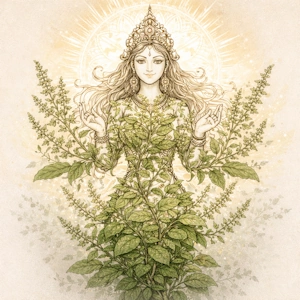
Tulasi is not just a plant.
That is the first thing to understand.
In every Indian home where a Tulasi grows, there is a belief that runs deeper than habit, deeper than routine. The belief is simple. Tulasi is not ordinary. She is divine. She is a living presence. And when she stands in your courtyard, something sacred stands with her.
In the ancient texts, Tulasi is described as the most beloved of Vishnu. Not symbolically. Literally. She is called Vishnupriya, the one Vishnu loves most. It is said that Vishnu himself declared that no worship of his is complete without a Tulasi leaf. Not gold. Not flowers. Not elaborate offerings. Just one leaf from this plant, offered with a clean heart, is enough to reach him.
Think about what that means for a moment.
The most powerful, the most benevolent force in creation, the one who preserves and protects all life, said that this plant is the one thing that connects you to him most directly.
So when a family plants Tulasi in their home, they are not gardening. They are inviting the grace of Vishnu to live with them. They are saying, let this home be protected. Let this home be blessed. Let something divine stand at our door.
And every evening, when the lamp is lit before her, it is not a chore. It is a greeting. It is a family saying to her, we see you. We honour you. We are grateful you are here.
There is something quietly powerful about that image. A small flame. A gentle plant. And an entire family's faith held in that one moment.
Now, who is Tulasi really?
Her story is one of the most moving in all of Indian tradition. She was once a devoted woman named Vrinda, whose love and faithfulness were so complete, so total, that she became a form of Lakshmi herself. After great suffering and great surrender, she was transformed. Vishnu gave her a permanent place beside him, not in the heavens only, but on earth, in every home, in every courtyard, in every family that would receive her.
She chose to stay close to people. That is her nature. She did not ascend and disappear. She took root. She grows among us. She breathes with us.
This is why the women of the house circumambulate her. This is why they water her with intention, not just with water. This is why no leaf of hers is plucked carelessly. Because she is not just a plant you tend. She is someone you respect.
And Vishnu, it is said, is never far from where Tulasi stands. His grace moves where she is honoured. Homes where Tulasi is cared for are homes where something unseen but real offers its protection. Illness comes less. Peace settles more. The air carries something you cannot quite name but can absolutely feel.
One grandmother once told her granddaughter something worth remembering. She said, when you light the lamp near Tulasi in the evening, you are not doing a ritual. You are keeping an appointment. She has been standing there all day. The least we can do is show up.
That line holds everything.
Now, at the edges of this devotion, science quietly walks in and confirms what faith always knew.
Ayurveda has documented Tulasi for over three thousand years. She is called the Queen of Herbs, and the title is earned. Her leaves carry oils that the body recognises as healing. She reduces fever. She clears the lungs. She strengthens immunity. She calms the nervous system. She fights infections that modern medicine still struggles with.
She releases oxygen through the night, which almost no plant does. The air around her is cleaner, measurably cleaner, than the air just a few feet away. Planting her in a courtyard is not superstition. It is environmental intelligence.
When her leaves are added to water, the water becomes safer. When she is consumed regularly, the body becomes more resilient. Ayurvedic physicians called her a rasayana, a substance that renews the body from within.
The ancients did not separate the sacred from the medicinal. To them, the most healing things were also the most divine. And Tulasi proved them right on both counts.
But here is the real takeaway.
Science explains what Tulasi does for your body. Devotion explains what she does for your home, your family, and your inner life. Both are true. Both are real. You do not have to choose between them.
When you light that small lamp every evening, you are doing something ancient and something alive at the same time. You are honouring a presence that has stood beside human beings for thousands of years, healing them, protecting them, and quietly holding the grace of Vishnu in her leaves.
She does not ask for much. Just a little water. A little light. And the willingness to show up every evening and remember that some things in life are worth treating as sacred.
- Why did Vishnu choose a plant and not a temple as his most direct connection to human beings?
Because a temple requires you to travel. A plant lives with you. Vishnu's intention, as described in the ancient texts, was not to remain distant and grand. He wanted to be accessible. He wanted his grace to live in ordinary courtyards, in humble homes, among working families. Tulasi makes that possible. You do not need wealth, rank, or learning to receive her presence. You only need a pot of soil and the willingness to care for her. That accessibility is itself a teaching. The divine does not hide behind walls. It grows where it is invited.
- What does the story of Vrinda tell us about how devotion transforms a person?
Vrinda was not born divine. She became divine through the completeness of her love and faithfulness. Her story tells us that devotion, when it is total and unconditional, does not go unnoticed by existence itself. It transforms the person who carries it. Vrinda's love was so pure that she was not simply rewarded. She was elevated. She became Tulasi. She became a permanent bridge between the human world and the divine. The secret in her story is this: what you love deeply enough, you eventually become.
- Why do women circumambulate Tulasi and not simply pray facing her?
Circumambulation is not decoration. It is an act of centering. When you walk around something, you are placing it at the centre of your world, literally and symbolically. You are saying, this is my axis. Everything in my life moves around this presence. Women who walk around Tulasi daily are performing an act of reorientation. They are choosing, every single day, to place the sacred at the centre rather than at the edge of their lives. That daily choice is itself a spiritual practice.
- Why is one Tulasi leaf considered more valuable to Vishnu than gold or elaborate offerings?
Because Vishnu is not measuring material. He is measuring intention. Gold can be given without love. Rituals can be performed without presence. But a Tulasi leaf, carried in a clean hand and offered with a quiet heart, carries something gold cannot buy. It carries sincerity. The teaching here is profound. What the divine responds to is not the size of your offering but the quality of your attention. One leaf given with full awareness outweighs a mountain of gold given out of habit or obligation.
- What is the real meaning behind lighting a lamp near Tulasi every evening?
The lamp is an act of acknowledgment. All day, Tulasi stands in the courtyard doing her work silently. She purifies the air. She holds the space. She asks for nothing. The evening lamp is the family's way of saying, we notice. We are grateful. We do not take this for granted. There is a deep psychological and spiritual truth here. When you practice daily acknowledgment of the sacred, you slowly train yourself to notice the sacred everywhere. The lamp near Tulasi is the beginning of a much larger awareness.
- Why does the tradition say Vishnu's grace moves wherever Tulasi is honoured?
Because Tulasi is not separate from Vishnu. She is his living presence on earth. Honouring her is not symbolic. It is direct. When a family cares for Tulasi with sincerity, they are in an active relationship with that energy. And like any relationship, the more attention and care you give, the more alive it becomes. Grace is not a reward handed out occasionally. It is a presence that grows in proportion to your openness toward it. Tulasi is the instrument that keeps that openness alive in daily life.
- What does Ayurveda's three thousand year documentation of Tulasi reveal about ancient Indian intelligence?
It reveals that ancient Indian thinkers were not choosing between the sacred and the practical. They saw them as the same thing. When they called Tulasi divine, they were also observing that she healed fevers, cleared lungs, and strengthened the body. When they called her a rasayana, a substance that renews from within, they were documenting what centuries of careful observation had confirmed. The secret this reveals is significant. A civilisation that treats its most healing plants as divine is a civilisation that will never neglect them, never fail to cultivate them, and never stop passing the knowledge of them to the next generation. The sacred status was also a preservation strategy.
- Why does Tulasi release oxygen at night when almost no other plant does?
Most plants take in oxygen at night through a process that reverses their daytime activity. Tulasi continues to give. This is not a small fact. The ancients placed Tulasi in the centre of the home's living space, in the courtyard where the family gathered. The air in that space was measurably cleaner because of her. They did not have instruments to measure it. But they observed it. They felt it. And they encoded that observation in devotion, ensuring that Tulasi would always be planted close to where people lived. The religion was quietly doing the work of environmental science.
- What is the deeper significance of Tulasi taking root on earth rather than remaining only in the heavens?
Every other divine being in Indian tradition ascends after their purpose is fulfilled. Tulasi chose differently. She stayed. She took root in soil. She chose to remain among ordinary people in ordinary homes. This tells us something essential about the nature of real grace. It does not elevate itself away from the world. It descends into the world. It gets its roots into the earth. It stays close to the people who need it most. Tulasi's choice to remain on earth is itself a teaching about what genuine love and service actually look like.
- Why has Tulasi survived as a living tradition for thousands of years when so many other practices have faded?
Because she asks for nothing complicated. She does not require a priest, a temple, a ceremony, or an auspicious date. She only requires daily presence. A little water. A little light. The willingness to show up. Traditions that survive are traditions that stay embedded in daily life. Tulasi survived because she became part of the morning and evening rhythms of the home. She was never left to special occasions. She was woven into the ordinary. And the ordinary, repeated with sincerity across thousands of years, becomes the most extraordinary thing of all.
Objection 1. This is just superstition. Worshipping a plant makes no rational sense.
Reply. The question is not whether a plant deserves worship in a transactional sense. The question is what daily reverence for a living thing does to the person practising it. A person who greets a plant every morning, waters it with care, and lights a lamp near it every evening is practising mindfulness, gratitude, and consistency. These are habits that modern psychology confirms as central to mental wellbeing. Whether you call it worship or practice, the outcome is real and measurable.
Objection 2. The stories about Vrinda and Vishnu are just mythology. They have no basis in fact.
Reply. Mythology is not the same as falsehood. Mythology is a civilisation's way of encoding its deepest truths in a form that ordinary people across all generations can remember and pass on. The story of Vrinda encodes a truth about the transformative power of devotion. Whether it happened literally or not, the principle it carries is real. A person whose love is total and unconditional is a person who is changed by that love. The story is a carrier for that truth, not a claim to be verified in a laboratory.
Objection 3. Ayurveda's claims about Tulasi are exaggerated and unverified by modern science.
Reply. This objection is simply outdated. Modern pharmacological research has confirmed that Tulasi contains compounds including eugenol, rosmarinic acid, and various flavonoids that carry anti-inflammatory, antimicrobial, and adaptogenic properties. Studies published in peer-reviewed journals have documented her effectiveness in reducing stress hormones, improving immune response, and fighting certain bacterial strains. The three thousand year head start Ayurveda had on this knowledge is not an embarrassment. It is a demonstration of what careful, patient observation produces over centuries.
Objection 4. Lighting a lamp every evening near a plant is just empty ritual with no real meaning.
Reply. No action is empty by nature. Actions become empty when performed without awareness. The same lamp lit with full presence, with genuine gratitude, with the intention of acknowledging something beyond yourself, is a different act entirely. The problem is not ritual. The problem is mechanical repetition without inner engagement. The tradition itself never asked for mechanical performance. It asked you to show up. Those are not the same thing.
Objection 5. Why would a supreme divine being care about one small plant in one small home?
Reply. This question assumes that the divine operates according to human hierarchies of importance. Small and large are human categories. A being described as all-pervading and present in every form of life has no reason to consider a home's courtyard beneath its attention. The tradition is saying something different from what the objection assumes. It is not saying Vishnu comes down specially for one plant. It is saying that grace is always present, and Tulasi is a living instrument that keeps you tuned to receiving it.
Objection 6. This tradition keeps women occupied with household rituals instead of more meaningful pursuits.
Reply. This objection projects a modern framework onto an ancient practice without examining what the practice actually does. A woman who circumambulates Tulasi daily is performing an act of centering, of grounding, of placing the sacred deliberately into her day. Many of the women who maintained this tradition across centuries were also the primary preservers and transmitters of medicinal knowledge, ethical teaching, and community wellbeing. The ritual was not a cage. In the context of its time and in its actual content, it was a form of daily authority over the sacred life of the home.
Objection 7. Plants cannot actually purify a home spiritually. That idea has no basis.
Reply. The air purification is not metaphorical. It is physical and measurable. Tulasi releases oxygen through the night, carries volatile compounds that reduce airborne bacteria, and creates a microenvironment around her that is genuinely cleaner than the surrounding air. When the ancients said she purifies the home, they were describing something they observed across generations. The spiritual language was the vocabulary available to them. The observation itself was accurate.
Objection 8. If Tulasi is so powerful, why do homes with Tulasi still face illness and suffering?
Reply. No tradition claims that Tulasi is a guarantee against all suffering. What the tradition claims is that she supports health, invites grace, and creates conditions that are more conducive to wellbeing. A person who eats well, sleeps well, and exercises regularly still gets ill sometimes. That does not disprove the value of those habits. Tulasi is a support, not a shield. The tradition was never making a transactional promise. It was describing a relationship, and relationships support without guaranteeing.
Objection 9. This is just a way of keeping old customs alive without asking whether they still make sense today.
Reply. The question of whether a practice makes sense today should be answered by examining what the practice actually does, not by the fact that it is old. Tulasi cleans air. She heals the body. She creates a daily moment of stillness and gratitude in a household. She connects families to something larger than their immediate concerns. In an age of extraordinary distraction, anxiety, and disconnection from nature, a daily practice that delivers all of these things is not a relic. It is precisely what the present moment needs.
Objection 10. You cannot prove that Vishnu exists, so the entire foundation of Tulasi worship is built on an unprovable belief.
Reply. You also cannot prove that love exists in a way that would satisfy a strict scientific standard. Yet no one seriously argues that love is therefore without value or reality. The traditions surrounding Tulasi are not primarily making a claim that can be verified in a laboratory. They are describing a relationship between a human being and a living presence that, when entered into with sincerity, produces real outcomes in the person's inner life, health, and sense of meaning. The proof asked for is the wrong kind of proof for the kind of truth being described.






English
Bhagavatam
Click on any topic to open
7
30
Astrology
Bhagavad Gita
Bhagavatam
Bharat Matha
Devi
Devi Mahatmyam
Ganapathy
Garuda Puranam
Glory of Venkatesha
Hanuman
Kathopanishad
Mahabharatam
Mantra Shastra
Mystique
Practical Wisdom
Purana Stories
Radhe Radhe
Ramayana
Rare Topics
Rigveda Explained
Rituals
Sages and Saints
Shiva
Spiritual books
Sri Suktam
Story of Sri Yantra
Temples
Vedas
Vishnu Sahasranama
Yoga Vasishta
26
17
10
0


