Where Self Ends, Service Begins
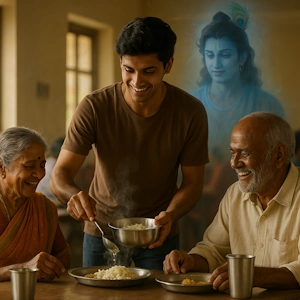
स्थविष्ठः
Means huge. Obviously, he who supports the innumerable universes with an amsha, a minuscule part of himself, has to be huge.
नास्त्यन्तो विस्तरस्य मे – there is no end to my expanse.
Like how Yudhishthira asked Bheeshmacharya – किं जपन् मुच्यते जन्तुः जन्मसंसारबन्धनात्
Once Shuka asked Vyasa Maharshi. Vyasa is Shuka’s father.
किं जपन् मुच्यते तात सततं विष्णुतत्परः
संसारदुःखात् सर्वेषां हिताय वद मे पितः
The same question – by chanting what does the devotee get release from samsara duhkha. Please tell me for the benefit of everyone, not just for me – सर्वेषां हिताय.
See, these are the great souls. Shuka is not asking for his personal benefit – सर्वेषां हिताय – for the benefit of everyone.
The world is an experience. If the world experience has to change, then the world has to change.
You can shut yourself out, through yoga sadhana or tapas. You can build a wall between yourself and the world so that the world experience does not affect you – both ways, good and bad.
Or you can try to change the world – the way the world functions, the world behaves.
You are in an island where the inhabitants are all rude and crude and criminal-minded. You can build a fort for yourself, put security cameras, put guards, and protect yourself from them. Or you go among them and try to transform them into good people. Then you don’t have to worry about your own security anymore.
People work both ways – shut themselves out or transform the world.
Since noble souls are not very concerned about their own well-being and safety, rather, their idea about self is not just their own body, they think in terms of अहं ब्रह्मास्मि.
So, if the world is bad, then they are not comfortable being unaffected by shutting out the world. Individually protecting one’s own body and mind from the onslaught of the bad world doesn’t satisfy them.
They feel satisfied only when the whole world changes, transforms.
Because they consider themselves to be the whole world, the whole world to be themselves. They are not different from the world.
Whatever effort they put in is towards the benefit of the whole world.
Everyone does this in a limited way, like a family – working for the family, rather than being absolutely selfish.
But noble souls like Shuka think about the whole world as their family – वसुधैव कुटुम्बकम्
And Vyasa Maharshi answers him:
अष्टाक्षरं प्रवक्ष्यामि मन्त्राणां मन्त्रमुत्तमम्
यं जपन् मुच्यते मर्त्यो जन्मसंसारबन्धनात्
A different method is given.
Vishnu Sahasranama is the simple method because Yudhishthira also asked for a simple method – केनोपायेन लघुना
Ashtakshara mantra – ॐ नमो नारायणाय – is yet another method.
Mantra sadhana is a bit more difficult than nama sankeertana or nama smarana.
But sadhana of Ashtakshara is also a very effective method for getting released from samsara duhkha, samsara bandhana.
-
If Sri Hari is vast beyond measure, what does that do to my daily worries?
It shrinks them. When the heart holds a bigger view, the nervous system calms, breath deepens, and choices get cleaner. -
How does chanting a short nama break long cycles of suffering?
Nama interrupts the thought loop, resets attention, and opens the mind to grace. Small input, large effect. -
Why are great devotees focused on the good of all, not just personal peace?
They see the world as their own larger self. Serving others feels as natural as tending one’s own hand. -
Is it better to shut out a toxic world or try to transform it?
Transform it. Build inner strength through nama, then act. Protection without contribution hardens the heart. -
What is the quickest daily practice to loosen samsara’s grip?
Ashtakshara japa: ‘om namo narayanaya’ for one mala, steady breath, clear posture. Direct, powerful, repeatable. -
How does Vishnu Sahasranama help a busy householder?
Even a few names with attention purify the mind, soften speech, and reduce friction at home. Peace compounds. -
What is the right emotion behind daana and service?
Cheerful firmness. Give with a clean heart and clear boundaries. Grief or showmanship cancels the inner gain. -
How do I apply the ‘sculptor of forms’ idea to self-improvement?
Remove one defect daily. Less anger, less noise, more presence. Subtraction reveals the true form. -
How can families practice world-mindedness without becoming preachy?
One shared act weekly: feed someone, plant a tree, sponsor a student. Do it quietly, thank Sri Hari, move on. -
What does ‘no end to my expanse’ mean for ambition and humility?
Aim high, hold light. Work hard, bow deeper. Success stays clean when the source is remembered. -
How do I keep spiritual pride from creeping in when practice goes well?
Do hidden seva, credit others, and keep a private tap of nama. Pride dries up when praise is redirected. -
Can mantra practice support physical health in a real way?
Yes. Slow rhythmic japa steadies breath, lowers heart rate, and improves sleep quality. Devotion first, the body follows. -
How do I train children to think beyond themselves?
Tell one dharma story nightly and assign one small weekly service. Praise effort, model steadiness. -
What is a 15-minute anchor for chaotic days?
5 minutes silence, 7 minutes Ashtakshara, 3 minutes gratitude. Short but sharp. -
How do I know if my practice is actually working?
You speak softer under stress, forgive faster, and keep promises better. These are clear signals. -
What should I do when anger flares at home?
Pause, take 8 slow breaths with nama, then speak. Less heat, more truth, relationships protected. -
How do I carry this cosmic view into money and work?
Earn clean, spend mindful, give a portion. Document processes so your team thrives even when you are away. -
What is the simplest daily reminder of Sri Hari’s hugeness?
At sunrise, one line: ‘Sri Hari, you hold all this. Guide my speech and hands today.’ Then act with courage.





English
Vishnu Sahasranama
Click on any topic to open
7
30
Astrology
Bhagavad Gita
Bhagavatam
Bharat Matha
Devi
Devi Mahatmyam
Ganapathy
Garuda Puranam
Glory of Venkatesha
Hanuman
Kathopanishad
Mahabharatam
Mantra Shastra
Mystique
Practical Wisdom
Purana Stories
Radhe Radhe
Ramayana
Rare Topics
Rigveda Explained
Rituals
Sages and Saints
Shiva
Spiritual books
Sri Suktam
Story of Sri Yantra
Temples
Vedas
Vishnu Sahasranama
Yoga Vasishta
26
17
10
0


