When Devas Give to Us We Should Also Give Back
Earlier we had seen the meaning of the first three mantras of the second sukta of the first mandala of Rigveda. The sukta starts with 'Vayava Yahi'.
Now the fourth mantra.
This mantra is addressed to Indra and Vayu both together. Indra is the energy in Surya Mandala. Vayu is the energy in the wind. Indra is directly thermal energy. Vayu is an effect of thermal energy. For the sustenance of the body, both are required. We get heat from the food that we take and oxygen from the air. Importance of both are recognized here. That's why the mantra tells these two Devatas:
Come to us with whatever you intend to give to us — food and air. In return, we will replenish you with the soma juice. This is a continuous give-and-take process between the Devatas, the primal energies of the universe, and us humans. Soma here represents all kinds of food that we give to Devatas to replenish their own energies. When they give to us, their energy is depleted. It is our responsibility to replenish them. Then the whole system works in harmony. If we are only takers, not also givers, then after some time the system would collapse. This is the idea that this mantra conveys.
The next mantra.
This concept is further elaborated here. Hey Indra and Vayu, you know that your food is this soma juice. That's why, pleased with our invitation, you have come here. In the same way, we also understand that it is you both who reside in food and air, give energy to us as our food.
We are preparing the soma juice for you at the best speed possible. Now that you have come, we will not keep you waiting.
Awareness of why this yajna is being done and also efficiency — both are expressed here. It is not just some mechanical action.
The next mantra.
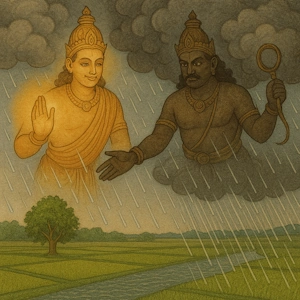
Heat from Indra, air from Vayu. What else is needed? Water. Water is needed for strength of the body. It is the role of the Devatas Mitra and Varuna together to supply water to earth in the form of rains. They act together. While Varuna rules over water, Mitra is the Devata who instills the property of pure strength in water. That's why he is called 'Puta Daksha'. This strength is friendly to the consumer. That's why he is called Mitra.
Imagine a gas cylinder. It has stuff with a lot of energy inside. But sometimes cylinders burst and destroy the cylinder itself. But the strength in water is always friends. It will never harm the consumer. It is with this strength, which is directed outwards, that rivals are taken care of. Varuna is the Devata responsible for the outward action of this strength. That is why Varuna is called 'Rishadasa' — eater of enemies. Mitra instills strength in water. Varuna makes sure that this strength is always aimed outside, upon rivals, not upon oneself.
Mitra and Varuna together have got another role. Once they are present here, they will ensure that the Yajamana, the sponsor of the yajna, definitely gets the result of the yajna.
'Rutena'. Ruta here means certainty.
Mitra and Varuna are experts in their role and also they are very kind. May they give us strength through the medium of water.
These are what we consume — solid food, which burns with the help of oxygen in the air and releases heat, energy, and liquids for strength. Indra being addressed for energy, Vayu for oxygen, and Mitra–Varuna for strength. Understand that energy and strength are two different things.
With this mantra ends the second sukta of Rigveda, first mandala.
-
Why are Indra and Vayu addressed together in this mantra?
Because life needs two complementary forces — heat and breath. Indra represents the thermal energy that comes from food, while Vayu represents the oxygen that makes that energy usable. The body survives only when both act together. -
What is meant by giving soma juice to devas in return?
It expresses a law of reciprocity. Humans receive food, air and rain from cosmic powers, and through yajna they offer soma back. This is not payment but participation, a cycle of mutual nourishment that keeps the universe balanced. -
Why does the mantra warn against being only takers?
If humans only consume and never replenish, the subtle energies that sustain life get exhausted. The Veda sees the cosmos as a living system where responsibility is shared, not a storehouse meant for exploitation. -
What does efficiency in preparing soma signify?
The mantra says the soma is made quickly so devas are not kept waiting. This shows that yajna is not blind ritual but conscious service done with alertness, gratitude and skill. -
Why are Mitra and Varuna connected with water instead of Indra and Vayu?
Heat and air give energy, but water gives stability and strength. Mitra and Varuna govern this nourishing aspect of creation, ensuring that the energy gained from food becomes steady vitality in the body. -
What is the meaning of Mitra being called Puta Daksha?
Mitra infuses water with pure, friendly strength that never harms the consumer. Like controlled power in a tool, it supports life without turning destructive. -
Why is Varuna called Rishadasa, eater of enemies?
Varuna directs the force present in water outward, against obstacles and diseases, not inward against the body. He ensures that strength becomes protection rather than self-destruction. -
How do these mantras distinguish energy from strength?
Energy is the heat released from food with the help of air. Strength is the stable resilience provided by water. One fuels activity, the other sustains the structure. Both are necessary but not identical. -
What does the word ruta, certainty, imply about Mitra–Varuna?
It means the results of yajna are not random. When these devas are invoked properly, the outcome is assured. The universe operates with dependable laws, not chaos. -
What overall vision of the human body appears here?
The body is seen as a miniature yajna. Food becomes heat through Indra, breath through Vayu makes it burn, water through Mitra–Varuna turns it into strength. Living itself is a daily ritual of cooperation with cosmic powers.





English
Vedas
Click on any topic to open
7
30
Astrology
Bhagavad Gita
Bhagavatam
Bharat Matha
Devi
Devi Mahatmyam
Ganapathy
Garuda Puranam
Glory of Venkatesha
Hanuman
Kathopanishad
Mahabharatam
Mantra Shastra
Mystique
Practical Wisdom
Purana Stories
Radhe Radhe
Ramayana
Rare Topics
Rigveda Explained
Rituals
Sages and Saints
Shiva
Spiritual books
Sri Suktam
Story of Sri Yantra
Temples
Vedas
Vishnu Sahasranama
Yoga Vasishta
26
17
10
0


