When Dasharatha’s Boons Turned into Chains
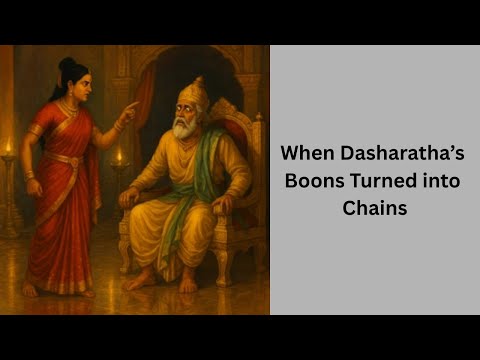
In the Ayodhya Kanda, Sarga 11 of Valmiki Ramayana, the palace chamber becomes the stage of betrayal. Bound by passion and blinded by Kaikeyi’s words, King Dasharatha is trapped. Here Kaikeyi unveils her cruel demand — Rama’s exile and Bharata’s coronation — a turning point sealing Ayodhya’s fate.
Verse 1
तं मन्मथशरैर्विद्धं कामवेगवशानुगम्।
उवाच पृथिवीपालं कैकेयी दारुणं वचः॥
Dasharatha was lost in passion, struck by Kamadeva’’s arrows.
His mind clouded, his heart weak.
Kaikeyi saw her chance.
Her lips, sweet outside, held poison inside.
She spoke harsh words, ready to shatter his world.
Verse 2
नास्मि विप्रकृता देव केनचिन्नावमानिता।
अभिप्रायस्तु मे कश्चित् तमिच्छामि त्वया कृतम्॥
‘O King, no one has insulted me.
I am not wronged, not dishonored.
But I have a wish.
A hidden desire burns in me.
You must fulfill it.’
Verse 3
प्रतिज्ञां प्रतिजानीष्व यदि त्वं कर्तुमिच्छसि।
अथ ते व्याहरिष्यामि यथाभिप्रार्थितं मया॥
‘Swear first.
Promise me with your kingly word.
Only then will I speak.
Only then will I reveal what I seek.’
Her tone was honey, her demand like a trap.
Verse 4
तामुवाच महाराजः कैकेयीमीषदुत्स्मयः।
कामी हस्तेन संगृह्य मूर्धजेषु भुवि स्थिताम्॥
Dasharatha smiled faintly, still caught in desire.
He held Kaikeyi’s hair, drew her close.
The mighty king was now a helpless lover.
Blind to danger, he stood on the edge of ruin.
Verse 5
अवलिप्ते न जानासि त्वत्तः प्रियतरो मम।
मनुजो मनुजव्याघ्राद् रामादन्यो न विद्यते॥
‘Foolish one, do you not know?
No one is dearer to me than you.
And among men, none surpasses Rama.
He is the lion among humans.
He is my very breath.’
Verse 6
तेनाजय्येन मुख्येन राघवेण महात्मना।
शपे ते जीवनार्हेण ब्रूहि यन्मनसेप्सितम्॥
‘By Rama — unconquerable, noble, supreme — I swear.
By him, my very life-breath, I vow.
Speak, Kaikeyi.
Tell me what your heart desires.’
Verse 7
यं मुहूर्तमपश्यंस्तु न जीवे तमहं ध्रुवम्।
तेन रामेण कैकेयि शपे ते वचनक्रियाम्॥
‘If I do not see him for even a moment,
I cannot live.
By that Rama, Kaikeyi,
I swear — your wish shall be done.’
Verse 8
आत्मना चात्मजैश्चान्यैर्वृणे यं मनुजर्षभम्।
तेन रामेण कैकेयि शपे ते वचनक्रियाम्॥
‘Among all — myself, my sons, the men of the world —
I choose Rama.
By that Rama, dearest to me,
I swear to bind myself to your word.’
Verse 9
भद्रे हृदयमप्येतदनुमृश्योद्धरस्व मे।
एतत् समीक्ष्य कैकेयि ब्रूहि यत् साधु मन्यसे॥
‘O gentle one, my heart lies open before you.
Pluck from it what you will.
Examine it, Kaikeyi.
Say what you think is best.’
Verse 10
बलमात्मनि पश्यन्ती न विशङ्कितुमर्हसि।
करिष्यामि तव प्रीतिं सुकृतेनापि ते शपे॥
‘See my strength. Doubt not.
I shall fulfill your joy.
I swear again —
Even at the cost of my life, your wish shall be granted.’
Verse 11
सा तदर्थमना देवी तमभिप्रायमागतम्।
निर्माध्यस्थ्याच्च हर्षाच्च बभाषे दुर्वचं वचः॥
Kaikeyi’s heart fixed on her dark intent.
Her plan ripened.
Joy mixed with cruelty.
From her lips came words that cut like steel.
Verse 12
तेन वाक्येन संहृष्टा तमभिप्रायमात्मनः।
व्याजहार महाघोरमभ्यागतमिवान्तकम्॥
Her joy swelled.
Her scheme now stood ready.
Her voice thundered like Death itself arriving.
What she spoke would shatter a kingdom.
Verse 13
यथा क्रमेण शपसे वरं मम ददासि च।
तच्छृण्वन्तु त्रयस्त्रिंशद् देवाः सेन्द्रपुरोगमाः॥
‘O King, you swore in order.
You vowed to grant my boon.
Let the thirty-three gods hear it!
Let Indra himself be witness!’
Verse 14
चन्द्रादित्यौ नभश्चैव ग्रहा रात्र्यहनी दिशः।
जगच्च पृथिवी चेयं सगन्धर्वाः सराक्षसाः॥
‘Let the moon, the sun, the sky above bear witness.
Let the stars, day and night, the ten directions hear.
This whole world, with Gandharvas and Rakshasas,
Let them all be witness to your word.’
Verse 15
निशाचराणि भूतानि गृहेषु गृहदेवताः।
यानि चान्यानि भूतानि जानीयुर्भाषितं तव॥
‘Let spirits of night, beings of shadow,
Gods of the household, unseen creatures —
Let every hidden power know:
Your promise is bound to me.’
Verse 16
सत्यसंधो महातेजा धर्मज्ञः सत्यवाक्शुचिः।
वरं मम ददात्येष सर्वे शृण्वन्तु दैवताः॥
‘This king, truth-bound, radiant, knower of dharma,
Pure in word, pure in vow —
He grants my boon.
Let every god in heaven hear it.’
Verse 17
इति देवी महेष्वासं परिगृह्याभिशस्य च।
ततः परमुवाचेदं वरदं काममोहितम्॥
Thus Kaikeyi sealed her snare.
She clasped the great archer’s hand.
She blessed him outwardly,
But inwardly struck.
Then she spoke again —
To the king, blinded by lust and promise.
Verse 18
स्मर राजन् पुरा वृत्तं तस्मिन् देवासुरे रणे।
तत्र त्वां च्यावयच्छत्रुस्तव जीवितमन्तरा॥
‘Remember, O King, the war of gods and demons.
There, your enemy nearly ended your life.
You stood on the edge of death itself.’
Verse 19
तत्र चापि मया देव यत् त्वं समभिरक्षितः।
जाग्रत्या यतमानायास्ततो मे प्रददौ वरौ॥
‘Then I, ever-watchful, guarded you.
I strove with sleepless care.
For that, you granted me two boons.
Two promises — my treasure, my claim.’
Verse 20
तौ दत्तौ च वरौ देव निक्षेपौ मृगयाम्यहम्।
तवैव पृथिवीपाल सकाशे रघुनन्दन॥
‘Those boons, O King, were pledged by you.
Now I demand them.
Now, before you, Lord of Earth,
I claim what is mine.’
Verse 21
तत् प्रतिश्रुत्य धर्मेण न चेद् दास्यसि मे वरम्।
अद्यैव हि प्रहास्यामि जीवितं त्वद्विमानिता॥ २१॥
Kaikeyi’s words turned sharp.
‘If you break your vow, I will die now.
Dishonored, I will cast away life at once.’
She used death as her weapon.
Verse 22
वाङ्मात्रेण तदा राजा कैकेय्या स्ववशे कृतः।
प्रचस्कन्द विनाशाय पाशं मृग इवात्मनः॥ २२॥
The king was caught by mere words.
Dasharatha, bound by his own promise.
Like a deer running into the hunter’s noose,
He leapt toward ruin.
Verse 23
ततः परमुवाचेदं वरदं काममोहितम्।
वरौ देयौ त्वया देव तदा दत्तौ महीपते॥ २३॥
She pressed harder.
‘The two boons you gave me then —
Now, O King,
You must fulfill them.’
Verse 24
तौ तावदहमद्यैव वक्ष्यामि शृणु मे वचः।
अभिषेकसमारम्भो राघवस्योपकल्पितः॥ २४॥
‘Listen well.
Rama’s coronation stands prepared.
But today, I claim my right.’
Verse 25
अनेनैवाभिषेकेण भरतो मेऽभिषिच्यताम्।
यो द्वितीयो वरो देव दत्तः प्रीतेन मे त्वया॥ २५॥
‘Let Bharata be crowned in Rama’s place.
This is the first boon.
And the second —
You gave me with joy, O King.’
Verse 26
तदा देवासुरे युद्धे तस्य कालोऽयमागतः।
नव पञ्च च वर्षाणि दण्डकारण्यमाश्रितः॥ २६॥
‘Now its time has come.
Let Rama go to the forest.
For fourteen years
Let him dwell in Dandaka.’
Verse 27
चीराजिनधरो धीरो रामो भवतु तापसः।
भरतो भजतामद्य यौवराज्यमकण्टकम्॥ २७॥
‘Let Rama wear bark and skin.
Let him live as a hermit, steady and firm.
Let Bharata, free of rivals,
Enjoy the throne.’
Verse 28
एष मे परमः कामो दत्तमेव वरं वृणे।
अद्य चैव हि पश्येयं प्रयान्तं राघवं वने॥ २८॥
‘This is my supreme desire.
This is the boon I demand.
Today itself, I must see Rama,
Leaving for the forest.’
Verse 29
स राजराजो भव सत्यसंगरः कुलं च शीलं च हि जन्म रक्ष च।
परत्र वासे हि वदन्त्यनुत्तमं तपोधनाः सत्यवचो हितं नृणाम्॥ २९॥
‘Be the king of kings, Dasharatha.
Keep your vow, guard your clan, protect your honor.
For sages declare —
Truth alone follows man beyond death,
Truth alone is his highest wealth.’
The chamber grew dark though lamps still burned.
Kaikeyi’s words echoed like thunder in Dasharatha’s heart.
The king who ruled the world was shackled by his own vow.
Her demand stood naked — Rama exiled, Bharata crowned.
Dasharatha’s breath choked.
His body trembled.
The very promise born of love had turned into poison.
The wheel of fate rolled on, unstoppable.
That night, Ayodhya’s joy curdled into grief.
The queen’s chamber became the forge of doom.
The king, bound by dharma, stood helpless.
And Kaikeyi, her eyes hardened, rejoiced in her cruel victory.
Thus ends the eleventh sarga of Ayodhya Kanda —
The snare tightened, the fall prepared.
The coronation of Rama was now only a dream,
And the forest path lay waiting.
- Dasharatha, overcome by desire, became vulnerable to Kaikeyi’s manipulation, losing the clarity of a ruler.
- Kaikeyi used soft words as a snare, binding him through repeated vows and oaths sworn in Rama’s name.
- Dasharatha, blinded by love for Rama, declared Rama dearer than his own life, making his promises irreversible.
- Kaikeyi turned those very vows into weapons, demanding the two boons once promised in battle.
- Her first demand was Bharata’s coronation in Rama’s place, shifting the throne away from the rightful heir.
- Her second demand was Rama’s exile to the forest for fourteen years, clothed as a hermit.
- Dasharatha, bound by truth and dharma, found himself trapped by his own words, like a deer caught in a hunter’s net.
- Kaikeyi invoked gods, spirits, and the cosmos as witnesses to Dasharatha’s oath, tightening the trap further.
- The king’s chamber turned from a place of intimacy into the forge of betrayal, sealing Ayodhya’s sorrowful fate.
- The eleventh sarga closes with Rama’s coronation shattered, exile decreed, and the wheel of events set irreversibly in motion.
What weakened Dasharatha’s judgment?
Dasharatha was overwhelmed by desire and affection, losing the firmness of a king. Kaikeyi waited for this moment to plant her demands. When a ruler is blinded by personal weakness, he becomes easy prey for manipulation.
Why is passion shown as dangerous here?
Because it strips a person of discrimination. Desire dulls reason, so even a mighty king can act like a helpless man, unable to see traps before him. Passion makes one vulnerable to betrayal.
Couldn’t Dasharatha have resisted Kaikeyi’s timing?
He could have, but his state of mind was unsteady. His affection and lust left him unguarded. Once Kaikeyi pressed, he was already bound by emotion and oath, leaving little room for resistance.
Why did Kaikeyi insist on vows before speaking?
She wanted to bind Dasharatha with sacred oaths before revealing her cruel plan. By securing his word in advance, she ensured he could not escape once her demands were voiced.
Why did she make Rama the reference for his promises?
Because Dasharatha’s deepest love and loyalty were toward Rama. Swearing on Rama meant he could never break the vow, since betraying it would mean betraying his own soul.
Isn’t it foolish to give a blank promise before knowing the request?
Yes, and this is the tragedy. Even kings can act rashly when clouded by passion. Once the vow is spoken, dharma forces them to keep it, no matter the cost.
What were Kaikeyi’s two boons?
She demanded Bharata’s coronation and Rama’s fourteen-year exile. These were the rewards she claimed from Dasharatha’s earlier promise made during the Deva-Asura war.
Why did she ask for exile, not just denial of the throne?
Because as long as Rama lived in Ayodhya, the people’s love for him could challenge Bharata’s rule. Exile removed both his presence and influence, making Bharata’s kingship secure.
Couldn’t she have been satisfied with Bharata’s coronation alone?
Her ambition was not just Bharata’s rise but Rama’s fall. Without removing Rama, her victory was incomplete. This reveals the depth of her jealousy and insecurity.
Why did Dasharatha feel trapped like a deer in a snare?
Because his own words bound him. By pledging truth before gods, spirits, and all creation, he left no escape. Dharma demanded he keep his word, even if it destroyed him.
What does this teach about promises?
That careless promises can enslave the one who makes them. Words carry weight, and once uttered, they become chains of duty that cannot be broken without dishonor.
Isn’t it unreasonable to keep a vow that causes ruin?
From a worldly view, yes. But in dharma, truth is supreme. A king’s authority rests on trust. If his word fails, his throne collapses. Dasharatha chose ruin over dishonor.
Why did Kaikeyi call gods and spirits as witnesses?
She wanted to sanctify the vow, making it impossible for Dasharatha to backtrack. By invoking heaven and earth, she trapped him in a web of divine accountability.
What does this reveal about manipulation?
It shows how ambition can cloak itself in piety. She used the sacred as a weapon, not for devotion but to tighten her scheme. Manipulation often wears the mask of righteousness.
Couldn’t Dasharatha deny her even with witnesses?
Not without shattering his image as a truth-bound king. Once the vow was made before gods and men, breaking it would brand him as false. That shame was heavier than death.
How does this sarga conclude?
It ends with Kaikeyi’s demands laid bare: Rama exiled, Bharata crowned. Dasharatha stood powerless, his vow binding him more tightly than chains. The chamber of love turned into a battlefield of betrayal.
Why is this moment a turning point?
Because it changes the course of Ayodhya. The joyous coronation collapses, and sorrow takes its place. From this moment, the destiny of Rama and the kingdom shifts irrevocably.
Isn’t this just Kaikeyi’s victory?
On the surface, yes. But her triumph planted the seeds of grief. By forcing exile, she unknowingly set the stage for Rama’s greater glory and the unfolding of dharma’s deeper design.





English
Ramayana
Click on any topic to open
7
30
Astrology
Bhagavad Gita
Bhagavatam
Bharat Matha
Devi
Devi Mahatmyam
Ganapathy
Garuda Puranam
Glory of Venkatesha
Hanuman
Kathopanishad
Mahabharatam
Mantra Shastra
Mystique
Practical Wisdom
Purana Stories
Radhe Radhe
Ramayana
Rare Topics
Rigveda Explained
Rituals
Sages and Saints
Shiva
Spiritual books
Sri Suktam
Story of Sri Yantra
Temples
Vedas
Vishnu Sahasranama
Yoga Vasishta
26
17
10
0


