What Is the Difference Between Asuras, Daityas, Danavas, and Rakshasas?
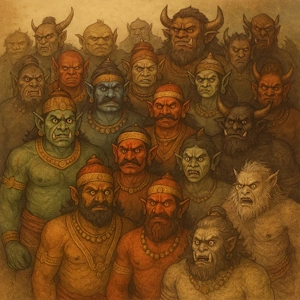
We use the terms Asura, Daitya, Danava, and Rakshasa very casually and interchangeably.
Actually, they are not the same.
There is a lot of difference between them.
Asura is a common term.
Asura means dweshis suras — those who hate Devas, those who are enemies of Devas.
In that sense, Daityas, Danavas, and Rakshasas — they are all deva-haters, enemies of Devas.
The basic difference between Devas and Asuras is that:
Asuras — asushu ramate — they believe only in the body.
They believe only in pampering of the body.
Even if they do tapas, they only ask for bodily comforts and pleasures, power and position.
They want to conquer Swarga because of the pleasures available in Swarga — not to take up responsibilities and manage the world.
Devas are aligned with Paramatma.
They are aligned with the processes of creation, sustenance, and elimination — with Brahma, Vishnu, and Shiva.
Brahma sets rules when he creates. These are the rights and duties. They never breach them.
This is the world order set by divine will.
Even when Ravana was terrorising the worlds, they didn’t venture to destroy him — not because they couldn’t — but because Brahma had given him a boon that Devas will not try to kill him.
In the same way, they follow the rules of Vishnu — rules of sustenance.
This is why Lord Vishnu is always on their side.
At the time of pralaya, they submit themselves to Lord Shiva to be eliminated.
But Asuras are not like this.
They have no respect for the divine order and will.
That is the problem with them.
So, all of them — Daityas, Danavas, and Rakshasas — they are all challengers and breakers of world order, divine order.
But — Vidyadharas, Apsaras, Yakshas, Gandharvas, Kinnaras, Pisachas, Guhyakas, Siddhas, and Bhutaganas — these are superhuman powers who are aligned with Devas.
In Rakshasas also, there are some exceptions like Vibhishana.
You should look at all these as different species in creation.
Like how we have lions, crocodiles, chimpanzees — these are also different species.
So they need not be like how you see in serials — humans with horns and protruding teeth.
Now, we will look at Daityas.
Daityas are Diti’s sons.
Three children were born to the couple Kashyapa and Diti — two sons and one daughter: Hiranyakashipu, Hiranyaksha, and the daughter Simhika.
Hiranyakashipu is the eldest.
Do you know how Hiranyakashipu got his name?
Once, Kashyapa Maharshi was conducting a yajna called Atiratra in Pushkar.
In this yajna, five seats covered with golden clothes are kept — three are meant for the Kulagurus, the rishis; one for the main Ritwik; and the fifth one for Hota, the Rigvedic priest.
When the yajna was going on, that’s when Diti gave birth.
The child, as soon as he was born, went and occupied the golden seat meant for the Hota, which was at that time empty because he was involved in the yajna.
The rishis saw the child doing this and gave him the name Hiranya-kashipu — Hiranya means gold, Kashipu means cover or cloth that covers.
That’s why they gave him that name.
You must be knowing how he got boons from Brahma Deva and later was killed by Narasimha.
Hiranyakashipu had four sons — Prahlada, Anuhrada, Samhrada, and Hrada.
Hrada had two sons — Sunda and Nisunda.
Mukasura, whom Duryodhana sent to kill Arjuna when he was doing tapas to get divyastras from Lord Shiva, was a descendant of this Hrada.
Maaricha was the son of Sunda and Tataka.
How did he end up as a Rakshasa even after belonging to Daitya vamsha?
Because of Agastya’s curse — even Tataka.
Nivatakavacha was the son of Samhrada.
Anuhrada’s son was Bashkala.
Jambha, Shatadundubhi, Daksha, and Chanda are sons of Bashkala and are very famous.
Prahlada’s son was Virochana, and Virochana’s son was Bali (Bali Chakravarti).
Bali had hundred sons.
The most famous among them was Bana — he had thousand hands.
His son was Indradhanva.
Among the hundred, there were three more who were famous — Kumbhagarta, Bhoja, and Kunchi.
Shakuni and Putana were daughters of Bali.
All these descendants of Bali are known by the name Baaleyas.
Hiranyaksha, the younger brother of Hiranyakashipu, had five sons:
Shambara, Shakuni, Kalanabha, Mahanabha, and Surasantapana.
The descendants of all these — basically starting from Hiranyakashipu and Hiranyaksha, lakhs and lakhs of them — they are collectively called Daityas.
Simhika’s son is Rahu.





English
Rare Topics
Click on any topic to open
7
30
Astrology
Bhagavad Gita
Bhagavatam
Bharat Matha
Devi
Devi Mahatmyam
Ganapathy
Garuda Puranam
Glory of Venkatesha
Hanuman
Kathopanishad
Mahabharatam
Mantra Shastra
Mystique
Practical Wisdom
Purana Stories
Radhe Radhe
Ramayana
Rare Topics
Rigveda Explained
Rituals
Sages and Saints
Shiva
Spiritual books
Sri Suktam
Story of Sri Yantra
Temples
Vedas
Vishnu Sahasranama
Yoga Vasishta
26
17
10
0


