What Is Liberation? Six Answers
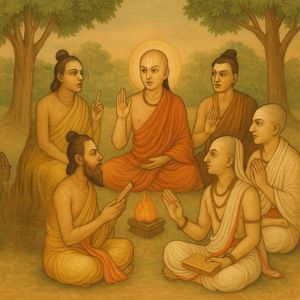
In Indian philosophy, liberation (moksha) is the highest goal of life — freedom from the endless cycle of birth, death, and suffering. But what exactly is this liberation? Is it bliss, pure awareness, or just the absence of pain? Is the soul merged with God, or does it remain separate? Different schools like Sankhya, Vedanta, Nyaya, and others all agree on the need for liberation but sharply differ on its meaning and the path to reach it. From total extinction of self to eternal bliss in union with the divine, the views range widely — yet all aim at ultimate freedom. Let’s explore how they agree and differ.
Nihilism
Also known as Ucchedavada, the doctrine of annihilation.
- It denies the reality of everything — physical and mental — saying all is ultimately illusion or non-existent.
- There is no eternal self or soul; what we call the self is just a temporary collection of perceptions and desires.
- Liberation (moksha) means complete extinction of this false self — no rebirth, no consciousness, no afterlife.
- The root cause of suffering is the will to live — as long as you want to exist, you suffer.
- The only solution is to eliminate this will through strict asceticism and detachment.
- True liberation is like a flame going out — once the illusion of self ends, suffering ends permanently.
- This view is commonly associated with certain strands of Buddhist and materialist (Charvaka) thought, which reject the authority of the Vedas.
Nyaya and Vaisheshika
- Nyaya and Vaisheshika are two allied systems — Nyaya focuses on logic and knowledge, Vaisheshika on metaphysics and atomism.
- Both accept that the self (atman) is real, eternal, and distinct from the body and mind.
- Liberation (moksha) is not extinction of the self, but its complete freedom from all suffering.
- The liberated self continues to exist as a pure, inert, unconscious substance — it doesn’t feel pain or pleasure.
- They argue that pleasure and pain are inseparable — so to eliminate pain completely, you must eliminate all sensation, including happiness.
- In liberation, the self is not destroyed but remains as a bare conscious entity, free from body, senses, and mind.
- Final liberation can only occur after death, when the soul is no longer connected to a physical body.
The path to liberation includes:
- Gaining correct knowledge of reality (self, body, world)
- Destroying false identification with the body and ego
- Performing actions without desire for results
- Letting karmas exhaust without generating new ones
When all karmas are exhausted, rebirth ends, and the self remains in a permanent, peaceful state beyond pleasure and pain.
Sankhya and Yoga
- Sankhya is a dualistic philosophy; Yoga builds on it with practical methods (like meditation and discipline).
- According to Sankhya-Yoga, the self (Purusha) is pure consciousness — eternal, unchanging, and separate from Prakriti (nature or matter).
- Bondage happens because the self falsely identifies with the body, mind, intellect, and especially the ego.
- Liberation (moksha) means the clear realisation that the self is completely distinct from all these — body, mind, senses, ego, actions.
- Once this realisation is attained, the self becomes detached, unaffected, and rests in its own nature as a witness (drashta).
- This state is called jivanmukti — liberation while living — where one lives in the world but remains untouched by its miseries.
- After death, the soul attains videhamukti — total release from all bodies, even the subtle ones.
- Liberation is not a state of pleasure or bliss, but the absolute end of all suffering — a calm, steady state of pure awareness.
- Yoga helps achieve this through self-discipline, detachment, concentration, and meditative absorption (samadhi).
- The self remains unchanging, just witnessing the dance of nature, but no longer getting involved.
Mimamsa
- Mimamsa is mainly concerned with the ritual and action (karma) portions of the Vedas — especially Purva Mimamsa.
- In early Mimamsa, heaven (svarga) was considered the highest goal, attainable through precise performance of Vedic rituals.
- Later Mimamsakas shifted focus and accepted moksha (liberation) as the supreme goal — freedom from rebirth and suffering.
What is Liberation in Mimamsa?
- Liberation means: freedom from the cycle of birth and death, caused by karmic bondage.
- The self (atman) is eternal and real, but suffers due to its connection with body and action.
- All actions driven by desire create fresh karma and lead to rebirth.
- Liberation happens when one performs duties without desire for their results — nishkama karma.
- Past karmas gradually get exhausted, and no new karmas are formed — rebirth stops.
Differences within Mimamsa on Nature of Liberation:
- Some say: in liberation, the soul remains as a pure substance, but with no consciousness, no pleasure, no pain — a blank state.
- Others say: the soul experiences eternal bliss, since it's freed from suffering and reflects its true nature.
- Both agree that the liberated self is no longer tied to body, mind, or world.
How to attain it?
- Through disinterested performance of Vedic duties, control over passions, and deep understanding of self and karma.
- Liberation is not by devotion or meditation, but mainly through correct ritual action and dispassion.
Advaita Vedanta
- Advaita Vedanta, founded by Adi Shankaracharya, is a non-dualistic system — it teaches that Brahman alone is real, and the world is ultimately an illusion (maya).
- The individual self (atman) is not different from Brahman, the infinite, formless, blissful reality.
- Bondage is caused by ignorance (avidya) — the false belief that the self is the body, the ego, or something separate from Brahman.
What is Liberation?
- Liberation (moksha) is the realisation that you are Brahman — not the body, not the mind, but pure, infinite consciousness.
- It is the end of ignorance, and along with it, the end of all suffering, fear, and rebirth.
- Liberation is not becoming something new, but realising what you’ve always been.
Nature of the Liberated State:
- A liberated soul experiences ananda (bliss) and limitless awareness.
- This state is not a void — it’s a positive experience of infinite existence (sat), consciousness (chit), and bliss (ananda).
- The self no longer feels limited by time, space, or ego.
Can it be attained in this life?
- Yes — one can become a jivanmukta, liberated while still living.
- The body may continue due to prarabdha karma (past karma already in motion), but the person remains untouched by it.
How is it attained?
- Through the fourfold discipline:
- Discrimination (viveka)
- Dispassion (vairagya)
- Moral virtues (shamadi shatka sampatti)
- Intense desire for liberation (mumukshutva)
- And the threefold process:
- Shravana – listening to the teachings of Vedanta
- Manana – reflecting and reasoning to remove doubts
- Nididhyasana – deep meditation and inner absorption
Final Liberation:
- After death, the jivanmukta attains videhamukti — full, irreversible union with Brahman.
- There is no return, no individuality, no separation — only oneness with the infinite.
Visishtadvaita
Key Thinker:
- Founded by Ramanujacharya, Visishtadvaita means 'qualified non-dualism' — it's non-dualism with distinction.
Core Philosophy:
- God (Brahman) is real, personal, and supreme — full of infinite knowledge, bliss, and power.
- Individual souls (jivas) and the world (jagat) are real, but they are parts or modes of Brahman, not identical with Him.
- So, unity with distinction — the soul is not totally separate from God, but not absolutely identical either.
- Like body and soul: the jiva is to Brahman as the body is to the soul — inseparably connected, but not the same.
What is Liberation?
- Liberation (moksha) is the soul's eternal, blissful communion with Bhagavan — not merging into Him or becoming Him.
- The soul retains its individuality and lives in constant awareness and love of God.
- It experiences eternal bliss, free from sorrow, karma, and rebirth.
How is it attained?
- Through:
- Karma Yoga – performing duties selflessly
- Jnana Yoga – knowing that the soul is a part of Brahman
- But ultimately through Bhakti Yoga – loving devotion and surrender (prapatti) to Bhagavan
- Liberation is granted by God's grace, not just human effort.
- True devotion and remembrance of God purify the mind and bring His grace.
Jivanmukti?
- No — Ramanuja does not accept jivanmukti.
- Full liberation occurs only after death — when the soul leaves the body and enters Vaikuntha, the abode of God.
Nature of the Liberated Soul:
- The soul becomes brahmaprakara — God-like, but not God.
- It remains individual, filled with knowledge and bliss, enjoying eternal service and closeness to Bhagavan.
- It never returns to the cycle of birth and death.
Conclusion
Liberation (moksha) is the highest goal in almost all Indian philosophical systems — above wealth, pleasure, or even virtue.
- While views differ, all systems agree that liberation means freedom from rebirth, suffering, and bondage to the body and world.
- The individual self (atman) is considered eternal, pure, and divine — bondage is due to ignorance or misidentification with the body and ego.
- Liberation is not a change in the self, but a realisation of its true nature, which was always present.
- Different schools offer different paths and definitions:
- Some see liberation as extinction of self (Nihilistic view),
- Others as freedom from pain (Nyaya, Sankhya),
- Others as blissful awareness or union with God (Vedanta schools).
- Some accept jivanmukti (liberation while living); others say it happens only after death.
- Liberation can come through:
- Right knowledge (Jnana)
- Ritual action without desire (Karma)
- Detachment and meditation (Yoga)
- Loving devotion and grace (Bhakti)
- Unlike Western thought, Indian philosophy sees liberation as the destined outcome for all beings — not a rare exception.
- It is a return to the soul’s original, untouched state, not a reward, but a birthright.
- The world is viewed as a moral and spiritual process, where all souls are evolving toward perfection and freedom.
- How does the Nihilistic view of liberation differ fundamentally from all other Indian schools?
While most schools believe in an eternal self (Atman) that is freed during liberation, Nihilism (Ucchedavada) denies the existence of a soul entirely. To a Nihilist, liberation is not the freedom of the self, but the total extinction of the false self—much like a flame going out—ending all consciousness and existence. - Why do Nyaya and Vaisheshika describe the liberated state as "unconscious" or "inert"?
These schools argue that pleasure and pain are two sides of the same coin and are inseparable. To ensure the complete and permanent absence of pain, one must also transcend pleasure. Therefore, the liberated soul remains as a bare, unconscious substance, free from all sensations, body, and mind. - In Sankhya philosophy, what is the specific "misunderstanding" that leads to bondage? Bondage is caused by the "false identification" of the Purusha (pure consciousness) with Prakriti (matter). The self mistakenly believes it is the ego, the mind, or the body. Liberation is the clear realization that the Purusha is actually a detached witness, completely distinct from the physical and mental world.
- What is the unique concept of "Jivanmukti" and which schools support it?
Jivanmukti is the state of being liberated while still physically alive. Advaita Vedanta and Sankhya-Yoga support this, suggesting that a person can realize their true nature and remain untouched by the world's miseries even while the body finishes its karmic course. In contrast, schools like Visishtadvaita and Nyaya believe full liberation only occurs after death. - How did the goal of Mimamsa evolve over time?
In its early stages (Purva Mimamsa), the highest goal was reaching Svarga (heaven) through the precise performance of Vedic rituals. Later Mimamsakas shifted their focus to Moksha—the total freedom from rebirth—realizing that even heaven is temporary and that nishkama karma (action without desire) is necessary for permanent release. - According to Advaita Vedanta, why is liberation not considered "attaining" something new? Advaita teaches that the self is already Brahman (infinite consciousness). We don't "become" Brahman; we simply remove the veil of ignorance (avidya) that made us think we were limited individuals. Liberation is the recognition of a reality that was always present.
- How does Visishtadvaita (Ramanujacharya) "qualify" its version of non-dualism?
It teaches that while there is a unity (Brahman is supreme), there is also distinction. The soul (jiva) is a part of God, like a cell is part of a body. In liberation, the soul does not merge and disappear into God; instead, it retains its individuality to enjoy an eternal, blissful relationship of love and service to the Divine. - What is the role of "Grace" in the path to liberation?
In Visishtadvaita, liberation is not achieved solely by human effort or knowledge. While Karma and Jnana are important, it is ultimately granted through Bhakti (devotion) and the grace of God (Bhagavan) in response to the soul's total surrender (prapatti). - How do the schools differ on the experience of "Bliss" during liberation?
The views vary sharply: Nyaya and early Mimamsa see it as a state of no sensation (neither pain nor pleasure). Sankhya sees it as pure, neutral awareness. Advaita and Visishtadvaita see it as a positive state of supreme, eternal bliss (Ananda). - What is the "universal birthright" mentioned in the conclusion of Indian philosophy? Unlike some traditions where salvation might be reserved for a chosen few, Indian philosophy generally views liberation as the destined outcome for every single soul. The universe is seen as a grand spiritual process where all beings are evolving toward their original, untouched state of freedom.






English
Mystique
Click on any topic to open
7
30
Astrology
Bhagavad Gita
Bhagavatam
Bharat Matha
Devi
Devi Mahatmyam
Ganapathy
Garuda Puranam
Glory of Venkatesha
Hanuman
Kathopanishad
Mahabharatam
Mantra Shastra
Mystique
Practical Wisdom
Purana Stories
Radhe Radhe
Ramayana
Rare Topics
Rigveda Explained
Rituals
Sages and Saints
Shiva
Spiritual books
Sri Suktam
Story of Sri Yantra
Temples
Vedas
Vishnu Sahasranama
Yoga Vasishta
26
17
10
0


