What Happens Immediately After Death
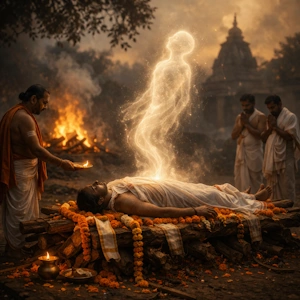
The Preta → Pitru transition
Death is not a clean switch.
It is a process.
The body falls. But the individual does not disappear. What continues is the subtle identity — mind, impressions, unresolved tendencies.
At this stage, the being is called Preta.
Not a Pitru. Not settled. Not established.
Preta literally means ‘one who has gone forth but not yet reached a stable state’.
The Preta state — unstable and transitional
Immediately after death, the being is in a disconnected condition.
No physical body.
No stable subtle placement.
No clear access to higher lokas.
This is why shastra describes the Preta state as:
- dependent
- vulnerable
- restless
It is not suffering in a dramatic sense. But it is incomplete.
Like someone who has left home but has not reached the destination.
Why the transition is required
A Pitru is not just ‘a dead ancestor’.
A Pitru is a ritually established ancestor.
That means:
- placed in Pitru Loka
- connected to lineage in a structured way
- made eligible to receive offerings
Without this transition, the being remains in an unsettled condition.
No proper role. No stable connection.
The role of rites — this is the bridge
This is the missing piece most people ignore.
The transition from Preta to Pitru does not happen automatically.
It is enabled and completed through rites.
Three key stages:
1. Antyeshti (last rites)
This is the starting point.
It separates the subtle being from the gross body properly.
Without this, the detachment is incomplete.
2. Preta-kriya (post-death rites)
These are performed over the initial days (commonly up to 10 days).
What is happening here?
The subtle being is being:
- stabilized
- oriented
- gradually prepared for transition
Think of this as guiding the being through a corridor.
Without this, the Preta remains disoriented.
3. Sapindi-karana (integration into Pitru system)
This is the decisive step.
Here, the departed is:
- formally linked with the lineage ancestors
- moved from Preta state to Pitru state
- given a defined place in the Pitru chain
Now the being is no longer wandering.
It becomes a Pitru.
What changes after becoming a Pitru
Now the structure is clear.
The being:
- gains a stable position in Pitru Loka
- becomes connected to descendants
- becomes eligible to receive Shraddha and Tarpana
- can respond in a limited, lineage-bound way
Before this, none of that is properly available.
Why this matters
If this process is ignored:
- the being is not properly settled
- the lineage connection remains incomplete
- the entire Pitru system is disrupted
This is why shastra insists on Shraddha.
Not as a ritual formality.
But as a functional necessity.
Straight understanding
Death creates a Preta.
Rites create a Pitru.
Without rites, the journey remains unfinished.
1
Question: Why is the Preta state described as incomplete rather than final
Answer: Because it is a transition phase. The being has left the body but has not yet gained a stable placement. It exists without full grounding, which is why it is called unsettled rather than finished.
2
Question: Why does the transition to Pitru not happen automatically
Answer: Because stability requires alignment. The system needs proper separation, orientation, and integration. Without these steps, the being remains without a defined role in the lineage structure.
3
Question: What is the functional role of Antyeshti in this process
Answer: It completes the separation between the physical body and the subtle identity. This is the first necessary step. Without it, detachment is not properly established.
4
Question: What actually happens during the post-death rites
Answer: The being is gradually stabilized. Disorientation reduces. The transition becomes directed instead of scattered. These rites act as a guided passage rather than a symbolic act.
5
Question: What is the significance of Sapindi-karana
Answer: It formally places the being within the Pitru system. It links the individual to the lineage chain and gives a defined position. Only after this does the being function as a Pitru.
1
Objection: This sounds like the family is responsible for the entire process after death
Reply: The individual’s karma and inner condition are primary. The family provides support for transition. It is a shared system, not complete control by one side.
2
Objection: Why would a system depend on rituals to stabilize something after death
Reply: Because rituals are structured actions designed to guide transition. They are not arbitrary. They create alignment where natural processes alone may leave gaps.
3
Objection: The idea of a Preta state seems like superstition
Reply: It represents an intermediate condition. Many systems recognize stages between states. This is a way of describing instability before final placement.
4
Objection: If someone misses these rites, is everything lost
Reply: No. The process may become delayed or less stable, but it is not permanently blocked. Later actions and continuity can still support the transition.
5
Objection: This makes death seem too dependent on external actions
Reply: External actions support the process. The core driver remains the individual’s own state and karma. The system combines both, not one alone.




English
Garuda Puranam
Click on any topic to open
7
30
Astrology
Bhagavad Gita
Bhagavatam
Bharat Matha
Devi
Devi Mahatmyam
Ganapathy
Garuda Puranam
Glory of Venkatesha
Hanuman
Kathopanishad
Mahabharatam
Mantra Shastra
Mystique
Practical Wisdom
Purana Stories
Radhe Radhe
Ramayana
Rare Topics
Rigveda Explained
Rituals
Sages and Saints
Shiva
Spiritual books
Sri Suktam
Story of Sri Yantra
Temples
Vedas
Vishnu Sahasranama
Yoga Vasishta
26
17
10
0


