Wedding of Radha and Krishna
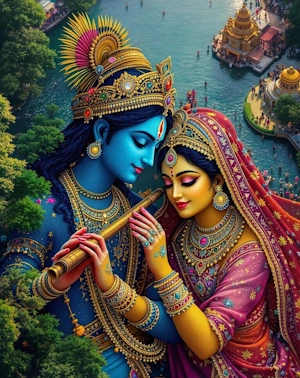
Deep within the Goloka Khanda of the Garga Samhita lies a lila known only to the most faithful — the divine marriage of Shri Radha and Shri Krishna. Performed in Bhandiravana by Brahma himself, and concealed from worldly eyes, this sacred event unfolds outside the bounds of ordinary time. Here, Radha is openly accepted as Krishna’s eternal consort, and their union is sanctified through Vedic rites, mantra, and sacred fire. Yet just as bliss peaks, Krishna suddenly resumes his child form — and the lila disappears. What happened in that moment?
Narada told -
Nanda Baba was gently tending the cows.
Krishna sat playfully in his lap.
The forest air was fragrant, the breeze from Kalindi’s groves danced.
Lost in the joy of fatherhood,
Nanda wandered deeper… unknowingly drawn.
His feet led him to the sacred Bhandiravana —
not by plan, but by Krishna’s hidden will.
The lila was calling.
The world was about to change.
The wind turned wild —
not nature’s mood, but Krishna’s will.
The sky darkened with clouds thick as secrets.
Tamala and Kadamba trees shimmered.
Leaves trembled, light flickered,
as if the forest was holding its breath.
Darkness swallowed the forest.
Baby Krishna, in Nanda’s arms, whimpered — frightened.
Nanda trembled.
He clutched the child close.
But this was no ordinary child.
In that moment of fear, his heart cried out to Hari himself.
O Krishna, O Supreme — protect us.
And then —
a light like millions of suns burst through the dark.
The sky blazed. The air stood still.
And there she appeared —
Radha.
Daughter of Vrishabhanu.
The heart of Goloka, now standing before Nanda.
A divine girl, radiant beyond form, beyond dream.
Her beauty?
Like a million full moons woven into one gaze.
She wore dark blue silks —
like the Yamuna flowing beneath starlight.
Anklets whispered as she moved —
soft, lilting music, as if the wind itself had learned rhythm.
She didn’t walk.
She glided through silence, and even the leaves watched in awe.
Her every ornament was alive with melody.
Bangles clinked like gentle laughter.
Rings and armlets sparkled like sun on water.
A pearl danced at her nose like a swan in moonlight.
Her ears held earrings like flames, her throat, a blazing gem.
She stood there, not just adorned —
She was the very source of adornment.
Overwhelmed by her radiance,
Nanda bowed low with folded hands.
His voice trembled in surrender:
'O Radha, this child is no ordinary boy.
He is the Supreme Purushottama.
And you — you are his eternal Beloved.
His very soul.'
'I know this truth,' he whispered,
'from the lips of Gargamuni.
Radhe, take your Lord into your arms.
He fears this storm —
not because he forgets who he is,
but because he chooses to feel.
Let me speak these words,
though he is far beyond all guṇas and nature.'
Radha replied softly:
'O Nanda, I am pleased.
Your words arise not from knowledge,
but from devotion.
You have touched the heart of truth —
and so,
what is rare for the world…
is yours today.'
Nanda bowed again, deeper than before.
'If you are truly pleased,
then bless me with one thing —
firm, unshakable devotion
to the lotus feet of you both.
Let me always serve those who serve you.
Let me live near saints,
in every age, forever.'
Radha gently said, 'So be it.'
And with her delicate hands,
she lifted her own Lord — Hari —
and placed him upon her lap.
As Nanda bowed and took his leave,
something shifted.
Bhandiravana awakened.
It was no longer just a forest.
It had become a divine theatre.
The land itself changed.
Bhumi Devi, the goddess of the Earth,
manifested her original divine body —
not mud, not dust —
but a golden floor,
inlaid with padmaraga gems,
radiant like the dawn of creation.
This was no longer Vrindavan.
It was Goloka shining through.
The trees bloomed with divine bodies —
wish-fulfilling kalpavrikshas,
each one a living prayer.
The Yamuna — Kalinda’s daughter —
shimmered with golden palaces upon her banks,
her steps lined with precious stones,
reflecting the light of a heaven hidden until now.
Govardhana rose in majesty.
No longer just a hill —
but a mountain of gems,
with golden peaks shining like flames of bliss.
Rivers flowed down its sides,
and bees danced around them,
as if the whole mountain was in love.
It stood tall — like the crown of the Earth herself.
The forest bower — the Nikunja — changed too.
It wore its true divine form —
a grand courtyard, a celestial pavilion.
Spring itself had arrived,
not as a season, but as a presence.
Bees hummed mantras,
peacocks sang with koel birds,
and the air was thick with sweet music and sacred longing.
The stage was set.
The Eternal Marriage was about to begin.
Lakes shimmered like mirrors of heaven.
Golden lotuses bloomed in full glory.
Swarms of black bees hovered —
buzzing like soft mantras,
offering their seva with every wingbeat.
The whole pond looked like a crown of nature,
set with moving gems and fragrance.
And then —
the Supreme Purushottama appeared.
No longer a child —
He took on his Kaishora form —
youthful, radiant, glowing like a fresh raincloud.
He wore a pitambara that fluttered like sunlit silk.
The Kaustubha gem shone on his chest.
A flute rested at his lips —
and his mere smile melted millions of Cupids.
This was not a boy.
This was the God of eternal charm.
With a soft laugh,
Krishna took Radha’s hand in his own.
And step by step,
the Divine Couple entered the wedding mandapa.
It was perfect.
Decorated with pots of darbha grass,
water jars, sacred rice, glowing lamps,
and everything needed for a celestial marriage.
The air itself bowed.
They sat upon a divine throne —
not high in arrogance,
but high in eternal unity.
They looked into each other’s eyes.
Their lips moved in soft whispers.
Words were spoken —
but only love was heard.
They shone like lightning meeting clouds —
brilliant, tender, alive with divine rasa.
And then…
Brahma himself appeared.
The Creator of worlds,
stood with folded hands,
his voice low, his heart overflowing.
Before the One beyond even creation,
Brahma bowed at Krishna’s feet —
and with trembling joy,
he began to speak…
Brahma said ….
O Krishna —
you are the beginning before all beginnings,
the first light, the Supreme among the supreme.
You care not for your own greatness —
but for your devotees' love.
You are the master of infinite universes,
and yet, in this moment,
I bow to you not as the Lord of all worlds,
but as the beloved of Radha.
I seek shelter at your feet,
because only there is the truth whole.
You are the Lord of Goloka,
where lila is not pastime — it is essence.
When you descend, it is not to fix the world —
it is to let your joy overflow into the world.
When you appear as Vaikuntha’s Lord,
Lakshmi walks beside you.
But here…
Radha is Lakshmi’s source.
This Vrishabhanu's daughter is that same Mahalakshmi,
in her highest, sweetest, fullest form.
When you came as Rama,
Sita followed — shadowing you like light follows the moon.
When you came to Earth as Hari,
she came as Lakshmi, born from the lotus.
As the Yajna-purusha,
you accepted Dakshina,
the sacred consort of sacrifice.
Wherever you went,
she was always with you —
not behind you,
but within you.
As Narasimha, you roared with fury —
yet Lakshmi sat beside you, unafraid.
As Narayana, you stood timeless,
and she stood beside you as Nara’s eternal consort.
But this Radha is not just Lakshmi.
She is your shanti,
your shadow,
your exact counterpart,
your mirror made of love.
Where you are fire,
she is the cool moonlight that contains it.
You are the Supreme Brahman —
beyond form, beyond name.
And she?
She is Prakriti — not inert matter,
but the living shakti dancing at your edge.
When sages speak of Kala (time) and Pradhana (cosmic substance) —
they speak of her.
When you become the seed of all creation,
she becomes the soil that holds it.
She is Saguna Maya — not illusion,
but your playful power in form.
Without her, you remain unmanifest.
With her, you become love, form, rasa, and the universe itself.
When you are known as the inner Self,
by those who meditate in stillness,
she becomes your nature — your living expression.
When you take on the Virat Purusha form,
filling the cosmos with limbs and light,
she becomes the canvas, the color, the movement.
O Krishna,
she is not different from you —
she is how you choose to be known.
You are two —
Shyama and Gaura,
dark and fair,
Radha and Krishna.
Yet this duality is not division —
it is divine completeness.
You are the Lord of Goloka,
the Supreme over even the Supreme.
And so I, Brahma,
take refuge in you,
not because I am confused,
but because you are the source of all clarity.
O Radha-Krishna —
you are already eternally married,
united in love, united in essence,
beyond time, beyond form.
But for the sake of the world —
to sanctify the idea of marriage itself,
to honor lokachara (worldly custom),
I, Brahma, will now perform your marriage
in full Vedic tradition.
The divine will enter the worldly —
so the worldly may remember the divine.
Narada sad -
And then it began.
Brahma, the Creator,
rose from his place.
He lit the sacred fire — Agni, the witness.
Before that fire, Radha and Krishna stood together.
He recited the mantras.
He performed the panigrahana —
the ritual of joining hands,
as prescribed in the Shrutis.
The marriage of the Eternal Couple
was now seen and celebrated by the universe.
Brahma, the priest of the gods,
led Hari and Radha around the sacred fire.
Seven golden circumambulations they took,
not just steps — but vows whispered in silence.
After the seventh round,
they bowed to Agni, the divine witness.
And then Brahma chanted the seven mantras,
each one like a flower placed on eternity.
He placed Radha’s hand upon Krishna’s heart —
right where the Kaustubha gem sparkled.
Then he took Krishna’s hand
and laid it gently on Radha’s back,
between her shoulders —
the space where trust rests and love begins.
Over these gestures,
Brahma chanted mantras —
not to bind them,
but to reveal what was already one.
With her own two hands,
Radha offered a garland to Krishna —
a string of fragrant flowers,
soft, buzzing with bees,
alive with rasa.
Krishna accepted it,
and Brahma bowed once more to Agni.
Agni smiled.
The sky held its breath.
Then Brahma made them sit, side by side,
on the royal divine seat.
Their hands folded,
their eyes soft with stillness,
they sat like eternity sitting beside time.
And Brahma, now not just a priest,
but a father in spirit,
offered Radha to Krishna,
reciting the final five mantras
with tenderness, awe, and a trembling voice.
O King, at that moment—
flowers rained from heaven.
Not scattered — but poured with joy.
Celestial damsels — vidyadharis — began to dance.
The sky swirled with fragrance and rhythm.
Gandharvas, Kinnaras, Siddhas, and Charanas
sang Krishna’s wedding songs,
each note soaked in sweetness.
The whole cosmos celebrated.
Because when Radha and Krishna unite,
even silence bursts into song.
The sky was ablaze with sound and celebration.
Drums rolled.
Veenas wept with joy.
Flutes sang like the Yamuna herself.
Conches roared, and bells trembled with bliss.
Divine instruments thundered from every direction.
And from the gods themselves, high above—
rose a single cry:
'Jaya! Jaya! All glory to the Divine Couple!'
Then Krishna, ever respectful, turned to Brahma and asked—
'O wise one, tell me your desired dakshina.
What gift shall I offer?'
Brahma folded his palms and smiled.
'O Prabhu, what could I ask from you?
Only this—
grant me unshaken, eternal bhakti at your feet.
Let that be my dakshina.'
Krishna replied, 'So be it.'
Brahma then bowed —
not once, but again and again —
placing his hands and head at the feet of Shri Radha.
He did not just bow.
He offered his soul.
Joyful, glowing, trembling,
Brahma returned to his abode —
forever changed.
Then Radha, with her own hands,
served Krishna a feast of divine delicacies —
four kinds of ambrosial foods,
sweet with love, perfumed with affection.
Krishna laughed softly —
not as God, but as a husband content.
He ate joyfully, and in return,
he offered a betel leaf,
gently placed in Radha’s hands —
not just as food, but as a kiss wrapped in leaf.
Then, Krishna reached for Radha’s hand.
He didn’t speak — but his touch did.
Fingers entwined like creepers in spring.
Together they walked into the forest bower.
He smiled. She blushed.
They wandered beneath the flowering vines,
beside the flowing Yamuna,
as birds sang and Vrindavan itself held its breath.
Every step was a rasa.
Every glance, a mantra.
Within the sacred bowers of Vrindavan,
where vines weaved temples of green,
Krishna vanished — hiding behind creepers,
a smile dancing on his lips.
Radha spotted a flicker of yellow cloth
fluttering between the branches.
She walked toward it, laughing softly,
and grasped the hem of his pitambara.
She had found him — again.
Then Radha ran,
playfully slipping from Krishna’s grasp,
her anklets jingling like giggles.
She disappeared into a Yamuna-side grove,
hiding, waiting, glowing.
Yet the very touch of Krishna’s hand
pulled her back toward him,
as if her soul had no direction but his fingers.
As the dark tamala tree
glows with the touch of a golden creeper,
as the raincloud shines
when kissed by a playful flash of lightning—
so did Krishna, dark and majestic,
shine brighter beside Radha.
She was not his ornament.
She was his mirror, his muse, his rasa.
In a secluded rasa-mandala,
where no eyes but nature's watched,
Krishna danced the rasa of eternity
with Radha alone.
Bees hummed. Peacocks called.
Creepers swayed.
The forest bowed.
The Lord of all love
walked slowly through Vrindavan,
trailing fragrance and ecstasy.
With Radha by his side,
Krishna, the Supreme Self, danced.
They wandered into the caves of Govardhana,
where waterfalls sang,
where bees buzzed like flutes,
and where lakes bloomed with lotuses.
In that hidden world of jewelled creepers,
Hari and Radha moved like eternal rasa in motion —
not dancers,
but the dance itself.
Krishna arrived at the Yamuna, hand in hand with Radha.
Their steps were laughter, their hearts were song.
As she bathed, Radha tossed a lotus into the water.
Krishna ran, caught it, as if it were her heart,
and grinned like a child who had won a kingdom.
Radha, smiling slyly, snatched Krishna’s flute, cloth, and cane.
She twirled them in her hands, like trophies.
Krishna cried, 'Give me my flute!'
She replied, laughing,
'Only if you give me the lotus!'
It was lila — the dance of desire in disguise.
And so, the Lord of gods offered the lotus with a smile.
Radha returned his flute and cloth —
each one handed back like a secret kiss.
The cane too — lightly passed, lightly received.
Their play resumed along the Yamuna's edge,
where even the trees leaned closer
just to hear their silence.
Back in Bhandiravana,
Krishna began to decorate Radha —
not with jewels, but with love.
He painted her with leaf-paste,
lined her eyes with kajal,
crowned her with flowers.
Every petal was placed with devotion,
as if the forest itself was being offered to her.
She was already perfect —
but he still adorned her,
because love finds joy in service.
And just as Radha lifted her hand
to return the gesture,
to anoint her beloved with her own affection—
Krishna vanished…
Not into thin air —
but into childhood.
In a flash,
the radiant Kaishora Krishna
was gone.
There sat a crying little boy,
mud on his cheeks,
trembling in her arms.
The lila had ended —
for now.
The Krishna Radha saw —
was now a crying infant,
rolling in the dust,
just like the one Nanda had handed her before.
Radha’s heart cracked.
Tears filled her eyes —
'O Hari, why this play?
How could you do this to me?
You, the Supreme,
now hiding in helplessness —
before me?'
As she wept in silence,
a voice rose from the sky — soft, compassionate.
'Radhe, do not grieve.
This lila was only for a moment.
What your heart longs for…
will be fulfilled again —
in the future.'
The sky itself consoled her.
Only the heavens understood her pain.
Wiping her tears,
Radha picked up the child Krishna,
and walked, quiet and composed,
to Yashoda’s home.
Placing the baby in her arms, she said:
'Your husband gave me this child on the way —
I’m returning him safe.'
No one knew…
what had just happened.
Yashoda smiled and blessed her.
'Radha, O daughter of Vrishabhanu,
you are truly blessed.
In that fearful forest, under stormy skies,
you protected my son like a goddess herself.
My heart is grateful beyond words.'
Radha was honored, praised, loved.
But the world saw only her grace —
not her grief,
not the wedding that had just unfolded and vanished.
With Yashoda’s permission,
Radha slowly walked back to her home,
carrying the weight of a secret
no one else remembered.
Thus ends the hidden story of Hari —
the secret wedding of Radha and Krishna,
wrapped in auspiciousness,
shielded from the unworthy,
revealed only to hearts full of prema.
Whoever hears it, reads it, or speaks it —
is untouched by sin.
Ever.
Because this is not just a tale.
It is Goloka poured into words.
Thus ends the sacred narration of Radha and Krishna’s divine wedding in Bhandiravana — a lila wrapped in sweetness, hidden in mystery, and preserved only in the hearts of true bhaktas. It was not a deviation from tradition, but a cosmic affirmation of their eternal unity, sanctified through Vedic rites by Brahma himself. Yet, as quickly as it appeared, the lila was concealed again — Krishna returned to his child form, and Radha silently carried the memory like a flame within. This is no mere story; it is a glimpse into Goloka, offered only to those ready to feel, not just believe.




English
Radhe Radhe
Click on any topic to open


