Virat Purusha: The Cosmic Form of Bhagavan Vishnu
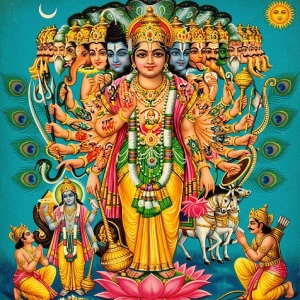
Srimad Bhagavatam vide chapter no.1 of the second skandha describes the form Virat Purusha. Virat Purusha is the cosmic form of Bhagavan Vishnu ( Supreme Being). Virat Purusha represents the entire universe as the body of Bhagavan, encompassing all creation.
The soles of the feet of Virat Purusha are Pathalaloka. His heels and toes are Rasathala, the joints above his ankles (shanks) are Mahathala, and his calves are Talathala.
The knees are Suthala, his thighs are Athala and Vithala.
(The seven nether worlds are Athala, Vithala, Suthala, Thalathala, Mahathala, Rasathala, and Pathala)
His pelvic region is Bhuloka and, his navel-lake is the sky.
The chest of Virat Purusha is Swargaloks, his neck is Maharloka, his face is Janaloka, and his forehead is Tapoloka. The thousand heads of the Lord is Satyaloka.
(The six upper worlds - Bhuvarloka, Swarloka, Maharloka, Janaloka, Tapoloka, and Satyaloka).
Indra and other gods are his arms. The ten directions are his ears, and sound is his faculty of hearing. The two Ashwini Kumaras are his nostrils, and the sense of smell is his faculty of smell. Blazing fire is his mouth.
Bhagavan's eyes are the sky, and the sun is his power of vision. His eyelids are night and day, and his brows are Brahmaloka. His palate is water, and his tongue is taste
The Vedas are said to be the Lord’s brain, and Yama (the god of death) is fangs. All forms of affection are his teeth, and his enchanting smile is Maya. This endless creation is but a glance of that Maya.
Modesty is his upper lip, and greed is his lower lip. Righteousness is his chest, and unrighteousness is his back. The progenitor (Brahma) is his reproductive organ, Mitra-Varuna are his testicles, the oceans are his waist, and the great mountains are his bones.
The nerves of Virat Purusha are rivers. Trees are his body hair. The mighty wind is his breath. Time is his movement, and the interplay of the three gunas (Satwa, Rajas, and Tamas) is his action.
The clouds are considered his hair (on the head). Twilight is his garment. The unmanifest (Moolaprakriti) is his heart, and the moon is his mind.
The principle of Mahat-tattva is regarded as the consciousness of the Lord of all beings, and Rudra is his ego. Horses, mules, camels, and elephants are his nails. All the wild animals and creatures of the forest are his hips.
The various birds are his amazing creative skill. Svayambhuva Manu is his intellect, and the human beings, descendants of Manu, are his dwelling place. Gandharvas, Vidyadharas, Charanas, and Apsaras are the recollection of the musical notes like Shadja, etc. The Daityas (demons) are his strength.
The Brahmins are his mouth, the Kshatriyas are the arms, the Vaishyas are the thighs, and the Shudras are the feet of the cosmic form of the Virat Purusha. The great yajna are his actions.
Seekers of liberation focus their minds on this form of Virat Purusha. There is nothing beyond this.
The description portrays the universe as a unified whole, where every element has a place and function. This suggests a sense of interconnectedness and unity between individuals and the cosmos, emphasizing the importance of seeing oneself as part of a greater whole.
- How does the Virat Purusha map the vertical dimension of the universe, and what does this signify about the lower and upper realms?
The text describes the seven nether worlds, from Athala down to Pathala, as the lower extremities of the Lord, while the earthly realm is his pelvic region. The six upper worlds ascend from his chest to his thousand heads. This signifies that the entire cosmos, from the most material realms to the highest spiritual planes, is an unbroken continuum forming a single divine body. It eliminates the idea that any realm is truly separate from the Supreme. - In the cosmic form, what represents the movement and action of the Supreme Being, and how does this reframe our understanding of everyday existence?
Time is described as the movement of the Virat Purusha, and the interplay of the three gunas, which are Satwa, Rajas, and Tamas, is his action. This reframes our understanding by showing that time is not merely a passing measurement, but the very stride of the Divine. Similarly, material dynamics driven by the gunas are part of the Lord's cosmic play, suggesting mundane actions are expressions of divine energy. - How are human faculties and natural elements interconnected through the anatomy of the Virat Purusha?
The text seamlessly blends human senses with vast natural phenomena. The sky is his eyes and the sun is his vision. The ten directions are his ears and sound is his hearing. Blazing fire is his mouth, and the mighty wind is his breath. This reveals a hidden symmetry between the microcosm of individual senses and the macrocosm of universal elements, implying our personal faculties are miniature reflections of cosmic forces. - How does the description handle moral dualities like righteousness and unrighteousness?
Righteousness is described as the chest of the Lord, while unrighteousness is his back. Furthermore, modesty is his upper lip and greed is his lower lip. This mysterious aspect shows that even concepts we perceive as negative have a structural place within the totality of the cosmic form. It suggests that duality is a necessary part of the whole, existing on opposite sides of the same divine entity. - Which elements constitute the psychological framework of the universe?
The moon acts as the mind of the Virat Purusha, Rudra represents his ego, Svayambhuva Manu is his intellect, and the Mahat-tattva is his consciousness. By mapping psychological components to celestial bodies and primeval entities, the text illustrates that the universe is not a dead, mechanical structure, but a living, conscious, and thinking entity. - What is the relationship between the Lord's smile, Maya, and the endless creation?
The Lord's enchanting smile is identified as Maya or illusion, and the endless creation is but a glance of that Maya. This highlights an overlooked principle: the physical universe we see is a beautiful, captivating illusion born from the joy and playfulness of the Supreme. Creation is not a burdensome labor, but an effortless and enchanting glance. - How are the geographical and environmental features of the earth personified in this cosmic form?
The oceans are described as his waist, the great mountains are his bones, rivers are his nerves, trees are his body hair, and clouds are the hair on his head. This instills a profound sense of ecological reverence. It implies that harming the environment, such as polluting a river or destroying a mountain, is metaphorically akin to damaging the nerves and bones of the Supreme Being. - Where do art, music, and creative skills find their origin in the Virat Purusha?
Various birds represent his amazing creative skill, while celestial beings like Gandharvas, Vidyadharas, Charanas, and Apsaras are the recollection of musical notes. This teaches that aesthetic beauty, artistic expression, and the harmony of music are not mere human inventions. Instead, they are fundamental, inherent attributes woven directly into the divine cosmic structure. - How is human society integrated into the body of the Virat Purusha, and what does this imply about social harmony?
Human beings are his dwelling place, and the societal classes are mapped to his body. Brahmins are the mouth, Kshatriyas the arms, Vaishyas the thighs, and Shudras the feet. This implies that all human roles are equally essential and interdependent. They must function together to support the single organism of society, just as limbs support and sustain a physical body. - Why do seekers of liberation focus their minds entirely on the form of the Virat Purusha?
The text states that there is nothing beyond this form. By meditating on the Virat Purusha, seekers internalize the interconnectedness and unity of all existence. Recognizing that every element, being, and concept is a working part of the Supreme Being dissolves the illusion of separation and ego, which is the ultimate key to spiritual liberation.





English
Bhagavatam
Click on any topic to open
7
30
Astrology
Bhagavad Gita
Bhagavatam
Bharat Matha
Devi
Devi Mahatmyam
Ganapathy
Garuda Puranam
Glory of Venkatesha
Hanuman
Kathopanishad
Mahabharatam
Mantra Shastra
Mystique
Practical Wisdom
Purana Stories
Radhe Radhe
Ramayana
Rare Topics
Rigveda Explained
Rituals
Sages and Saints
Shiva
Spiritual books
Sri Suktam
Story of Sri Yantra
Temples
Vedas
Vishnu Sahasranama
Yoga Vasishta
26
17
10
0


