Upendro Vamana Pramshu....
उपेन्द्रो वामनः प्रांशुरमोघः शुचिरूर्जितः ।
अतीन्द्रः सङ्ग्रहः सर्गो धृतात्मा नियमो यमः ॥ १७॥
upendro vamanah pranshuramoghah shuchirurjitah
atindrah sangrahah sargo dhritatma niyamo yamah
उपेन्द्रः (Upendra)
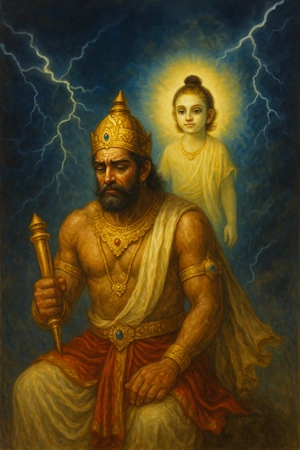
He is Upendra — the one born as the younger brother of Indra (Vamana), but oh, do not get fooled by the title 'younger'. He came not to merely support Indra, but to restore the shattered balance of the worlds when Indra himself stood powerless against the tidal surge of adharma.
In the soft frame of a boy, the lion roared.
In the shadow of Indra, the true thunder flashed.
Upendra is not merely a brother, but the secret sovereign,
the divine ace hidden up the sleeve of cosmic dharma.
वामनः (Vamana)
He is Vamana — the dwarf, but ah, what a dwarf!
Not a weakling, not a beggar, but a strategic miracle compressed into a tiny form.
He stood before Bali, humble like a blade of grass,
but within that little form, the infinite vaults of creation pulsed and waited.
With three simple strides, He measured the earth, the heavens, and the netherworlds,
and in doing so, He humbled the pride that no armies could touch.
Small in appearance. Boundless in effect.
Such is the miracle called Vamana.
प्रांशुः (Pranshu)
Pranshu — the Tall, the Lofty, the Towering.
Here is the twist: Vamana became Pranshu.
In an instant, that tiny form erupted into cosmic immensity,
a sight so overwhelming that Bali and all his forces
could only stand stunned, rooted like trees before a cyclone.
Height here is not about limbs, but about spirit rising,
about the soul reaching across worlds and claiming destiny.
He who is small when He wills,
and vast when He chooses,
is the true master of Maya.
अमोघः (Amogha)
Amogha — the One whose actions never fail.
Every movement of His finger, every flicker of His glance,
each step He takes — delivers. Always. Without miss.
In the world of humans, effort often struggles, and wishes go astray.
But in Him, will is arrow, and outcome is the target.
Straight, unwavering, inevitable.
He is Amogha — the perfect strike in the battlefield of fate.
शुचिः (Shuchi)
Shuchi — the Pure, the Stainless.
The one untouched by the grime of karma, the mud of desire, the smog of illusion.
In the murky world of samsara, He walks as the untouched lotus.
No attachment clings. No stain soils His robe.
He burns brighter than a thousand suns,
yet remains cooler than the light of the moon within.
He is Shuchi — the stainless mirror in which the soul sees its true reflection.
ऊर्जितः (Urjita)
Urjita — the Mighty, the Vigorously Powerful.
This is not brute strength, not the mere crushing of stone and bone.
It is spiritual might,
the force that moves mountains of destiny,
the strength that upholds the trembling heavens.
When dharma needs a foundation, it leans on Urjita.
When the gods need a champion, they look to Urjita.
Silent, unstoppable, like the flow of sacred rivers in flood.
अतीन्द्रः (Atindra)
Atindra — Beyond Indra, beyond even the greatest of gods.
Indra reigns over the skies.
But He? He reigns over Indra himself.
Not bound by heavenly thrones or limited powers,
He is the force behind the forces,
the true king of kings, god of gods,
the unseen hand that weaves the dance of galaxies.
He is Atindra — beyond reach, beyond rule.
सङ्ग्रहः (Sangraha)
Sangraha — the Gatherer, the One who unites.
He pulls together the scattered pieces of existence,
weaves them into the grand tapestry of being.
He gathers the frightened hearts, the broken dreams, the wandering minds —
and in His embrace, they find purpose, they find home.
He is Sangraha — the one who holds the scattered petals of life
into a single garland of meaning.
सर्गः (Sarga)
Sarga — Creation itself.
He is the source.
The first breath, the first light, the first tremor of being.
From Him, the oceans surged, the mountains rose, the stars were kindled.
Sarga is not just 'creation' — it is the outpouring of love,
the great cosmic song that said, let there be beauty! let there be life!
He is Sarga — the sacred fountain from which the universe drinks.
धृतात्मा (Dhritatma)
Dhritatma — the One whose soul is held firm.
No gusts of sorrow, no hurricanes of temptation, no earthquakes of doubt
can shake Him.
He stands like the unyielding mountain, rooted in Himself.
Dhritatma is not just self-controlled —
He is self-rooted, the core of stability in the cyclone of existence.
नियमः (Niyama)
Niyama — the Law, the Self-Regulation.
He binds Himself to laws not because He must, but because order is His nature.
He is the self-imposed discipline that keeps the cosmos from tearing apart.
In the dance of billions of stars,
in the breath of every being,
in the cycle of birth and death —
it is Niyama, His silent vow, that moves unseen.
यमः (Yama)
Yama — Restraint.
He is the invisible curb, the divine boundary.
Without Yama, there would be chaos —
desire would rage, greed would devour, pride would poison.
But He, through His presence, puts the necessary limit.
He is Yama — not as a punisher,
but as the guardian of cosmic health,
the gatekeeper who says, thus far, and no further.
Conclusion:
This one verse, is not a dry list of names.
It is a symphony of powers,
a kaleidoscope of divine movements,
a portrait of the Protector who stands unseen behind the trembling tapestry of this world.
Upendra. Vamana. Pranshu. Amogha. Shuchi. Urjita. Atindra. Sangraha. Sarga. Dhritatma. Niyama. Yama.
Each name a flame.
Each name a sword.
Each name a promise.
-
Why is the younger brother of Indra shown as the hidden sovereign of cosmic dharma?
Because the message is that true power does not depend on position or title. Chanting any nama from the Vishnu Sahasranama reminds us that the unseen protector often works silently, restoring balance where visible authority fails. -
What lesson lies in the dwarf form that becomes cosmic in three steps?
It shows that humility can contain limitless strength. Japa of any nama 108 times steadies the mind and teaches that what looks small can still transform the world. -
Why is towering height linked with spirit rather than body?
Because true greatness is not in size but in how far the inner self can reach. Repeating the Sahasranama slowly helps the family remember that growth of character is higher than growth of frame. -
How does action that never fails differ from human effort that often does?
His will and its result are one and the same, while ours get blocked by weakness and doubt. Regular chanting of any nama makes us steady, so our decisions align with purpose rather than chance. -
What does purity mean when described as stainless like a lotus?
It means living untouched by the mud of greed and anger, even while standing in the middle of them. Chanting the Sahasranama with family builds that inner clarity, just as clean water protects health in the home. -
Why is power described as silent like a river in flood rather than loud like a clash of weapons?
Because true strength does not need display; it moves steadily, reshaping everything in its path. Nama japa 11 times daily builds quiet inner force that strengthens patience and relationships. -
How is being beyond Indra a message for us?
It tells us that even the highest ruler is limited, but the source behind him is limitless. Remembering this through chanting breaks our fear of authority and makes us see the bigger order. -
Why is gathering scattered pieces of life important for spiritual health?
Because without unity, both families and minds fall apart. Reciting the Sahasranama together pulls wandering thoughts into one rhythm, just as it pulls relatives into one bond. -
What makes creation itself an act of love rather than just a mechanical beginning?
Because existence is offered as a gift, not a burden. Slow recitation of the Sahasranama reminds us that life itself is prasad, meant to be received with gratitude. -
What does it mean to have a soul held firm like a mountain?
It means to stand unshaken by storms of desire or sorrow. Family chanting once a week builds this steadiness, helping everyone remain calm in crisis. -
Why is self-regulation shown as the unseen law that holds the stars together?
Because discipline is not forced from outside but chosen from within. Japa of any nama makes that discipline a habit, so order flows into daily living without strain. -
Why is restraint called the guardian of cosmic health rather than punishment?
Because without limits, desires would destroy both people and the world. Chanting any nama from the Sahasranama teaches gentle self-control, which keeps relationships peaceful and life balanced.
-
Why call him Upendra if he is said to be greater than Indra himself?
The title shows relation, not rank. He appeared as Indra's younger brother, but the role was to step in where Indra failed. That contrast makes the point sharper: power is not in the throne but in the force that restores balance. -
How can a dwarf figure like Vamana be described as containing infinity?
The form was symbolic. The small frame disarmed pride and suspicion, but the act of spanning all realms in three strides shows the infinite hidden inside the finite. The story conveys that limitation of form does not limit capacity. -
What proof is there that Pranshu, the towering form, is more than exaggeration?
The sudden growth from dwarf to cosmic scale is narrative shorthand for overwhelming might. Eyewitnesses in the tale are stunned, unable to resist or even respond. The scale signals authority that cannot be opposed. -
Why insist that every act of Amogha succeeds when human action clearly fails often?
The difference lies in who acts. Human effort is blocked by ignorance and circumstance, but the divine act represents intention fused with perfect knowledge. In that framework, outcome matches will without error. -
What does Shuchi, the pure one, actually mean in practice?
It means being untouched by corruption while moving within a corrupt world. Just as a lotus grows in mud but is not smeared by it, purity here is the ability to remain unaffected by desire or fear while still present in life. -
How is Urjita, silent power, more convincing than visible strength?
Because quiet force shapes outcomes without spectacle. A river in flood shifts landscapes more surely than a noisy clash of swords. The image stresses that real strength is steady, inevitable, and beyond display.





English
Vishnu Sahasranama
Click on any topic to open
7
30
Astrology
Bhagavad Gita
Bhagavatam
Bharat Matha
Devi
Devi Mahatmyam
Ganapathy
Garuda Puranam
Glory of Venkatesha
Hanuman
Kathopanishad
Mahabharatam
Mantra Shastra
Mystique
Practical Wisdom
Purana Stories
Radhe Radhe
Ramayana
Rare Topics
Rigveda Explained
Rituals
Sages and Saints
Shiva
Spiritual books
Sri Suktam
Story of Sri Yantra
Temples
Vedas
Vishnu Sahasranama
Yoga Vasishta
26
17
10
0


