This Yajna Didn’t Purify - It Created Sin
There is a moment where even Vishnu stands affected.
Not by weakness.
By process.
He had performed a yajna.
Not symbolic.
A real exchange.
Offerings were accepted.
Energy was received.
But something went wrong.
That very act created sin.
A subtle burden.
An unseen imbalance.
The Devas saw it.
They did not hide it.
They did not justify it.
They went straight to Shiva.
They bowed and said:
This yajna must be completed properly.
This impurity must be removed.
Restore Vishnu to his full state.
Shiva does not start something new.
He finishes what was left incomplete.
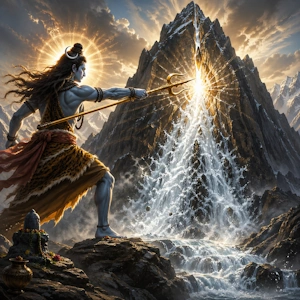
He lifts his trident.
He pierces the mountain.
From that break, something unexpected emerges.
Water.
Pure.
White.
Cooling like nectar.
This is not ordinary water.
This is corrective force.
They use it to bathe Vishnu.
And then the hidden truth reveals itself.
The sin does not vanish quietly.
It comes out.
It takes form.
A terrifying being.
Distorted.
Violent.
Ready to destroy.
The Devas prepare to strike.
Shiva stops them.
Do not kill it.
Instead, he transforms its role.
That same force becomes Sandhya.
A sacred tirtha.
A purifier.
A force that uplifts generations.
This is the first law.
Nothing is wasted.
Even impurity can be redirected.
Vishnu understands the depth of this.
He asks:
How do I remain untouched?
Not just from sin.
Even from tapas.
Because even effort can bind.
Shiva gives no lecture.
He gives a system.
The Pashupata path.
Not belief.
Not ritual.
A restructuring of power.
Vishnu practices it.
With intensity.
With discipline.
For twelve years.
When Shiva sees this, he does something rare.
He gives half his own body.
This is not metaphor.
This is merging.
Vishnu-Shankara.
Two principles.
One expression.
Then the shift.
Asuras rise.
Taraka.
Maya.
Nivatakavachas.
Organized.
Relentless.
The war begins.
It does not end.
Thousands of years pass.
No victory.
Then the Devas collapse.
They run back to Shiva.
This time not for knowledge.
For survival.
Shiva does not step in directly.
He calls Parashurama.
A warrior.
But exhausted.
He says:
I am weak.
I cannot fight.
Shiva does not accept that.
He empowers him.
Indra gives him a divine chariot.
Now the balance shifts.
Parashurama enters the battlefield.
What follows is not a fight.
It is overwhelming force.
One warrior.
Against thousands.
Arrows move faster than sight.
He appears in many forms.
Enemies fall in waves.
Entire divisions collapse.
The Devas watch in silence.
Then in awe.
They bless him.
Strength that does not fade.
Victory that does not break.
The tide turns.
Balance returns.
What this actually shows
Yajna is not automatically pure.
If misaligned, it creates residue.
Completion is everything.
Correction is everything.
Power is not position.
It is discipline.
Victory is not numbers.
It is alignment.
For deeper understanding
Why did the yajna create impurity
Because acceptance of offerings creates exchange. If alignment is incomplete, residue forms.
Why did Shiva not destroy the emerging sin
Because destruction removes form. Transformation removes root.
Why did Vishnu ask about escaping even tapas
Because effort can create identity. Identity creates bondage.
What is the real nature of the Pashupata path
It restructures the source of power, not just behavior.
Why was Parashurama chosen
Because divine force works through prepared instruments, not shortcuts.
Objections and replies
This is just symbolic storytelling
No. The sequence follows strict logic. Action, consequence, correction. That is system, not fantasy.
How can sin become sacred
Because energy is not rejected. It is reassigned.
Why would Vishnu need correction
Because roles do not override universal laws.
One warrior defeating thousands is unrealistic
Only if you assume normal limits apply in all states.
Why didn’t Shiva directly end the war
Because systems are maintained through delegation and empowerment, not bypass.
Vedadhara is working to bring out these deeper layers — not just stories, but the systems behind them. Share this so more people start seeing the structure, not just the surface.





English
Purana Stories
Click on any topic to open
7
30
Astrology
Bhagavad Gita
Bhagavatam
Bharat Matha
Devi
Devi Mahatmyam
Ganapathy
Garuda Puranam
Glory of Venkatesha
Hanuman
Kathopanishad
Mahabharatam
Mantra Shastra
Mystique
Practical Wisdom
Purana Stories
Radhe Radhe
Ramayana
Rare Topics
Rigveda Explained
Rituals
Sages and Saints
Shiva
Spiritual books
Sri Suktam
Story of Sri Yantra
Temples
Vedas
Vishnu Sahasranama
Yoga Vasishta
26
17
10
0


