There Is a Mother-Child Relationship Between Water and All Living Beings
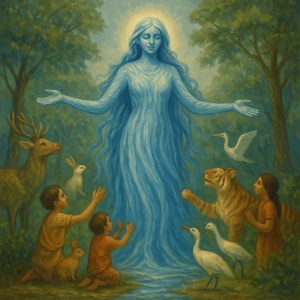
This set of mantras are there across Vedas.
We are going to look at it as it is there in Atharva Veda.
आपो हि ष्ठा मयोभुवस्ता न ऊर्जे दधातन महे रणाय चक्षसे
Water, or as it is said in Vedas, Waters — used in plural — they are Mayobhavah, givers of comforts. Maya means sukha, comfort, happiness.
Why are they considered so?
Two reasons:
-
आपोमयः प्राणः — Chhandogya Upanishad — It is because we drink water that there is life in the body.
If water intake is reduced, then prana or the life force becomes unstable. -
Everything that we eat or drink, water is behind their production.
Without water, none of these will be available.
What happens if food is not available? Health is gone, energy is gone, diseases come in the body, hunger.
By taking care of all these, water, if you see, is the provider of comfort and happiness.
Let waters provide us with energy, provide nourishment to the body.
What for? What for energy?
For enjoyment — Mahe ranaya, Ramanaya.
Or — Ranaya chakshase — for vision.
Vision of truth, the ultimate truth, for sakshatkara of Parabrahma or Paramatma.
For this also, energy is needed.
May waters provide us energy needed for physical needs and also for realization of truth.
यो वः शिवतमो रसस्तस्य भाजयतेह नः उशतीरिव मातरः
We don’t really know what is there in water.
It is not just quenching thirst.
What water does to the body — we haven’t really understood.
A lot has been understood about water chemically.
But water is much, much more than the scientific knowledge.
Water is hardly understood by H2O.
Have you noticed this — there is a lot of difference between being hungry and being thirsty.
You can do fasting — most people do — without much difficulty.
But to do nirjala, without even water, is extremely difficult.
You shouldn’t do it casually.
It can completely disorient you.
You have to be very, very careful when doing nirjala.
It can completely disorient you.
We know water purifies — externally and internally.
So all these can be hardly understood by science.
Water is one of the few materials that can be charged up with devata chaitanya.
So the real essence of water — we have hardly known a small part of it.
But we know that every living being derives benefit out of this rasa or essence of water, in some way or the other.
And because of this, the essence of water is shiva tama — most auspicious — in the superlative degree.
There are beautiful insights in the Vedas.
Another greatness about water.
Yajurveda says –
नानामसो खलु वै पशवः नानाव्रताः ते अपः एव अभि समनसः
All different animals — they have different likes.
Lion likes meat and blood, crow likes decayed stuff, crane likes fish.
Even man — geography to geography and person to person — the likes are different.
Someone wants spicy, someone wants salty, without salt.
Even within a family, the tastes are different.
Not only this — in terms of action also, the living beings are completely different.
Even as simple an act as eating — see how a leopard would get its food and how a sparrow would.
People also — someone likes to talk, someone else wants to be silent, someone is aggressive, someone else is laid back.
With so many varieties and variations, there is one thing common to all of them.
They all like water.
They all drink water.
They all like to drink water, want to drink water.
By water, what is meant here is liquid.
Is there any living being that doesn’t drink water, doesn’t want to drink water — in some form or the other?
That’s why Veda says, between water and every living being there is a bond — matrutva.
Affection — a child or a cub or a calf has towards the mother.
And water, or waters, they have motherly affection towards all living beings.
उशतीरिव मातरः
The affection of waters is not passive.
It is full of enthusiasm.
It has the concern of a mother when she is breastfeeding the child — all the enthusiasm and concern with which a mother breastfeeds her child.
The concern for the nourishment of the child. The well-being of the child.
This is what Veda recognizes, which is part of the essence of water.
Can this be scientifically explained or justified?
There are two more mantras in this sukta which we will see later.





English
Vedas
Click on any topic to open
7
30
Astrology
Bhagavad Gita
Bhagavatam
Bharat Matha
Devi
Devi Mahatmyam
Ganapathy
Garuda Puranam
Glory of Venkatesha
Hanuman
Kathopanishad
Mahabharatam
Mantra Shastra
Mystique
Practical Wisdom
Purana Stories
Radhe Radhe
Ramayana
Rare Topics
Rigveda Explained
Rituals
Sages and Saints
Shiva
Spiritual books
Sri Suktam
Story of Sri Yantra
Temples
Vedas
Vishnu Sahasranama
Yoga Vasishta
26
17
10
0


