The Vedic Secret Of Blessed Effort
People do not rise by effort alone.
They rise when effort finds the right support.
A person may work hard.
He may plan well.
He may even have talent.
Still, something may not open.
Because life is not only about pushing.
It is also about receiving.
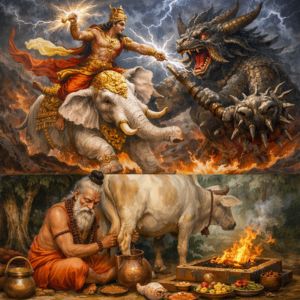
Rigveda Mandala 1 Sukta 4 shows this through Indra.
The Sukta is not merely asking Indra to come.
It is asking strength to enter the right place.
At the right time.
In the right mood.
With the right friendship.
This is the hidden principle here:
Power must be invited.
It cannot be forced.
Modern life teaches us only one thing.
'Do more.'
But the Sukta teaches something deeper.
'Become worthy of help.'
That is why the imagery is of offering, drinking, friendship, praise, protection, and victory.
Indra is not treated like a distant power.
He is approached like a great ally.
A protector.
A giver of strength.
A remover of resistance.
A friend of the one who offers Soma.
This is the human secret.
When the mind becomes dry, arrogant, and self-closed, strength does not stay.
When the mind becomes humble, prepared, and devotional, strength descends.
Soma here is not just a ritual drink.
It is the refined inner offering.
The best part of oneself.
Attention.
Faith.
Sincerity.
Gratitude.
Readiness.
When these are offered, life stops feeling like a fight fought alone.
Indra becomes the force that breaks the inner Vritra.
The blockage.
The pressure.
The thing that holds back movement.
Many people fail not because they lack ability.
They fail because they lose divine friendship.
They become isolated inside.
They depend only on cleverness.
They stop invoking higher strength.
They stop remembering Bhagavan.
Then even small obstacles look huge.
But when devotion returns, something changes.
The same person becomes lighter.
His courage returns.
His speech becomes steadier.
His decisions gain force.
His relationships improve.
His effort becomes protected.
That is grace.
Not magic.
Not laziness.
Grace is the unseen support that makes effort fruitful.
The Sukta is about the protection of worthy effort.
It says:
Do your part.
Prepare the offering.
Call the higher power.
Stay in friendship with the divine.
Then strength comes.
Then obstacles break.
Then wealth, courage, and movement become possible.
The unseen depth:
The deepest message is this.
Human effort begins the journey.
Divine alignment completes it.
Indra does not empower the careless.
He supports the one who prepares, offers, remembers, and calls with sincerity.
This is why blessings matter.
They protect the subtle spaces where human control ends.
Your timing.
Your courage.
Your unseen enemies.
Your inner collapse.
Your loss of faith.
Your sudden opening.
These are not managed by effort alone.
They are protected by alignment with Bhagavan.
Vedadhara preserves and brings out such Vedic insights so that ancient mantras do not remain as sound alone.
They become guidance.
For daily life.
For courage.
For devotion.
For inner protection.
Share this wisdom if it can help someone move from lonely effort to blessed effort.
-
Why does the Sukta call Indra again and again?
Because strength has to be invited repeatedly.
One prayer is not enough.
The mind forgets.
Ego returns.
Fear returns.
So remembrance must return.
-
What is the practical lesson here?
Do not depend only on hard work.
Prepare well.
Act sincerely.
Keep devotion alive.
Then your work carries a different force.
-
Why are blessings needed after effort?
Because effort controls action.
Blessings protect outcome, timing, courage, and unseen resistance.
That is where Bhagavan enters.
Objection:
'If I work hard, why do I need divine grace?'
Reply:
Hard work is necessary.
But hard work does not control everything.
You do not control people’s minds.
You do not control timing.
You do not control hidden obstacles.
Grace protects the parts of life your effort cannot reach.
सुरूपकृत्नुमूतये सुदुघामिव गोदुहे ।
जुहूमसि द्यविद्यवि ॥१॥
उप नः सवना गहि सोमस्य सोमपाः पिब ।
गोदा इद्रेवतो मदः ॥२॥
अथा ते अन्तमानां विद्याम सुमतीनाम् ।
मा नो अति ख्य आ गहि ॥३॥
परेहि विग्रमस्तृतमिन्द्रं पृच्छा विपश्चितम् ।
यस्ते सखिभ्य आ वरम् ॥४॥
उत ब्रुवन्तु नो निदो निरन्यतश्चिदारत ।
दधाना इन्द्र इद्दुवः ॥५॥
उत नः सुभगाँ अरिर्वोचेयुर्दस्म कृष्टयः ।
स्यामेदिन्द्रस्य शर्मणि ॥६॥
एमाशुमाशवे भर यज्ञश्रियं नृमादनम् ।
पतयन्मन्दयत्सखम् ॥७॥
अस्य पीत्वा शतक्रतो घनो वृत्राणामभवः ।
प्रावो वाजेषु वाजिनम् ॥८॥
तं त्वा वाजेषु वाजिनं वाजयामः शतक्रतो ।
धनानामिन्द्र सातये ॥९॥
यो रायोऽवनिर्महान्सुपारः सुन्वतः सखा ।
तस्मा इन्द्राय गायत ॥१०॥





English
Rigveda Explained
Click on any topic to open
7
30
Astrology
Bhagavad Gita
Bhagavatam
Bharat Matha
Devi
Devi Mahatmyam
Ganapathy
Garuda Puranam
Glory of Venkatesha
Hanuman
Kathopanishad
Mahabharatam
Mantra Shastra
Mystique
Practical Wisdom
Purana Stories
Radhe Radhe
Ramayana
Rare Topics
Rigveda Explained
Rituals
Sages and Saints
Shiva
Spiritual books
Sri Suktam
Story of Sri Yantra
Temples
Vedas
Vishnu Sahasranama
Yoga Vasishta
26
17
10
0


