The Sword of Vichara
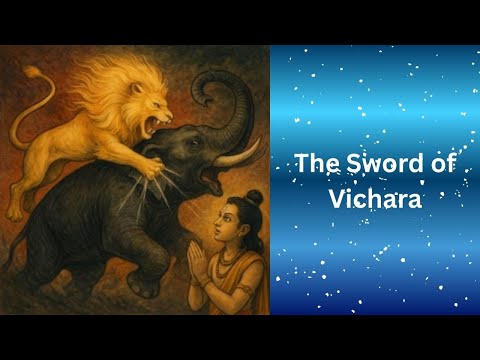
Yoga Vasishta - Mumukshu Vyavahara Prakarana - Sarga 14:
Sarga 14 of the Mumukshu Vyavahara Prakarana is a blazing anthem to vichara — deep, relentless self-inquiry. Vasishtha declares that true strength, clarity, and liberation come not from rituals or renunciation, but from sharp, focused thinking. This sarga slices through the illusions of the world, showing how vichara is the only medicine for the disease of samsara. Without it, even wisdom turns toxic; with it, even fear and bondage dissolve like mist in sunlight.
O Rama,
a pure, unwavering intellect—
cleansed by deep understanding of shastra—
must keep asking:
‘What is this self? Who am I?’
For one who knows how cause and effect work,
self-inquiry is not optional.
It’s a daily duty.
Inquiry sharpens the intellect
like a sword honed on stone.
And once sharp—
it pierces illusion
and reveals the supreme state.
For the long disease of samsara,
only inquiry is the real medicine.
This life — a jungle of dangers.
Creepers of misery, endlessly sprouting.
But the saw of vichara
cuts them at the root.
Once cut,
they do not grow back.
When delusion strikes,
when friends fall away,
when crises rise,
when peace slips —
the wise turn inward.
Vichara covers it all.
It is the path of the noble.
It is how they survive.
There is no other way,
no other method.
Without vichara,
even the wise stumble.
But with it,
the mind drops the impure,
and embraces the good.
Not by accident—
but by clarity.
Strength, brilliance, clear insight,
success in actions—
none of these come by chance.
For the truly wise,
it is vichara alone
that lights the fuse.
It makes even the smallest effort fruitful.
Right or wrong?
Desirable or dangerous?
Only the blazing lamp of vichara
can reveal.
Hold on to it—
and you can cross
the terrifying ocean of samsara.
Maya, like a wild elephant,
tramples the heart-lotus.
But vichara —
it is the lion.
It tears apart
that dark beast of delusion
without hesitation.
Even the ignorant
who somehow reach the Supreme,
do so only because
the lamp of vichara
was lit somewhere
somehow.
It alone opens the ultimate gate.
Rama,
all that men chase—
kingdoms, pleasures, wealth,
even moksha itself—
are just the fruits
of a single tree:
the tree of vichara.
The thoughts of the wise—
they grow from the soil of viveka.
Even when storms hit,
they do not sink.
Like gourds floating on water,
they rise back every time.
They cannot be drowned.
Those who act with a mind
bathed in vichara's dawn
become vessels—
not of ordinary results—
but of the rarest fruits:
deep peace,
great clarity,
a fragrance that doesn’t fade.
Where fools let wild vines
of unexamined desires grow,
where no vichara cuts the mess,
there—
blossoms bloom too.
But their scent is sorrow.
Those buds burst only into pain.
That sleep—
dark as crushed soot,
intoxicating as wine,
clouding dharma—
is born of avichara.
Let it vanish, Rama!
May such deluded slumber
be destroyed forever!
A man rooted in vichara,
even when thrown
into deepest calamity—
does not drown in delusion.
Like light piercing through darkness,
he shines on.
He burns through moha
like the sun melts night.
In the clear lake of the mind,
if the lotuses of vichara bloom,
that person glows—
serene and majestic—
like Himavan himself.
Still. Luminous. Unshakable.
But for one whose intellect has no vichara,
whose mind has dulled into fog—
their thoughts rise and fall
like the moon appearing
in a fool child's drawing.
Delusion paints dreams
with no root.
O Rama,
stay far away from the one
who lacks vichara.
Even if they look sweet like honey,
they are a tangle of thorns—
a bundle of sorrow
wrapped in ignorance.
Those who leap into wrong deeds,
who live crooked lives,
who run on impulse—
they shine for a moment,
lit by avichara’s eerie fire.
Like ghosts in a dark forest,
they flicker, then vanish.
O scion of Raghu,
keep far—very far—
from the one without discernment.
He’s like a tree in a deep forest:
useless for good,
incapable of offering fruit,
standing in shade,
with no light of dharma.
When the mind becomes inward, still, and free from craving,
it touches bliss.
Just like the full moon rises in the clear sky—
serene, complete, luminous—
so too peace rises in the soul
of one who has silenced desires.
When viveka (clear discernment) dawns in the body,
it cools everything—like moonlight calming a fevered earth.
It decorates life,
like gentle light adorning every branch,
every path, every being.
Vichara (true reflection) waves like a white royal fan
at the top of the flagpole of Truth.
It shines in the intellect of the seeker
like the full moon ruling the night—
gentle, guiding, silent.
Beings lit by vichara,
who walk in its radiance,
light up all ten directions—
like suns rising at once!
Where they go, the fear of samsara dissolves.
Just like the ghost a frightened child imagines
in the dark sky at night—
terrifying, yet unreal—
so too the monsters of the mind disappear
when vichara rises like dawn.
What kills fear is not running, but seeing.
Without vichara, everything in the world feels real—
joys, fears, cravings, losses—
but it's all like mirages seen by a drunken ghost.
These so-called 'realities' are made of fog.
The sword of vichara slashes through the illusion—
what never really was is shown to be just that.
Samsara — this long-lived ghost —
is nothing but a projection
of one’s own mind gone mad with delusion.
It clings, it haunts, it suffocates—
but one glance of true inquiry
and it vanishes, like a shadow in sunlight.
Know this, O Raghava—
the fruit of supreme vichara is this:
Unshaken happiness,
pure, boundless, and never dependent
on anything outside.
This is kevalibhava — the state of the self-alone.
From this kevalibhava arises
a majestic steadiness—
a brilliance of presence without desire.
Not burning like the sun, but cooling,
like the full moon rising
over the ocean of stillness.
The noble one,
seated firmly in the calm of their own mind,
having drunk the nectar of vichara—
doesn’t grasp at joy, doesn’t push away pain.
They don’t desire liberation,
nor do they reject anything.
They are the medicine.
When the mind holds on to That Supreme State,
it spreads like the open sky—
neither rising nor setting,
beyond movement, beyond pause,
like space itself—
untouched by time.
It gives nothing. It takes nothing.
It neither soars nor sinks.
It just is.
A silent witness, unmoved—
gazing upon the dance of the world,
unbound, unconsumed.
It doesn’t retreat into silence,
nor cling to the inner or the outer.
It doesn’t grab on to renunciation,
nor drown in action.
It walks neither path,
yet flows through both.
It watches the past fade,
moves gently with the present.
Not stirred. Not still.
Like the ocean, vast and whole—
reflecting all, disturbed by none.
Such is the mind of the great ones—
whole, free, radiant.
They move through this world as jivanmuktas—
liberated while still alive.
They play in the world,
but the world plays no part in them.
The wise ones live in the world for as long as they choose—
unattached, clear, content.
And when the time comes,
they cast aside the shell of this life
like a robe grown old—
merging into the pure One,
the infinite silence.
Even in crisis, the seeker must ask—
Who am I? What is this world?
This questioning is no luxury—
it's the only medicine.
And the effort must come from within.
No one else can do it for you.
Rama, a king knows what’s to be done
only through inner clarity—
not by haste, not by guesswork.
Success or failure—both are decided
only by sharp thought,
not blind action.
The firm truths of the Vedas,
the heights of Vedanta—
they don’t reveal themselves to the dull.
Only in the lamp of clear inquiry
do they shine—
like a lighthouse on a moonless night.
Even in the densest darkness,
when the world is hidden and curved—
pure vichara, bright-eyed and fearless,
still sees the truth.
It doesn’t grope. It knows.
The one blind to wisdom is worse than one born blind.
He stumbles not on stones, but on truth itself.
But the one whose eye is made of viveka — insight —
sees through the veil of the world,
and conquers everything by seeing rightly.
This marvel called vichara — divine inquiry —
is soaked in the presence of Paramatma.
It alone leads to the supreme bliss.
Even for a second, never abandon it.
It is the only wonder truly worth knowing.
A person glowing with refined inquiry
is adored even by the great.
Like a fully ripened mango,
he exudes sweetness—
quiet, irresistible, unpretentious, full.
Those whose minds shine with inquiry—
but only briefly, not firmly—
keep falling again and again
into the dark wells of sorrow,
like travelers who once saw the path
but forgot the way.
Even a sick man suffering a hundred misfortunes
doesn’t weep like the one
whose soul is shattered by lack of inquiry.
This crying fool, who abandoned vichara,
is like a broken drum — hollow, noisy, helpless.
Better to be mud.
Better to be a worm that feeds on filth.
Better to live blind in a cave—
but never, never live without inquiry.
A life without vichara is a curse worse than death.
Throw away avichara— thoughtlessness.
It is the house of every calamity.
It mocks all goodness,
welcomes disorder, and births ruin.
Leave it far behind, like fire in your robe.
A noble one must always live with vichara like breath.
For those falling into the dark pit of samsara,
it is the only rope that holds.
Without it, you’re gone.
Hold your mind like a beast
by the reins of inquiry.
With vichara, pull it out of the ocean of illusion,
save yourself— by yourself.
You are both the rescuer and the rescued.
Ask. Who am I?
What is this mess called samsara?
Why am I caught in it?
Seek, not emotionally, but logically.
That disciplined introspection— that is vichara.
A foolish man, lost in double darkness —
blindness and delusion —
treasures sorrow like it’s nectar.
His heart is stone, his life a curse,
for he refuses to inquire.
He chooses pain over freedom.
Raghava, those who chase 'is' and 'is not',
gain and loss, shadow and shine —
they are chasing smoke.
Without vichara, no truth is seen.
Not even a drop.
The real is found only in the fire of discernment.
From vichara rises tattva — the essence.
From tattva, the Self rests in itself.
And when the Self rests,
the mind is still.
When the mind is still,
sorrow ends — completely.
Only actions ripened by clear vichara bear sweet fruit.
Only those seen with the eyes of wisdom shine.
Let your work be touched by deep thought,
and it shall lead you to peace
and glow with timeless light.
Thus ends a sarga that roars like a lion — declaring that vichara alone lights the path through darkness. Without it, man remains a ghost in his own life; with it, he awakens to the eternal.
-
The highest strength lies not in rituals or outward renunciation, but in sharp, focused inquiry into the Self — that alone can cut through delusion.
-
Vichara (self-inquiry) is the one medicine that heals the disease of samsara — the endless cycle of suffering rooted in ignorance.
-
Real progress begins when the mind turns inward and repeatedly asks, 'Who am I? What is this world?'
-
Without vichara, even wise people stumble; with it, even the troubled can rise and find clarity.
-
A mind refined by inquiry drops toxic patterns and chooses right actions by clarity, not habit or emotion.
-
Discernment (viveka) and inquiry bring calm strength, like a moonlit night cooling fever — the wise glow with this silent brilliance.
-
Vichara alone reveals what’s right or wrong, real or unreal — it is the only torch in the darkness.
-
Cravings, grief, confusion, even illusions that look sweet — all vanish under the blade of inquiry.
-
A person of inquiry, even amidst loss or pain, remains rooted, steady like a mountain, undisturbed like the ocean.
-
Those who lack inquiry may appear successful for a while, but fall quickly — like ghosts flickering in wind.
-
Inquiry isn't an academic exercise — it’s the lifeline that rescues a drowning mind from samsara.
-
Without vichara, one's mind is overrun by unexamined desires that bloom into sorrow, not joy.
-
Vichara cuts through the hallucination of reality — joys and fears dissolve when seen with clear eyes.
-
The fruit of vichara is kevalibhava — the supreme state where happiness is unshaken and complete by itself.
-
One who abides in vichara lives freely in the world but is untouched by its noise, like a lotus in muddy water.
-
Vichara leads to jivanmukti — liberation while still alive — a serene, content life without clinging to joy or resisting pain.
-
This practice of inquiry must come from within; no one can hand it to you — it is self-effort at its purest.
-
Even dharma and the scriptures shine only in the light of inquiry; dull minds cannot grasp their true meaning.
-
A person without vichara is worse than blind — they stumble not over the world, but over truth itself.
-
Vichara connects one to Paramatma — the Supreme — and even a moment of it is more valuable than a lifetime of distraction.
-
Shallow inquiry leads to repeated sorrow; only deep, unwavering reflection lifts one out permanently.
-
A person who abandons vichara suffers like a broken drum — noisy, empty, useless.
-
Better to live as a worm than to live without vichara — that’s how crucial it is to a meaningful life.
-
Vichara tames the wild mind, steers it out of delusion, and helps the seeker save themselves — by themselves.
-
True discernment (viveka) gives rise to tattva (essence), which leads the Self to rest in itself and end sorrow completely.
-
Only those actions that arise from deep inquiry bear true fruit — lasting peace and luminous clarity.
-
What is vichara and why is it called the only medicine for samsara?
Vichara means self-inquiry — a disciplined reflection on 'Who am I?' and 'What is this world?'. It alone reveals the truth of existence and dissolves illusions. Samsara, the cycle of suffering, thrives on ignorance. Vichara shines light on that ignorance and ends the confusion that keeps it going. -
Why not rely on devotion or rituals instead of inquiry?
Because without clear thinking, even devotion becomes emotional entanglement. Inquiry is what reveals the essence behind all practices. Without it, even sacred rituals become mechanical. -
Isn't constant inquiry exhausting or impractical in daily life?
Not when it's properly understood. Vichara doesn’t mean sitting all day in abstract thought — it’s an inner alertness, a habit of pausing to examine motives, choices, and identity. It strengthens you, it doesn’t drain you.
-
How does vichara help during tough emotional times?
It anchors you. When you're in grief, confusion, or anger, vichara gently redirects your attention from the surface chaos to deeper awareness. It reminds you that you are not the storm, but the sky that holds it. -
What should one do when desires cloud the mind or peace slips away?
Turn inward. Instead of reacting, ask: what is this desire really about? Is it freedom, safety, recognition? Often, desires point to something deeper. Vichara helps decode and dissolve them. -
How can simply thinking about oneself remove emotional suffering?
Because most suffering is based on misunderstanding who we are. If you think you're just the body, or just your story, life becomes a constant threat. But inquiry shows that the Self is deeper, untouched by ups and downs.
-
What is kevalibhava and how does it relate to vichara?
Kevalibhava is the state where the Self rests in itself — complete, needing nothing outside. Vichara leads to this by clearing all illusions and cravings. It's not a trance, but a steady clarity that doesn't depend on circumstances. -
Can someone feel happiness without depending on external situations?
Yes, when vichara clears the fog, a natural joy arises from within — unshaken by gain or loss. This is not excitement, but deep contentment. -
Is it possible to live in the world without being affected by it?
Absolutely. Just like a lotus stays untouched by the muddy water it grows in, a mind grounded in inquiry remains free even while engaged in worldly life.
-
Why is a life without vichara considered worse than death?
Because without it, you're constantly pulled by external events, never truly living from your core. Such a life is directionless, repetitive, and hollow. Inquiry gives meaning and insight. -
Is it better to live blindly and peacefully rather than overthink everything?
There's a difference between overthinking and true inquiry. Overthinking is circular and emotional. Vichara is clean, clear, and liberating. Peace without clarity is fragile. -
Aren’t some people happy without ever questioning deeply?
What seems like happiness often hides restlessness. The moment crisis hits, it collapses. Vichara builds a happiness that endures because it is rooted in understanding, not denial.
-
How does vichara give strength in times of failure or confusion?
It brings perspective. Instead of panicking or blaming, you examine the root of what’s happening. This calms the mind and helps you respond wisely instead of reacting blindly. -
What should I do when everything in life feels out of control?
Start by asking, ‘What is truly mine? What am I clinging to?’ Vichara restores control not over events, but over how you relate to them. That’s real strength. -
Isn’t thinking too much during tough times a trap in itself?
If it’s emotional rumination, yes. But vichara is not brooding. It’s active clarity. It helps you cut through the fog and act from truth, not panic.
-
What does it mean to be liberated while still alive?
It means living fully engaged with the world, yet untouched by it. You play your roles, but don’t lose yourself in them. The joy is real, but not dependent. The sorrow may come, but doesn’t stick. -
Is renunciation necessary for liberation?
No. What matters is inner renunciation — not of objects, but of attachment. A person in a family, at work, can be freer than a hermit if they are clear inside. -
Can such a detached person truly love or care?
Yes, even more deeply — because their care isn’t based on fear or need. It comes from fullness, not emptiness. True love flourishes when you’re not enslaved by it.
-
Why are even good people without inquiry prone to downfall?
Because goodness without clarity can be swayed by emotion, pressure, or ignorance. Vichara strengthens the root. Without it, even noble intent can get twisted or exhausted. -
Isn't being 'good' enough if you treat others kindly?
Kindness is important, but wisdom makes it sustainable. Otherwise, one harsh event or betrayal can break you. Vichara gives kindness its backbone. -
Aren’t some people just born wise without inquiry?
Even accidental wisdom has inquiry somewhere behind it — maybe in past lives, or in moments they don’t even recognize. Wisdom is never random.
-
How does vichara end sorrow completely?
Because sorrow is a reaction to something misunderstood — loss, rejection, fear. Vichara questions the root of those reactions. Once you see the illusion, the sorrow fades. -
What does 'essence' mean in this path?
Tattva — the essence — is the truth beyond appearances. It's not philosophical abstraction. It’s the living experience of what is real, right now. -
Is it realistic to say sorrow can end forever?
Yes — not that sadness never arises, but it no longer shakes you. It passes like a cloud in a sky you now know is endless.





English
Yoga Vasishta
Click on any topic to open
7
30
Astrology
Bhagavad Gita
Bhagavatam
Bharat Matha
Devi
Devi Mahatmyam
Ganapathy
Garuda Puranam
Glory of Venkatesha
Hanuman
Kathopanishad
Mahabharatam
Mantra Shastra
Mystique
Practical Wisdom
Purana Stories
Radhe Radhe
Ramayana
Rare Topics
Rigveda Explained
Rituals
Sages and Saints
Shiva
Spiritual books
Sri Suktam
Story of Sri Yantra
Temples
Vedas
Vishnu Sahasranama
Yoga Vasishta
26
17
10
0


