The Rise of Vrikodara: Power, Poison, and Plot
Ahead lies the slow but certain crumbling of innocence.
What began as childish rivalry now ripens into deep-rooted enmity.
The Pandavas, though silent, sharpen their strength.
The Kauravas, though restless, sink deeper into deceit.
The first winds of the great storm of Mahabharata are about to rise.
धार्तराष्ट्रैश्च सहिताः क्रीडन्तो मुदिताः सुखम्।
बालक्रीडासु सर्वासु विशिष्टास्तेजसाऽभवन्॥
The Pandavas and the Kauravas played together —
In gardens golden under the gaze of the sun, in courtyards trembling with laughter.
The Earth wore their footsteps like jewels.
Childhood bound them in fleeting unity, as waves that kiss before parting.
But even in sport, destiny spoke.
The Pandavas, with a brilliance woven into their very souls, stood apart.
In every leap, in every throw, in every burst of laughter — they shone.
Their radiance was not of skill alone; it was the hidden fire of dharma stirring awake.
The Kauravas, though joyful, bore a silent shadow —
The beginning of a wound that would never heal.
जवे लक्ष्याभिहरणे भोज्ये पांसुविकर्षणे।
धार्तराष्ट्रान्भीमसेनः सर्वान्स परिमर्दति॥
In the races of speed, in the rush to seize the mark, in the wrestling of dust and bone —
Bhima rose like a living tempest.
Before his might, the sons of Dhritarashtra were but saplings against a monsoon.
He toppled them with a laugh, crushed them with the weight of his vigor.
He knew not cruelty, but his power bruised like iron wrapped in flowers.
Every fall of a Kaurava in the dust was a blow to pride —
A secret ember of rage planted deep into tender hearts.
Bhima, the child, played.
But Time, the unseen scribe, carved each blow into the stone of future war.
हर्षात्प्रक्रीडमानांस्तान् गृह्य राजन्निलीयते।
शिरःसु विनिगृह्यैतान्योजयामास पाण्डवैः॥
Bhima, the whirlwind born of Vayu, roared through the fields of play.
Not with anger. Not with hatred.
But with the wild delight of strength unmeasured, unchecked.
In his joy, he seized the sons of Dhritarashtra.
One by one, laughing as he bound them —
Their heads pressed under his mighty arms, their pride crushed before it could ripen.
Hidden from the watching eyes, he gathered them like sheaves of grain —
An offering of conquest laid before the Pandavas.
In that secret sport, something ancient stirred.
The laughter of Bhima was the drumbeat of destiny.
The bruises upon the Kauravas were the first scars of Kurukshetra.
The playful bondage was the first tightening of fate's noose.
शतमेकोत्तरं तेषां कुमाराणां महौजसाम्।
एक एव निगृह्णाति नातिकृच्छ्राद्वृकोदरः॥
A hundred and one mighty sons — fierce as young lions, roaring with the pride of royal blood.
Yet against them stood Bhima — alone, unshaken, unwearied.
Like a storm that sweeps away a forest without breaking its own breath,
Bhima seized them, subdued them, scattered them —
Not with labor, not with strain — but with the ease of destiny unfolding itself.
The Kauravas, though strong, though brave, found themselves powerless before him,
As rivers find themselves helpless against the sea's call.
Vrikodara (Bhima) — the Wolf-Bellied — smiled.
But his smile was the flash of thunder before a fated storm.
The children's struggle was a whisper,
But the cosmic loom wove this scene into the tapestry of Mahabharata —
Threads dyed in bruises, pride, and the gathering dark.
कचेषु च निगृह्यैनान्विनिहत्य बलाद्बली।
चकर्ष क्रोशतो भूमौ घृष्टजानुशिरोंसकान्॥
Bhima, the strong-armed, seized the Kauravas by their hair —
Roughly, powerfully, like a lion dragging prey from a thicket.
Their cries pierced the air, but mercy had no place in that wild festival of strength.
Bhima hurled them down, their knees scraping, their heads striking the earth.
Like fallen warriors upon a bloodied battlefield — though this was no battle, only the sport of boys —
They writhed and wept,
Their royal pride grinding into dust beneath his hands.
He dragged them along the ground —
Their garments torn, their ornaments scattered, their dignity bleeding into the soil of Hastinapura.
Each cry, each fall, was a note in the symphony of fate.
The dust rose around them like a mist of wounded dreams.
And unseen by all, destiny smiled —
For what Bhima sowed in innocent laughter, the world would one day reap in sorrow and fire.
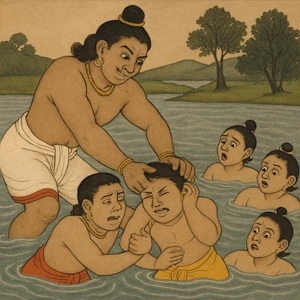
दश बालाञ्जले क्रीडन्भुजाभ्यां परिगृह्य सः।
आस्ते स्म सलिले मग्नो मृतकल्पान्विमुञ्चति॥
Bhima, whose arms bore the fury of storms, seized ten young Kauravas at once —
Gathering them as easily as a handful of petals.
With joyous might, he plunged into the waters,
Submerging himself and his hapless playmates deep into the trembling pools.
The boys flailed, their cries swallowed by the cold embrace of the water.
Their bodies floated — limp, gasping —
As though lifeless, as though abandoned by breath itself.
Bhima, laughing still, released them one by one,
Watching them drift like broken reeds upon the surface.
But the waters of Hastinapura bore witness.
They carried the bruises, the gasps, the silent weeping —
As offerings to a future soaked in blood and lamentation.
The pond that day was not just water —
It was the first battlefield where helplessness, fear, and humiliation silently learned to wear the armor of hatred.
फलानि वृक्षमारुह्य विचिन्वन्ति च ये तदा।
तदा पादप्रहारेण भीमः कम्पयते द्रुमान्॥
The young princes, eager and laughing, climbed the trees,
their hands reaching out to pluck the ripe fruits of joy.
They clambered higher and higher, like birds chasing the scent of the sky.
But Bhima — the unstoppable — came thundering below.
With a single mighty kick, he struck the roots,
and the great trees trembled from trunk to crown,
as if the breath of storms had entered their bones.
The branches shook, the fruits rained down, and the boys,
clinging for dear life, cried out in terror.
Their play turned into a struggle for survival,
and the laughter of moments past fled into the winds.
Bhima, radiant and unheeding, stood laughing amidst the fallen bounty —
Unaware that his strength, so casually unleashed,
was carving dread into the hearts of brothers who would one day seek his life.
प्रहारवेगाभिहता द्रुमा व्याघूर्णितास्ततः।
सफलाः प्रपतन्ति स्म द्रुमात्स्रस्ताः कुमारकाः॥
Struck by the thunderous force of Bhima's kicks,
the towering trees swayed and shuddered —
their mighty arms flailing against the sky.
Fruits rained down like golden tears,
and from among the quivering branches,
the young princes fell — helpless, shaken, stripped of pride.
One by one they tumbled,
their hands grasping empty air,
their cries piercing the trembling groves.
No longer were they warriors in play,
no longer were they heirs of a mighty kingdom —
they were but leaves torn from the tree of arrogance,
cast to the dust by a boy who wielded the strength of destiny itself.
The earth caught them — bruised, broken, and silent.
The sky looked on —
silent witness to a wound that would bleed through generations.
Thus, even amidst laughter and innocent play,
the first great humbling unfolded —
the pride of Kuru's heirs, battered to the ground,
in the shadow of Bhima's mighty will.
केचिद्भग्नशिरोरस्काः केचिद्भग्नकटीमुखाः।
निपेतुर्भ्रातरः सर्वे भीमसेनभुजार्दिताः॥
Some lay with broken heads,
some groaned with shattered chests,
others clutched their torn hips and bleeding faces —
the mighty sons of Dhritarashtra,
brought low by the playful fury of Bhima.
The ground drank their cries,
the winds scattered their moans.
No war trumpet had been blown,
no battlefield had been declared —
yet the first fall of Kaurava pride was written,
not with weapons, but with bare hands, with naked might.
Bhima's arms — fierce as thunderbolts —
had crushed the princes like dry twigs under a raging storm.
The brothers, who once laughed with pride and pranced with confidence,
now lay sprawling in the dust,
their bodies marked by destiny,
their hearts secretly ignited with the first fire of vengeance.
न ते नियुद्धे न जवे न योग्यासु कदाचन।
कुमारा उत्तरं चक्रुः स्पर्धमाना वृकोदरम्॥
In no contest of arms,
in no race of swiftness,
in no feat of skill —
could the Kaurava princes match Bhima,
the son of the wind, the crusher of pride.
Every trial they attempted,
every game they seized,
ended the same —
their dreams broken, their honor humbled at his feet.
Yet pride, wounded and burning, refused to kneel.
Spurred by bitterness, fueled by silent shame,
they dared again and again
to challenge Vrikodara —
like moths flying into a merciless flame.
Each contest was a prayer,
a desperate cry of defiance against destiny itself.
But Bhima — radiant, unstoppable —
crushed every rebellion before it could rise,
unaware that with every defeat he sowed a deeper hatred,
a hatred that would one day drown the Kuru race in blood and ash.
Thus, pride fought against fate — and lost, again and again.
एवं स धार्तराष्ट्रांश्च स्पर्धमानो वृकोदरः।
अप्रियेऽतिष्ठदत्यन्तं बाल्यान्न द्रोहचेतसा॥
Thus Bhima, mighty as a young lion, competed endlessly with the sons of Dhritarashtra.
His strength, his laughter, his victories — all became wounds to their pride.
Yet in Bhima's heart, there was no malice.
He played with the innocence of a child,
knowing nothing of envy, of hatred, of the poison slowly gathering across the fields of fate.
His blows were heavy, his games rough,
but his spirit was untouched by the blackness of intent.
The Kauravas, though crushed and humiliated,
festered within —
while Bhima danced through his boyhood,
blazing like a sun too bright for envious eyes.
Thus destiny allowed the seeds of ruin to ripen silently,
while outwardly, it was still only children's laughter that filled the royal gardens.
ततो बलमतिख्यातं धार्तराष्ट्रः प्रतापवान्।
भीमसेनस्य तज्ज्ञात्वा दुष्टभावमदर्शयत्॥
As Bhima’s strength grew into legend,
shining like an unchallenged sun across Hastinapura,
the heart of Duryodhana darkened.
He who was born to rule,
he who dreamt of thrones and bows before his feet,
now burned at the sight of Bhima’s effortless supremacy.
From that day,
no longer could Duryodhana laugh in true joy,
no longer could he see Bhima without tasting the bile of envy.
A twisted feeling took root in him —
a feeling cold, sharp, and cruel —
the first true hatred among the sons of Bharata.
Thus did Duryodhana, recognizing that he could never conquer Bhima in fair contest,
allow wickedness to bloom in the secret chambers of his soul.
तस्य धर्मादपेतस्य पापानि परिपश्यतः।
मोहादैश्वर्यलोभाच्च पापा मतिरजायत॥
Driven far from dharma,
blinded by pride in his royal blood,
Duryodhana began to see the world through the dark glass of sin.
Where others saw brotherhood, he saw enemies.
Where others saw play, he saw insult.
Where others saw strength, he saw a threat to his throne.
Under the heavy hand of delusion and greed for power,
his very mind turned foul,
like a clear river poisoned at its source.
Thoughts he once would have cast away as wicked
now appeared before him as rightful strategies.
Thus, not by outer war, but by the silent corrosion within,
Duryodhana crossed the unseen line —
from prince to destroyer,
from heir to ruination.
And the gods, watching from above,
uttered not a word —
for destiny had begun to move its wheels.
अयं बलवतां श्रेष्ठः कुन्तीपुत्रो वृकोदरः।
मध्यमः कुन्तिपुत्राणां निकृत्या सन्निगृह्यतां॥
Duryodhana’s mind, now steeped in wickedness, whispered venomous resolves.
'Here stands Bhima,' he thought —
'the mightiest among Kunti’s sons,
the heart of their strength, the shield of their pride.'
As long as Bhima lived,
the Pandavas would stand tall, unbroken.
Remove Bhima — and the mountain would crumble into sand.
Thus, in secret chambers of thought,
Duryodhana forged a dreadful resolve —
to ensnare Bhima not by open battle,
but by deceit, by cunning, by hidden treachery.
He who could not be broken in fair play,
he who could not be defeated by strength,
must be dragged down into ruin
by the black hands of betrayal.
Thus was born, in the darkness of a boy’s jealousy,
a plot that would stain the corridors of Hastinapura forever.
प्राणवान्विक्रमी चैव शौर्येण महताऽन्वितः।
स्पर्धते चापि सहितानस्मानेको वृकोदरः॥
Bhima, breathing the fire of life,
overflowed with valor and irresistible might.
Not one, not two —
but a hundred sons of Dhritarashtra together
could barely match the storm that he was.
Even when all of them stood united,
Vrikodara, alone, rose higher —
like a single mountain towering over a chain of hills.
Each act of his strength,
each effortless triumph,
was a dagger into the heart of Duryodhana’s pride.
'How long can we endure this shame?' he thought.
'How long shall one boy,
with arms strong as fate itself,
mock the might of a hundred brothers?'
Thus hatred, once a whisper,
now roared inside him like a raging river seeking to drown the sun itself.
तं तु सुप्तं पुरोद्याने गङ्गायां प्रक्षिपामहे।
अथ तस्मादवरजं श्रेष्ठं चैव युधिष्ठिरम्॥
In the shaded peace of the royal gardens,
Bhima slept, unguarded, trusting.
Watching him, Duryodhana’s mind darkened.
'Now is the moment,' he thought,
'Let us cast him into the Ganga —
let the river's current wash away our humiliation.'
Without Bhima, Yudhishthira, though great,
would stand alone, fragile before the winds of fate.
प्रसह्य बन्धने बद्ध्वा प्रशासिष्ये वसुन्धराम्।
एवं स निश्चयं पापः कृत्वा दुर्योधनस्तदा।
नित्यमेवान्तरप्रेक्षी भीमस्यासीन्महात्मनः॥
Duryodhana, sunk in sin, made his dreadful vow.
'Bind Bhima by force,
and the earth shall be mine to rule, unchallenged.'
Thus resolved,
he watched Bhima constantly —
eyes always burning with hidden schemes,
waiting for a moment when strength would sleep
and treachery could rise.
Bhima, radiant and fearless,
remained unaware that behind every glance,
every laugh of his cousin,
lurked a shadow blacker than death.
ततो जलविहारार्थं कारयामास भारत।
चैलकम्बलवेश्मानि विचित्राणि महान्ति च॥
Duryodhana, weaving his plot with smiling deceit,
arranged a great festival of water-sports.
Magnificent pavilions of cloth and wool were built,
glorious and colorful, floating upon the Ganga,
inviting joy and celebration.
To all outward eyes, it was a day of games,
of princes frolicking by the sacred river.
But beneath the beauty,
beneath the laughter,
lay a snare woven by treachery —
a net waiting to drag Bhima into darkness.
उदकक्रीडनं नाम कारयामास भारत।
प्रमाणकोट्यां तं देशं स्थलं किंचिदुपेत्यह॥
Duryodhana prepared a grand festival of water games,
drawing the princes to the curving arms of the Ganga.
Near a hidden bend where the river deepened treacherously,
he chose the ground with cunning hands.
Amidst the rising joy and glittering pavilions,
no one saw the quiet danger waiting just beneath the surface.
The laughter of childhood would soon ripple across the waters,
even as treachery quietly seeped into the sacred flow of the river.
क्रीडावसाने ते सर्वे शुचिवस्त्राः स्वलङ्कृताः।
सर्वकामसमृद्धं तदन्नं बुभुजिरे शनैः॥
After the games, the young princes, dressed in pure garments and adorned with ornaments,
gathered to feast upon a banquet rich with every delight.
The fragrance of sacred foods filled the air,
golden plates gleamed under the afternoon sun,
and laughter wove through the gentle breeze.
They ate slowly, content, unaware that each bite, each sip,
brought them closer to a fate already coiling in the shadows.
In the sweet ease of trust,
danger crept closer, silent as a serpent in tall grass.
दिवसान्ते परिश्रान्ता विहृत्य च कुरूद्वहाः।
विहारावसथेष्वेव वीरा वासमरोचयन्॥
At the close of day, the mighty sons of Kuru, weary from their endless revelry,
chose to rest in the grand floating mansions built upon the Ganga.
Their bodies, tired but hearts light with the joy of play,
sought comfort under roofs of silk and banners.
The shimmering waters lulled them into trust,
the gentle evening breeze whispered peace —
but beneath that soft night,
the trap woven by envy and deceit tightened its unseen hold.
खिन्नस्तु बलवान्भीमो व्यायामाभ्यधिकस्तदा।
वाहयित्वा कुमारांस्ताञ्जलक्रीडागतान्विभुः॥
Bhima, tireless and fierce by nature,
had worn out the other princes during the games.
His strength, far greater than theirs,
forced them to the limits of their endurance,
even as he moved among them like a living tempest.
He led them tirelessly through the waters,
their limbs aching, their spirits struggling to keep pace.
While others gasped for breath,
Bhima stood untamed,
his mighty vigor unwittingly deepening the resentment
that already smoldered in envious hearts.
प्रमाणकोट्यां वासार्थं सुष्वापारुह्य तत्स्थलम्।
शीतं वासं समासाद्य शान्तो मदविमोहितः॥
Seeking rest after his ceaseless vigor,
Bhima climbed onto the wide raft set upon the Ganga and lay down.
The cool breeze, the soft sway of waters,
lulled his mighty spirit into stillness.
Drunk with the simple exhaustion of joy,
free of all suspicion,
Bhima surrendered to sleep —
like a lion resting in an open meadow,
never sensing the hunters circling in the grass.
निश्चेष्टः पाण्डवो राजन्सुष्वाप मृतवत्क्षितौ।
ततो बद्ध्वा लतापाशैर्भीमं दुर्योधनः शनैः॥
Bhima, unmoving as if dead,
slept deeply upon the raft, trusting the night that veiled betrayal.
Duryodhana, his heart pounding with wicked triumph,
crept forward with silken cruelty.
With creepers fashioned into ropes,
he bound Bhima’s mighty limbs —
slowly, carefully,
as one would bind a sleeping tiger before plunging the knife.
The hero who had shaken the Kauravas awake with fear
now lay helpless,
ensnared by hands he had once called brothers.
प्रमाणकोट्यां संसुप्तं गङ्गायां प्राक्षिपज्जले।
ततः प्रबुद्धः कौन्तेयः सर्वान्संछिद्य बन्धनान्॥
Bound and helpless,
Bhima was cast into the deep waters of the Ganga,
his great body swallowed by the trembling river.
But even the currents could not chain a spirit like his.
Stirred by the icy touch of the depths,
the son of Kunti awoke.
With a roar silent in the waters,
he snapped the bonds as if they were threads,
rising from the river’s womb like a force death could not claim.
उदतिष्ठद्बलाद्भूयो भीमः प्रहरतां वरः।
स विमुक्तो महातेजा नाज्ञासीत्तेन तत्कृतम्॥
Bhima, the foremost among warriors,
rose from the waters with the force of a thunderclap,
shaking free the last remnants of his bonds.
His blazing energy burst forth,
and no trace of weakness clung to him.
Freed by his own might,
he stood bewildered,
unaware that the treachery he had escaped
was not the work of chance,
but the fruit of Duryodhana’s dark resolve,
already rooted deep in betrayal.
पुनर्निद्रावशं प्राप्तस्तत्रैव प्रास्वपद्बली।
अर्धरात्र्यां व्यतीतायामुत्तस्थुः कुरुपाण्जवाः।
दुर्योधनस्तु कौन्तेयं दृष्ट्वा निर्वेदमभ्यगात्॥
Bhima, his body exhausted by struggle and release,
sank once more into deep sleep upon the raft.
As midnight passed and the stars turned pale,
the princes of Kuru and Pandu rose from their resting places.
Duryodhana’s eyes fell upon Bhima —
alive, untouched, unbroken —
and a dark despair gripped his heart.
All his schemes, his secret labor,
had been washed away like dust before the wind,
while Bhima lay there, radiant and invincible as ever.
सुप्तं चापि पुनः सर्पैस्तीक्ष्णदंष्ट्रैर्महाविषैः।
कुपितैर्दंशयामास सर्वेष्वेवाङ्गसन्धिषु॥
Still unwilling to accept defeat,
Duryodhana devised a deadlier cruelty.
He released furious serpents,
their fangs sharp, their bodies filled with burning poison,
to strike the sleeping Bhima.
The snakes, angered and wild,
sank their deadly teeth into every joint of his body,
seeking to flood his blood with venom,
to end by poison what strength could not overcome.
In the silent darkness, death itself was summoned
to claim the unbreakable son of Kunti.
दंष्ट्राश्च दंष्ट्रिणां मर्मस्वपि तेन निपातिताः।
त्वचं न चास्य बिभिदुः सारत्वात्पृथुपक्षसः॥
The venomous fangs struck deep,
aiming for the tender joints where life breathes closest to death.
Yet Bhima’s body, mighty and unyielding,
was like a fortress forged of thunder.
The serpents’ fangs could not pierce his thick, vital skin,
nor could their poison seep into the marrow of his strength.
Even where the fiercest of creatures sought to tear,
Bhima remained untouched —
a living mountain, impervious to the weapons of both men and beasts.
प्रबुद्धो भीसेनस्तान्सर्वान्सर्पानपोथयत्।
सारथिं चास्य दयितमपहस्तेन जघ्निवान्॥
Awakened by the burning bite of poison,
Bhima rose with the fury of a thundercloud torn open.
With a sweep of his mighty arms,
he crushed the serpents against the earth,
smashing their coiled bodies without mercy.
Seizing the beloved charioteer of the one who had sent them,
Bhima hurled him down with a blow that shattered bone.
The hand that had once only known the weight of play
now answered treachery with the weight of righteous wrath.
तथान्यदिवसे राजन्हन्तुकामोऽत्यमर्षणः।
वलनेन सहामन्त्र्य सौबलस्य मते स्थितः॥
Yet again, O King, on another day,
Duryodhana, burning with rage and shame,
resolved to kill Bhima by any means.
Unable to bear the weight of repeated defeat,
he sought counsel with Shakuni,
the crafty son of Subala,
who moved through schemes like a serpent through grass.
Together, they hardened their hearts,
standing firm in a pact woven with deceit,
ready to stain the paths of brotherhood with blood.
भोजने भीमसेनस्य ततः प्राक्षेपयद्विषम्।
कालकूटं विषं तीक्ष्णं संभृतं रोमहर्षणम्॥
At the secret urging of Shakuni,
Duryodhana chose a darker path.
Into Bhima’s meal he poured the venom of death itself —
the dreadful Kalakuta,
a poison sharp as a thousand needles,
a terror capable of withering life in a single breath.
Hidden within food meant for celebration,
death now waited,
silent and unseen,
seeking to slay the unconquered prince not by battle,
but by treachery in the guise of brotherhood.
तच्चापि भुक्त्वाऽजरदॉयदविकारो वृकोदरः।
विकारं नाभ्यजनयत्सुतीक्ष्णमपि तद्विषम्॥
Bhima, the indestructible son of Vayu,
consumed the poisoned meal without fear, without suspicion.
The deadly Kalakuta, fierce enough to fell armies,
flowed into his veins —
yet his mighty frame, blessed with unearthly resilience,
remained untouched, unshaken.
Not a tremor passed through his limbs,
not a cloud touched the clarity of his spirit.
Poison that could melt flesh and shatter bone
vanished like mist before the blazing sun that was Bhima’s inner fire.
भीमसंहननो भीमस्त्समादजरयद्विषम्।
ततोऽन्यदिवसे राजन्हन्तुकामो वृकोदरम्॥
Bhima, whose very body was forged like thunder,
burned away the deadly poison within him as if it were nothing.
His strength devoured the venom,
leaving him unscathed, radiant, unbroken.
Seeing his every scheme crumble against Bhima’s invincible spirit,
Duryodhana, restless and consumed by fury,
sought once again another day,
another cruel design
to destroy the one who stood beyond the reach of both poison and treachery.
सौबलेन सहायेन धार्तराष्ट्रोऽभ्यचिन्तयत्।
चिन्तयन्नालभन्निद्रां दिवारात्रमतन्द्रितः॥
With Shakuni ever whispering beside him,
Duryodhana brooded without rest.
Day and night, sleepless and fevered,
he plotted Bhima’s ruin,
his mind a battlefield of endless schemes and poisoned dreams.
No peace touched his heart,
no slumber cooled the fire of his hatred.
His very soul, once princely and proud,
was now a forge where only destruction was hammered and shaped,
beating against the walls of destiny with growing desperation.
एवं दुर्योधनः कर्णः शकुनिश्चापि सौबलः।
अनेकैरप्युपायैस्ताञ्जिघांसन्ति स्म पाण्डवान्॥
Thus Duryodhana, Karna, and Shakuni,
bound by a dark brotherhood of envy and hatred,
conspired endlessly against the Pandavas.
Their minds, sharpened by malice,
forged countless traps,
seeking to strike where strength alone could not prevail.
Deception became their weapon,
treachery their shield,
and every breath they took
wove deeper the web meant to ensnare the sons of Kunti.
Brotherhood had withered;
only ambition and fear now fed their restless hearts.
वैश्या पुत्रस्तदाचष्ट पार्थानां हितकाम्यया।
पाण्डवा ह्यपि तत्सर्वं प्रत्यजानन्नरिन्दमाः।
उद्भावनमकुर्वन्तो विदुरस्य मते स्थिताः॥
A son of a Vaishya woman (Yuyutsu), moved by love for the Pandavas,
revealed the plots brewing against them.
The sons of Kunti, wise and ever watchful,
understood the depth of danger that wrapped itself around them.
Yet they made no outcry,
raised no banners of suspicion.
Holding fast to Vidura’s counsel,
they endured in silence,
knowing that in the war between dharma and deceit,
strength lay not in reacting,
but in waiting for destiny’s hour to strike.
Thus in the silent corridors of Hastinapura,
brotherhood fractured into shadows.
The Pandavas, radiant yet patient,
stood firm like mountains beneath gathering storms,
carrying the weight of treachery without a word.
The Kauravas, restless in their hatred,
wove darker and darker webs,
forgetting that destiny, once stirred, never sleeps.
The waters of the Ganga had witnessed deceit,
the earth had tasted silent cries,
and the heavens, though unmoved,
held their breath for the battles yet unborn.
A great wheel had begun to turn —
slow, terrible, and unstoppable —
grinding pride, ambition, and fate into dust.





English
Mahabharatam
Click on any topic to open
7
30
Astrology
Bhagavad Gita
Bhagavatam
Bharat Matha
Devi
Devi Mahatmyam
Ganapathy
Garuda Puranam
Glory of Venkatesha
Hanuman
Kathopanishad
Mahabharatam
Mantra Shastra
Mystique
Practical Wisdom
Purana Stories
Radhe Radhe
Ramayana
Rare Topics
Rigveda Explained
Rituals
Sages and Saints
Shiva
Spiritual books
Sri Suktam
Story of Sri Yantra
Temples
Vedas
Vishnu Sahasranama
Yoga Vasishta
26
17
10
0


