The Reality Beyond the Senses
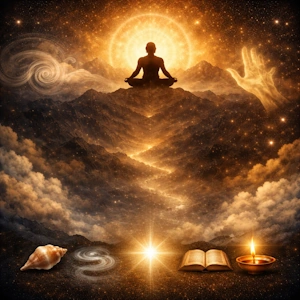
Explanation of the remaining verses 15–17 of the Kathopanishad, First Adhyaya, Third Valli.
- The Nature of the Supreme Reality
अशब्दमस्पर्शमरूपमव्ययं
तथाऽरसं नित्यमगन्धवच्च यत् ।
अनाद्यनन्तं महतः परं ध्रुवं
निचाय्य तन्मृत्युमुखात् प्रमुच्यते ॥
This verse describes the highest reality that a seeker must realize. The Upanishad uses a very special method here. Instead of defining Brahman directly, it explains what Brahman is not.
First understand why this approach is used.
Everything we normally know is understood through the senses. We know objects because we see them, hear them, touch them, taste them, or smell them. But Brahman does not belong to this category. Brahman is not an object among other objects in the universe.
So the Upanishad removes all sensory characteristics.
Ashabdam means without sound. Brahman cannot be heard like a physical vibration.
Asparsham means without touch. It cannot be contacted or felt like a physical surface.
Arupam means without form. There is no shape, color, or visible appearance.
Arasam means without taste.
Agandhavat means without smell.
By removing all five sensory qualities, the Upanishad makes one thing very clear. Brahman is not part of the material world experienced through the senses.
The verse then adds deeper characteristics.
Avyayam means undecaying. Everything in the world undergoes change. Bodies age, objects break, stars collapse. Brahman does not undergo any such transformation.
Nityam means eternal. It is always present.
Anadi means without beginning. Brahman did not arise at some moment in time.
Anantam means without end. There is no termination point.
Mahatoh param means beyond even the cosmic principle called Mahat, the universal intelligence that appears at the beginning of creation.
Dhruvam means absolutely stable and unchanging.
So the Upanishad gradually removes all limitations and reveals a reality that is beyond matter, beyond time, and beyond change.
Now comes the practical result.
Nichayya tan mrityu mukhat pramuchyate.
When a person clearly realizes this truth, that person becomes free from the mouth of death.
This statement does not mean the physical body will never die. Bodies always perish.
The meaning is deeper. Death belongs to the body and the mind. But the true Self is none of these. When a person realizes the Self as Brahman, the fear of death disappears. The cycle of birth and death also ends because ignorance is destroyed.
This is the central teaching of the Upanishad.
- The Glory of Nachiketa’s Teaching
नाचिकेतमुपाख्यानं मृत्युप्रोक्तं सनातनम् ।
उक्त्वा श्रुत्वा च मेधावी ब्रह्मलोके महीयते ॥
Now the Upanishad shifts from philosophical teaching to praising the dialogue that has just been presented.
Nachiketam upakhyanam refers to the sacred story of Nachiketa and Yama.
Mrityu proktam means spoken by the Lord of Death himself.
Sanatanam means eternal.
This dialogue is not a temporary philosophical discussion. It reveals eternal truth about the Self and the nature of liberation.
The verse then states the benefit.
A medhavi, a person with intelligence and sincerity, who studies or teaches this teaching becomes honored in the world of Brahman.
The idea here is not about gaining a heavenly location in a physical sense. The meaning is that the person becomes established in Brahman knowledge.
There is an important detail here.
Both actions are mentioned.
Uktva means teaching it to others.
Shrutva means listening to it properly.
Both learning and sharing this knowledge are considered sacred activities.
This reflects a central tradition of Vedic learning. Wisdom is preserved through transmission. A student listens from a teacher, understands it deeply, and later shares it with others.
So the teaching continues to live across generations.
- The Sacredness of Sharing This Knowledge
य इमं परमं गुह्यं श्रावयेद् ब्रह्मसंसदि ।
प्रयतः श्राद्धकाले वा तदानन्त्याय कल्पते ॥
This final verse emphasizes the sacred responsibility of sharing spiritual knowledge.
Imam paramam guhyam means this supreme secret.
The Upanishads often use the word secret. This does not mean hidden deliberately. It means subtle and difficult to grasp without proper preparation.
Brahma samsadi refers to an assembly of seekers or scholars engaged in discussions about Brahman.
The verse says that if someone teaches this wisdom in such a gathering, it brings immense spiritual benefit.
Another context is also mentioned.
Shraddha kale va. During rituals performed in memory of ancestors.
In traditional practice, shraddha ceremonies are occasions where sacred texts are recited and knowledge is shared. Teaching the wisdom of the Self during such times is considered highly auspicious.
The result is described as anantyaya kalpate.
This means it leads toward the infinite.
The idea is that teaching or sharing the knowledge of the Self connects a person to the limitless reality of Brahman. It becomes an act that supports spiritual growth not only for the teacher but also for the listeners.
The verse ends by repeating the statement again.
Tad anantyaya kalpate.
It truly leads toward the infinite.
This repetition is deliberate. The Upanishad wants to stress the greatness of sharing true knowledge.
The Final Insight of This Section
This entire section of the Katha Upanishad completes a powerful spiritual journey.
The teaching begins with Nachiketa questioning the nature of death. Yama gradually guides him through deeper levels of understanding.
First comes control of the senses.
Then mastery of the mind.
Then recognition of the hierarchy of reality — senses, mind, intellect, Self.
Finally the Upanishad reveals the nature of Brahman itself, beyond all sensory qualities and beyond all change.
When a person understands this truth, fear disappears. The confusion of identifying only with the body ends. Life is seen from the standpoint of the eternal Self.
That is the liberation spoken about throughout the Upanishads.
And the tradition continues because this wisdom is listened to, understood, and passed forward from one generation to the next.





English
Kathopanishad
Click on any topic to open
7
30
Astrology
Bhagavad Gita
Bhagavatam
Bharat Matha
Devi
Devi Mahatmyam
Ganapathy
Garuda Puranam
Glory of Venkatesha
Hanuman
Kathopanishad
Mahabharatam
Mantra Shastra
Mystique
Practical Wisdom
Purana Stories
Radhe Radhe
Ramayana
Rare Topics
Rigveda Explained
Rituals
Sages and Saints
Shiva
Spiritual books
Sri Suktam
Story of Sri Yantra
Temples
Vedas
Vishnu Sahasranama
Yoga Vasishta
26
17
10
0


