The Psychology of ‘More’ – Ancient Explanation
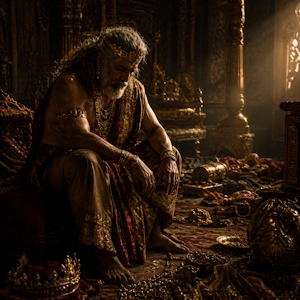
A king had everything.
Power. Wealth. Women. Status.
Still, something was missing.
That king is Yayati.
He did not lack anything.
He lacked end.
He became old.
Desire did not become old.
This is the first crack in our understanding.
We assume desire belongs to the body.
It does not.
The body weakens.
Desire does not weaken.
So he made a strange move.
He asked his sons:
Take my old age. Give me your youth.
Everyone refused.
One son, Puru, accepted.
Now understand this carefully.
The story is not about exchange.
It is about exposure.
Yayati got youth again.
Now there was no excuse.
No limitation.
No restriction.
He could enjoy fully.
Without interruption.
He lived like that for a long time.
Not days.
Not years.
A very long stretch of uninterrupted indulgence.
Still, something did not change.
The feeling of ‘not enough’ remained.
This is where the ancient teaching cuts sharply.
More does not reduce desire.
More expands desire.
The mind does not say:
Enough.
It says:
What next.
You give it comfort.
It asks for luxury.
You give it luxury.
It asks for variation.
You give it variation.
It asks for intensity.
This is not greed in the moral sense.
This is structure.
This is how the mind is built.
The text does not hide it.
It states clearly:
Desire does not end by enjoyment.
It grows like fire fed with fuel.
न जातु कामः कामानामुपभोगेन शाम्यति
So what actually happened to Yayati?
He did not suddenly become pure.
He became clear.
After exhausting the path of ‘more’,
He saw the pattern.
Not intellectually.
Directly.
Everything he wanted,
He got.
Everything he got,
Lost meaning.
This is the turning point.
Not suffering.
Not failure.
But seeing the cycle clearly.
He understood something very uncomfortable:
The problem is not outside.
The problem is the mechanism of wanting itself.
Then comes the real shift.
He gives the youth back.
Accepts old age.
Not helplessly.
Knowingly.
This is not renunciation from weakness.
This is renunciation from understanding.
Now bring this to daily life.
You think:
If this problem is solved, I will be at peace.
Then:
If I earn more, I will settle.
Then:
If this one thing improves, life will be complete.
But observe carefully.
Each ‘more’ becomes baseline.
Then a new ‘more’ appears.
That is exactly the same pattern.
Different scale.
Same structure.
So what is the real teaching here?
Not to run away.
Not to suppress.
But to see clearly.
If you don’t see it,
You will keep chasing upgrades.
If you see it,
You start choosing differently.
Peace does not come from reaching the last desire.
Because there is no last desire.
Peace begins when the mind stops expecting completion from accumulation.
That is the ancient explanation.
Simple.
Direct.
Uncomfortable.
Accurate.
Alright — tight, sharp, your style.
Q&A
Why does ‘more’ never feel enough even after getting it
Because the mind does not seek completion. It seeks continuation. The moment something is achieved, it becomes normal. Then the mind creates a new target. The feeling of lack is not removed. It is simply shifted.
Why did Yayati still feel incomplete after full enjoyment
Because experience does not end desire. It expands its range. What was once a peak becomes baseline. He did not lack opportunity. He lacked an end to wanting.
What exactly changed in Yayati at the end
Nothing outside. Everything inside. He stopped expecting fulfillment from accumulation. The shift was not from enjoyment to rejection. It was from illusion to clarity.
Is desire itself the problem
No. Blind movement inside desire is the problem. When desire is seen clearly, it loses its control. When it is chased unconsciously, it multiplies.
How do I know I am stuck in the ‘more’ cycle
When every achievement is followed by a new dissatisfaction. When relief is temporary. When you keep saying just one more step. That pattern is the signal.
Objections and replies
If desire never ends, then why not enjoy endlessly
Because enjoyment does not stay stable. It demands increasing intensity. What starts as pleasure slowly becomes dependency. You don’t stay in control. The cycle starts controlling you.
This sounds like rejecting success and growth
No. It is correcting misunderstanding. Growth is action. ‘More’ is expectation of completion. You can grow without believing it will finish your inner restlessness.
Why did Bhagavan allow Yayati to continue for so long
Because forced understanding does not work. Some realizations come only after direct exhaustion. He was allowed to see the pattern fully, without interruption.
Isn’t this impractical in modern life
What is impractical is endless dissatisfaction. This teaching does not ask you to stop living. It asks you to stop expecting final peace from accumulation.
If not ‘more’, then what should drive life
Clarity should drive action. Not inner emptiness. When action comes from clarity, it is stable. When it comes from lack, it keeps chasing without ending.





English
Mahabharatam
Click on any topic to open
7
30
Astrology
Bhagavad Gita
Bhagavatam
Bharat Matha
Devi
Devi Mahatmyam
Ganapathy
Garuda Puranam
Glory of Venkatesha
Hanuman
Kathopanishad
Mahabharatam
Mantra Shastra
Mystique
Practical Wisdom
Purana Stories
Radhe Radhe
Ramayana
Rare Topics
Rigveda Explained
Rituals
Sages and Saints
Shiva
Spiritual books
Sri Suktam
Story of Sri Yantra
Temples
Vedas
Vishnu Sahasranama
Yoga Vasishta
26
17
10
0


