The Pitfall of Ignoring Direct Perception: Insights from the Yoga Vasistha
The Pitfall of Ignoring Direct Perception: Insights from the Yoga Vasistha

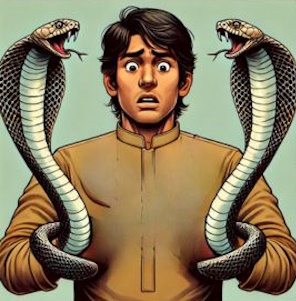
A man sees his own arms in dim light and, instead of recognizing them, imagines they are snakes. Terrified, he flees from what is in fact a harmless part of himself. The error lies not in reality but in his mind’s false conclusion. This tale is used as a metaphor to show how illusions and wrong assumptions cause fear and suffering when clear perception is ignored. It reminds us to rely on direct awareness instead of jumping to baseless inferences.

 
  • The story highlights how people often ignore direct evidence and instead fall for false conclusions, creating unnecessary fear and confusion.

  • Direct perception (pratyaksha) is the most reliable way of knowing, while inference (anumana) is secondary and prone to mistakes if the base idea is wrong.

  • The mind can project illusions that distort reality, like mistaking one's own arms for snakes.

  • Self-deception is a major cause of suffering, as people accept false beliefs about themselves and the world.

  • Mindfulness and clear awareness prevent false judgments and keep emotions steady.

  • Effort and choice, not fate, decide whether one lives wisely or in ignorance.

  • Modern life proves the same: misinformation and fear spread easily when people jump to conclusions without checking facts.

  • Taking responsibility for perception and action empowers people to shape their future instead of blaming destiny.


  • What lesson does the example of mistaking arms for snakes teach?
    It shows how ignoring clear evidence leads to illusions and fear. The man had no reason to panic, but his own misjudgment caused distress. This is how most suffering arises, not from reality itself but from how the mind interprets it.

  • Isn't it possible that people panic first and check later, so the example is unfair?
    The point is not about the instinct to react but about persisting in the wrong view. If he looked carefully, he would have corrected the mistake. The error was clinging to the false idea despite clear evidence in front of him.


  • Why is direct perception valued above inference?
    Because perception shows things as they are, immediately and without layers of assumption. Inference depends on reasoning, which can be flawed if the base facts are wrong. Trusting perception keeps one grounded, while faulty inference can lead to spirals of error.

  • But can't perception also deceive, like mirages or optical tricks?
    Yes, perception has limits, but those errors are usually corrected by closer examination or repeated observation. Inference errors, on the other hand, can persist endlessly if the premises are wrong. Perception remains the most immediate and self-correcting form of knowing.


  • How does this teaching connect to personal growth?
    It reminds us that much of our fear and confusion comes from the mind’s projections. By paying attention to what is real here and now, we avoid being trapped by false assumptions. This builds clarity, confidence, and the courage to face life directly.

  • How can anyone prove that mind projections cause suffering rather than external forces?
    Look at how different people respond to the same situation: one stays calm, another panics. The external trigger is the same, but the inner interpretation differs. That shows suffering is largely shaped by mental filters, not just outer conditions.


  • What does the story suggest about destiny versus effort?
    It shows that destiny is not to blame when errors happen; it is our own failure to use discernment. By making the effort to see clearly and act wisely, we shape our outcomes. Fate does not push us into panic; our misreading of reality does.

  • If destiny is rejected, how do you explain illness or accidents beyond human control?
    They are results of past actions, but even then present effort matters. Two people with the same illness can respond differently—one recovers, another declines. That proves effort in the present can tip the balance even when conditions seem fixed.


  • Why is mindfulness stressed here?
    Because awareness stops the mind from rushing into false conclusions. Staying present allows one to test what is actually happening rather than what fear imagines. This is the shield against self-deception and unnecessary suffering.

  • Isn't mindfulness just another word for paying attention—why dress it up in philosophy?
    Paying attention is exactly the point, but philosophy reminds us it is not trivial. It is the difference between living under illusions and living in clarity. The story dramatizes how neglecting awareness can ruin peace even when danger is absent.

English

English

Yoga Vasishta

Click on any topic to open

0

Copyright © 2026 | Vedadhara | All Rights Reserved. | Designed & Developed by Claps and Whistles
| | | | |
Vedahdara - Personalize

We use cookies