The People’s Prince, The Father’s Joy
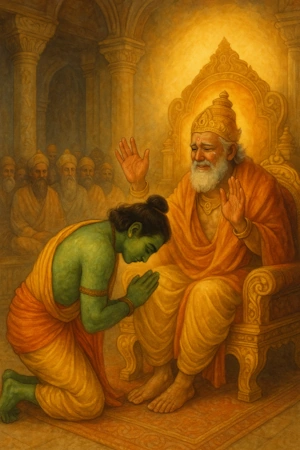
The third sarga from the Ayodhya Kanda of Valmiki Ramayana captures a sacred and historic turning point — the moment when King Dasharatha publicly declares Rama as the Yuvaraja, the Crown Prince of Ayodhya. The verses are not just royal announcements; they are echoes of dharma, devotion, and destiny converging. In this intimate yet grand setting, we witness the king's joy, the people's reverence, and Rama’s divine grace. Every line is soaked in emotion — a father’s pride, a nation’s hope, and the fragrance of Rama’s character. This is not just coronation — it is the world preparing to receive Rama Rajya.
तेषामञ्जलिपद्मानि प्रगृहीतानि सर्वशः |
प्रतिगृह्याब्रवीद्राजा तेभ्यः प्रियहितं वचः || १||
Picture this scene — the court of Ayodhya glows with wisdom and dharma. The Brahmanas, ministers, and noble counselors stand with their hands folded, palms joined like blossomed lotuses — añjali-padma — not just in gesture, but in spirit.
These weren’t empty rituals. These were men offering the flower of their faith, the fragrance of their loyalty, into the hands of their king.
And what did Dasharatha do?
He didn’t just receive their respect. He embraced it.
With eyes softened by affection, voice warmed by gratitude, and heart opened by their unity, the king gave them something back — words that were both sweet and useful, dear and dharmic.
This is the dharma of a true king. He doesn’t just rule — he listens, he honors, and he speaks with love. A ruler who sees his people’s folded hands not as submission, but as sacred trust — such a ruler is worthy of Ayodhya’s golden throne.
And so begins the sacred sequence — not with pomp, but with praṇāma.
अहोऽस्मि परमप्रीतः प्रभावश्चातुलो मम ।
यन्मे ज्येष्ठं प्रियं पुत्रं यौवराज्यस्थमिच्छथ ॥ २॥
Aho! — A cry of the soul, not just a word of speech. A breath soaked in bliss escapes Dasharatha’s chest. The sabha watches — but what stands before them now is not merely a king on a throne. It is a father whose heart has just been touched by a thousand lotuses blooming at once.
He declares —
'I am deeply, immeasurably pleased. Not because I sit on a mighty throne, not because my empire stretches wide, but because today, you — my people, my guides, my dharmic path-makers — have echoed what lives in my soul.'
'You wish that Rama, my eldest, my most cherished son, should ascend as the Yuvaraja. And in that wish... you have brought me my greatest joy.'
This moment crackles with more than joy. It is the roaring river of rājadharma meeting the still lake of pitr̥bhāva. The outer crown meets the inner love. And both point to one name — Rama.
Dasharatha isn’t speaking like a strategist planning succession. He is revealing what the gods themselves have whispered into his heart — that Rama, born of virtue, wrapped in grace, should now be the rising sun of Ayodhya.
इति प्रत्यर्च्य तान्राजा ब्राह्मणानिदमब्रवीत् ।
वसिष्ठं वामदेवं च तेषामेवोपशृण्वताम् ॥ ३॥
Having poured his heart into words that rang with love and dharma, Dasharatha — that jewel among kings — did not stop at emotion. He turned toward action, the next sacred step.
He first pratyarcya — honoured, saluted — the Brahmanas again. Not as a formality, but with reverence, like one offers sandal to the flame before lighting it.
Then, in that court, before the sages and elders still present, his voice found new gravity — not heavy with doubt, but weighty with purpose.
He turned to the two radiant pillars of his royal dharma:
Vasishtha — the Brahmarshi, torchbearer of knowledge.
Vamadeva — the seer of subtle truths, guardian of inner yajna.
And he addressed them — not privately, not secretly — but right there, in the presence of those who had just opened their hearts to him.
Because what was about to unfold was not a private family matter. It was राज्यसंस्कार — a cosmic rite, where divine will would be carried by earthly hands.
Dasharatha, thus, was not merely consulting. He was offering the reins of this moment to those who understood the ṛta, the sacred rhythm behind every crown and command.
The throne would rise only when sages raised their voices.
And so, with firm grace, he began to speak…
चैत्रः श्रीमानयं मासः पुण्यः पुष्पितकाननः |
यौवराज्याय रामस्य सर्वमेवोपकल्प्यताम् || ४||
Now Dasharatha’s voice became the conch that declared destiny.
He turned to the sages, and through them, to dharma itself, and said:
‘This is the month of Chaitra — Shriimaan, sacred and splendid. Look around — the forests are in bloom, the skies are clear, the winds carry fragrance instead of dust. This is no ordinary time. This is ऋतुकाल — the season when even Nature herself dresses up for ceremony.’
Not just a good season — a punya kaala, when every leaf is a witness, and every flower becomes a garland of consent from the devas.
And in such a time, he gave the command, not with pride, but with purpose:
‘Let everything be prepared for the coronation of Rama.’
No hesitation. No waiting for omens or politics. Dasharatha knew — when Time stands with you, when Dharma glows through your son, and when Rasa surges in the people’s hearts, you do not delay.
This was not just a royal ritual. This was a festival of the universe, where Rama would not just be crowned — he would be revealed.
And so began the preparations — not with bricks and banners, but with the scent of sandalwood in the air and joy bubbling in the veins of Ayodhya.
कृतमित्येव चाब्रूताम् अभिगम्य जगत्पतिम् |
यथोक्तवचनं प्रीतौ हर्षयुक्तौ द्विजर्षभौ || ५||
The command had been spoken — not like a ruler’s order, but like a mantra released into the winds.
And the ones who received it?
Vasishtha and Vamadeva — not mere priests, but seers among seers, blazing with inner fire, holding lifetimes of yajnas in their gaze.
They came forward — not with slow feet, but with hearts full of light. They approached Dasharatha, the Jagatpati in his realm — the master of his people, the guardian of the land.
And with eyes gleaming, with their voices like the first notes of a sacred chant, they declared:
‘Kṛtam’ — It is done. So shall it be.
They didn’t question. They didn’t hesitate. Why? Because what Dasharatha had uttered wasn’t just royal will — it was aligned with cosmic rhythm.
And their minds?
Pritau. Harshayuktau.
Full of love. Soaked in joy. These weren’t officials performing duty. These were Rishis rejoicing — because they knew: when Rama ascends, Dharma ascends.
It was as if the very Vedas had nodded in agreement.
This was not a coronation in the making. This was a festival of truth being born in the world of men.
ततः सुमन्त्रं द्युतिमान्राजा वचनमब्रवीत् |
रामः कृतात्मा भवता शीघ्रमानीयताम् इति || ६||
The moment was ripe. The sky of Ayodhya had already begun to glow with the light of Rama’s destiny.
Dasharatha, majestic and luminous — dyutimān, not from jewels but from the radiance of fulfilled longing — turned now to Sumantra, the minister, the one whose counsel had steadied the throne through years of rule.
Sumantra was no mere courier — he was mantrimukhya, the wise and steady flame in the palace, privy to secrets of court and soul.
And to him, Dasharatha spoke. Not with casual ease, but with the weight of sacred urgency:
‘Bring Rama. Quickly.’
But hear how he calls his son —
‘रामः कृतात्मा’ — Rama, the self-mastered one, already complete within.
This is not a prince being summoned to claim something. This is a realization being summoned to its seat.
Dasharatha’s tone is clear — this is not a preparation. This is fulfillment. And Sumantra is to go — not just swiftly, but with the reverence due to a holy act.
For the next footstep of Dharma was not to be taken by soldiers or messengers — but by the wise hands of a minister, who knew what it meant to call Rama, not just as a son, but as the soul of a nation.
स तथेति प्रतिज्ञाय सुमन्त्रो राजशासनात् |
रामं तत्रानयां चक्रे रथेन रथिनां वरम् || ७||
Sumantra — the seasoned minister whose wisdom was sharpened by years of service and loyalty — bowed his head. Not as a servant, but as a sage who understood the gravity of the moment.
'Tathēti pratijñāya' — He vowed. Without hesitation. Without delay.
Dasharatha’s words were not mere instructions — they were राजशासनम्, a sacred royal ordinance rooted in dharma. And Sumantra received it with the care one gives to mantras whispered into sacred fire.
And then…
He called for the ratha — the royal chariot, polished and golden, its wheels made to carry not just bodies, but the weight of fate itself.
Upon it, he set out to bring रामं — रथिनां वरम् — the best among those who ride chariots, but truly, the best among men.
Can you imagine this moment?
The minister is not just going to fetch a prince. He is the chosen link between a kingdom’s anticipation and its fulfillment. The horses begin to stir, their hooves echoing destiny’s rhythm. The reins tighten. Wind gathers. Every eye in the palace turns toward the doorway.
Rama is about to enter the sabha. But more than that — Rama is about to enter the seat of history.
The chariot rolls — not just over earth, but across the hearts of the waiting world.
अथ तत्र समासीनास्तदा दशरथं नृपम् |
प्राच्योदीच्याः प्रतीच्याश्च दाक्षिणात्याश्च भूमिपाः || ८||
The stage was set, not just with flowers and banners, but with the presence of the guardians of Bharatavarsha themselves.
In that radiant sabhā, under the gaze of dharma, were seated kings — rulers from the East (प्राच्याः), from the North (उदीच्याः), from the West (प्रतीच्याः), and from the South (दाक्षिणात्याः).
They had all arrived — not with armies, not with ambition, but with respect carved deep into their hearts, seated in silence, eyes upon Dasharatha.
This was not a court of politics. This was a divine conclave, a mahāsabhā where the four directions themselves bowed to the center — and that center was Ayodhya, and upon its throne, Dasharatha, radiant like the midday sun.
These kings had seen many coronations. But today, they waited for something far greater — the installation of Maryāda-Purushottama. They weren’t just witnessing a new heir being declared; they were about to watch dharma take the throne.
Each of them sat still, like mountain peaks around a blazing sun. Their very presence sanctified the moment — for when noble kings sit before a greater king with humility, it is a sign that the world is ready for a righteous age.
This wasn’t just a capital city. It had become the navel of the world, and the world had come home.
म्लेच्छाश्चार्याश्च ये चान्ये वनशैलान्तवासिनः |
उपासां चक्रिरे सर्वे तं देवा इव वासवम् || ९||
Not just kings, not just nobles — the gathering in Ayodhya had become a mirror of the world itself.
Who else was there?
Mlecchāḥ — those beyond the boundaries of varnāshrama, tribes and peoples outside the pale of the Vedic fold.
Āryāḥ — the noble, the cultured, the scriptural elite.
And others, from the deep forests, from the hidden valleys of mountains, wild in appearance, but drawn by something deeper — the pull of Rama’s dharma that even the winds had begun to carry.
They came — not by compulsion, not for favor — but with devotion trembling in their steps.
And when they arrived at the sabhā?
They upāsāṁ chakrire — they sat in reverence.
Not restless, not speaking, not demanding — just watching, worshipping, silently placing their minds at the feet of Dasharatha, just like the Devas gather around Indra in the heavenly court.
This was no longer a royal event. It had turned into a yajna of unity — where the sacred and the simple, the forest-dweller and the scholar, the king and the tribesman, all sat as one, breathing the same air, sharing the same hope.
For this was not about race. Not about ritual.
This was about Rama — whose very name bridges every divide.
And in this moment, Dasharatha was not just king of Ayodhya — he had become king of hearts, with all beings sitting before him as the devas sit before Vāsava — Indra, awaiting his word, and rejoicing in his radiance.
तेषां मध्ये स राजर्षिर्मरुतामिव वासवः |
प्रासादस्थो रथगतं ददर्शायान्तमात्मजम् || १०||
In the midst of that ocean of kings, sages, tribes, and seekers — he sat, Dasharatha — not just a ruler, but a Rājṛṣi, a sage-king, one whose power had been polished by penance, whose throne rested on truth.
He sat upon his prāsāda — his royal balcony, the high seat of Ayodhya — radiant and still. And how did he appear?
Like Indra among the Maruts.
Yes — just as Indra sits at the center of the storm-gods, resplendent and unshaken, Dasharatha stood as the axis of this assembly, his presence holding the sabhā like a mantra holds a yajna.
But then — a shift in his gaze. His eyes turned outward — and suddenly they softened, brightened, melted.
Why?
Because he saw Rama.
From a distance, coming in a royal chariot, that familiar form approached — but today, it seemed larger than memory.
This was no longer just his son. This was the walking promise of dharma, the one the world was preparing to crown.
And yet, to Dasharatha, in that one heartbeat…
He saw his child — the boy he had cradled, the youth he had trained, the soul who had never once wavered from righteousness.
The rath rolled forward, and time itself seemed to pause, for what the king saw was not just the future of his kingdom —
he saw the shining answer to every prayer he had ever whispered into the winds.
गन्धर्वराजप्रतिमं लोके विख्यातपौरुषम् |
दीर्घबाहुं महासत्त्वं मत्तमातङ्गगामिनम् || ११||
There he came — Rama — the heartbeat of Ayodhya, the embodiment of all that is noble, gentle, and unshakable.
And how did he appear to the world?
गन्धर्वराजप्रतिमं — Like the king of the Gandharvas himself, ethereal, luminous, draped in divine grace, as if music had taken form and stepped into the chariot.
His fame?
लोके विख्यातपौरुषम् — Renowned across the world for his valor, but not the valor of brute strength — this was pāuruṣa born from self-mastery, from compassion with courage, from firmness guided by fairness.
His arms?
दीर्घबाहुं — Long and powerful, the kind of arms that could hold a bow steady or embrace a frightened child with equal ease. Arms that reached not just around the shoulders of men, but deep into their hearts.
His presence?
महासत्त्वं — Great in spirit, vast in soul, a being whose silence could calm storms, whose mere gaze could awaken inner strength in others.
And his gait?
Ah! मत्तमातङ्गगामिनम् — He walked like a majestic, intoxicated elephant — not in carelessness, but in supreme self-assurance. Each step deliberate, each movement drenched in majesty. The kind of stride that made even the earth wait before it shook.
The sabhā didn't just see Rama.
They experienced him — like a monsoon breeze through parched leaves, like a raga that silences the mind.
This was not the entrance of a prince.
This was dharma arriving in flesh and form, with the beauty of the heavens and the weight of the earth, rolled into one radiant soul.
चन्द्रकान्ताननं राममतीव प्रियदर्शनम् |
रूपौदार्यगुणैः पुंसां दृष्टिचित्तापहारिणम् || १२||
Now the eyes of the world rose to his face — and the sabhā forgot to breathe.
रामः — his face like a moonstone, चन्द्रकान्ताननम् — cool, radiant, calming.
Not the burning glow of a harsh sun, but the soft shimmer of the full moon bathing a weary earth. A face that did not command — it consoled.
And yet, in that gentleness, there was something that could not be looked away from.
अतीव प्रियदर्शनम् — Irresistibly beautiful to behold, more than pleasing — his very darshan was nectar to the soul.
But this wasn’t beauty that lingered only in the eyes. No. His form, his face, his entire being — captured hearts, not just glances.
रूप-औदार्य-गुणैः — with his flawless form, his unmatched nobility, and his oceanic virtues,
he became — दृष्टि-चित्त-अपहारिणम् — the one who stole both sight and mind of all who beheld him.
Men, kings, sages, strangers — all sat still, their thoughts plucked from them like leaves from a tree by a sweet storm.
Rama’s presence did not overwhelm. It enveloped.
It did not dazzle the ego — it disarmed it. It reminded every heart of what it longed for, and every eye of what it was born to see.
In that moment, the sabhā disappeared. There was only one face, and it belonged not just to Dasharatha, not just to Ayodhya —
but to the entire universe.
घर्माभितप्ताः पर्जन्यं ह्लादयन्तमिव प्रजाः ।
न ततर्प समायान्तं पश्यमानो नराधिपः ॥ १३॥
Dasharatha sat high upon the prāsāda, but his gaze had descended into a trance — locked upon Rama, his son, his strength, his joy.
And what he felt in that moment?
Just as parched earth, scorched by relentless sun, heaves a sigh when the clouds break...
Just as rain falls upon cracked soil, and even the dust begins to bloom again...
So too, was Dasharatha’s heart relieved and overjoyed by the sight of Rama approaching.
घर्माभितप्ताः प्रजाः पर्जन्यं ह्लादयन्तम् — The people scorched by worldly trials, now felt a cooling bliss as if Rama were that long-awaited raincloud.
But this was not just the people’s emotion — even the king himself, the most majestic among men, was swept up in it.
And then comes the most delicate stroke of truth:
न ततर्प — He could not be satisfied.
Even as Dasharatha kept his eyes on Rama, even as he watched him move step by step toward him, he could not have enough. The eyes wanted more. The soul wanted more.
पश्यमानो नराधिपः — The king kept looking… and looking… and looking… but it was never enough.
Because this wasn’t just a son arriving. This was like truth taking form, hope wearing limbs, dharma riding a chariot.
And when such a sight rises before you — even a father, even a king, even Dasharatha — is left thirsting through love.
अवतार्य सुमन्त्रस्तं राघवं स्यन्दनोत्तमात् ।
पितुः समीपं गच्छन्तं प्राञ्जलिः पृष्ठतोऽन्वगात् ॥ १४॥
And now — the moment of descent. The chariot had carried the flame of dharma to the very steps of the throne. But even flames know when to soften.
Sumantra, the noble minister, wise and seasoned, gently helped Rama alight from the chariot —
अवतार्य राघवम् स्यन्दनोत्तमात् — for even the best of chariots bowed to the worth of the one it carried.
And Rama?
He walked toward his father.
Not like a prince striding to claim his right. No.
He walked like a disciple to his Guru,
like a river approaching the ocean,
like a son who carries mountains of reverence in his chest.
पितुः समीपं गच्छन्तम् — Drawing near to his father, not in pride, but in prayer.
And behind him walked Sumantra, not ahead, not beside — behind, with folded hands, प्राञ्जलिः पृष्ठतः —
following like a shadow of duty behind the glow of truth.
It was a divine procession, yet silent.
No drums. No cheers. Only the sound of humility touching the stones.
Here was the ideal son stepping toward the ideal king,
and the minister walking behind, like time itself witnessing history unfold.
स तं कैलासशृङ्गाभं प्रासादं नरपुङ्गवः ।
आरुरोह नृपं द्रष्टुं सह सूतेन राघवः ॥ १५॥
There it stood — the royal prāsāda, towering, gleaming, dignified — a palace not made merely of stone and ornament,
but of legacy, sacrifice, and dharma.
It shone like the peak of Kailāsa itself — कैलासशृङ्गाभं, not just in height, but in sacredness. For within it sat not just a king — but a father waiting with a full heart, a sage-king whose soul trembled with love.
And to this sanctum walked Rāma, the lion among men — नरपुङ्गवः, strong in body, soft in soul.
He did not rush. He did not hesitate. With every step up those golden stairs, it felt as though the earth itself was being lifted, as though truth was rising to meet grace.
And with him was Sumantra — the trusted minister, silent and steady, still following, still honoring, still witnessing.
आरुरोह नरपुङ्गवः — The best among men ascended. But it was no mere physical ascent —
it was the rising of a moment toward the eternal.
He wasn’t just entering a palace.
He was entering the heart of his father, the throne of his lineage, and the soul of Ayodhyā itself.
This was not just a meeting.
This was a mahāmilana — where Pitr̥bhakti, Rajadharma, and Lokakalyāṇa all merged into one quiet, glowing moment.
स प्राञ्जलिरभिप्रेत्य प्रणतः पितुरन्तिके ।
नाम स्वं श्रावयन्रामो ववन्दे चरणौ पितुः ॥ १६॥
The stairs ended, the hall opened, and there he stood — Rāma, before his father, the lamp before its flame, the wave before its ocean.
He approached with folded hands — प्राञ्जलिः — not just a gesture of formality, but of fullness.
Hands that had strung bows and blessed sages now curled in humility.
Abhipretya — he moved with purpose, with eagerness born not from ambition, but from love.
He came close — but did not rush into embrace.
He bowed — प्रणतः — his back bent, his heart open, his breath stilled.
And then, like a whisper soaked in honey, he spoke:
‘Rāma.’
That’s all. He announced his name — नाम स्वं श्रावयन् — not as an identity, but as an offering.
Imagine this:
A prince standing in royal attire, with the world waiting, says simply — ‘I am Rāma’ —
as if saying, ‘I am yours, Father. I am yours, Ayodhyā.’
And then — that moment of sacred surrender:
ववन्दे चरणौ पितुः — He bowed to his father’s feet.
Not to the throne.
Not to the crown.
But to the feet of the man who had given him life, who had guided his dharma,
and who now sat, not as a king — but as a father about to weep.
It was in that touch — forehead to foot — that Rāma declared his allegiance, not to power, but to love.
तं दृष्ट्वा प्रणतं पार्श्वे कृताञ्जलिपुटं नृपः ।
गृह्याञ्जलौ समाकृष्य सस्वजे प्रियमात्मजम् ॥ १७॥
And then came the moment no eyes could remain dry.
Dasharatha, the sovereign of Kosala, the lion among kings, looked to his side —
and what did he see?
Not a warrior.
Not a prince.
Not a successor.
He saw his son, his Rāma, standing beside him — head bowed, hands folded like a lotus held in the breeze, कृताञ्जलिपुटं, glowing with reverence.
That sight pierced him — not like a sword, but like a father’s heart breaking open with love.
He could not sit still. He could not speak.
He reached forward with trembling hands and did what only a father intoxicated with affection could do:
गृह्याञ्जलौ समाकृष्य — He took those folded hands, not gently, but drew them toward himself, with the force of longing long-held.
Not as a king commands, but as a father pulls his very heartbeat into his chest.
And then — he embraced him.
सस्वजे प्रियमात्मजम् — He pressed Rama to his bosom.
There were no words.
Just the press of love,
the weight of tears unshed,
the silent roar of a father who knew —
‘This child is my pride, my joy, my strength, my peace, my very soul walking outside my body.’
That embrace —
it was not two bodies meeting.
It was the very fusion of blood and dharma, of rājyam and rīti, of love and lineage.
तस्मै चाभ्युद्यतं श्रीमान्मणिकाञ्चनभूषितम् ।
दिदेश राजा रुचिरं रामाय परमासनम् ॥ १८॥
The embrace had passed — but the fragrance of that moment still hung in the air, like sandal after the flame.
Now Dasharatha, the king once more, rose with grace in his limbs and majesty in his gaze. He had held his son as a father — now he would honor him as the future king.
And so he lifted his hand — not merely as a host, but as a rājadhirāja, offering not a seat, but a symbol of destiny.
दिदेश रामाय परमासनम् — He offered to Rāma the paramāsana — the supreme seat (not Dasharatha’s throne)
This was no ordinary throne.
It was अभ्युद्यतं — exalted, shining forth, glowing as though it had risen up in welcome, as though even the seat knew who was coming.
श्रीमान् — full of auspicious energy, steeped in prosperity.
मणिकाञ्चनभूषितम् — adorned with gold and gems, but dim in comparison to the one about to grace it.
It glittered, yes — but not with mere ornament.
It sparkled because it anticipated the weight of Rāma’s virtue, the purity of his presence.
Dasharatha did not speak many words — he gestured, and in that gesture, the entire sabhā felt it:
‘This is no longer a prince. This is Ayodhyā’s anchor. This is dharma’s throne-bearer.’
Even the throne, it seemed, sighed with joy, for at last it would hold one who would honor it not with power, but with restraint.
तेन विभ्राजिता तत्र सा सभाभिव्यरोचत ।
विमलग्रहनक्षत्रा शारदी द्यौरिवेन्दुना ॥ २०॥
And the moment Rāma sat, the sabhā was no longer just a royal hall —
it became a divine kṣetra, an altar bathed in golden stillness.
तेन विभ्राजिता तत्र — With Rāma's radiance filling the space,
सा सभा अभिव्यरोचत — the entire assembly began to glow.
Not metaphorically.
Actually.
Visibly.
Palpably.
It was like someone had lit a thousand lamps — but without a single flame.
Like truth had become visible — not just spoken of in scriptures, but seated right there, breathing, smiling.
How did it feel?
विमलग्रहनक्षत्रा शारदी द्यौः इव इन्दुना
Like the clear autumn sky, washed clean by rain, where the moon has risen — full, unblemished, and surrounded by silent stars.
No clouds. No shadow.
Just luminosity without noise, majesty without weight.
This was not just Rama on a throne.
This was a kingdom seeing its future.
This was the heavens remembering their promise.
This was the moon rising not to rule the sky — but to comfort it.
तं पश्यमानो नृपतिस्तुतोष प्रियमात्मजम् ।
अलङ्कृतमिवात्मानमादर्शतलसंस्थितम् ॥ २१॥
Dasharatha sat still — yet waves rose in his heart, waves not of pride, but of peace so deep it quieted even time.
He looked upon Rāma, seated upon the throne, regal yet humble, glowing yet grounded, and his soul whispered a single truth:
'I am fulfilled.'
तं प्रियमात्मजम् पश्यमानः तुतोष नृपतिः —
The king, beholding his beloved son, was filled — not with pride, not with ambition, but with santosha, deep soul-satisfaction.
No garland, no gold, no conquest had ever touched him like this.
Because Rāma was not just his son — he was his reflection, purified and perfected.
अलङ्कृतम् इव आत्मानम् — It felt as though he were looking at his own self, adorned, uplifted, transcended.
आदर्शतलसंस्थितम् — as though he saw his soul seated upon a mirror’s surface, flawless and shining.
Rāma was not just going to inherit his throne.
He will be inheritin his essence, his śraddhā, his śakti — and refined it into something the world could now look up to.
In that moment, Dasharatha was no longer just a father or a king.
He became a witness — of legacy fulfilled, of love crowned, of dharma manifested.
स तं सस्मितमाभाष्य पुत्रं पुत्रवतां वरः ।
उवाचेदं वचो राजा देवेन्द्रमिव कश्यपः ॥ २२॥
And then —
Dasharatha spoke.
But first, a smile.
सस्मितम् — not wide, not loud — a soft, glowing smile that rose like morning light through mist.
A smile that said everything before words even began.
He looked at Rāma, who sat like a blooming lotus upon the throne, and addressed him — not as a ruler to heir, not even as teacher to disciple — but as father to son.
Putraṁ, putravatāṁ varaḥ — The best among sons spoke to the best of sons.
That’s what Dasharatha had become — not just a king, not just a proud parent —
but the ideal among fathers, now offering words soaked in wisdom and soaked in love.
And how did he speak?
Like Kaśyapa spoke to Indra —
Calm, composed, glowing with the dignity of the ages, and echoing with cosmic sanction.
He didn’t just bless.
He passed the torch of time itself.
This wasn’t just a conversation.
This was a śruti being uttered — where lineage, legacy, and light braided themselves into a father’s voice.
Rāma, seated. Dasharatha, speaking.
The sabhā, silent.
He was about to say the words that would anoint, not just install.
ज्येष्ठायामसि मे पत्न्यां सदृश्यां सदृशः सुतः ।
उत्पन्नस्त्वं गुणश्रेष्ठो मम रामात्मजः प्रियः ॥ २३॥
Now the stream of the king’s heart began to pour, one syllable at a time — warm, weighty, and woven with love.
Dasharatha looked at Rāma — not as a ruler views his successor, but as a soul speaks to its very reflection, and said:
‘You were born of my eldest queen — my Kausalyā — whose nobility equals my own. And from that sacred womb came you — not merely as a son, but as my mirror in every way.’
ज्येष्ठायामसि मे पत्न्यां — you are the first son, born of my first queen.
सदृश्यां सदृशः सुतः — she matches me in dharma, and you match us both in every virtue.
In those words, Dasharatha isn’t recounting genealogy.
He’s laying the foundation of legitimacy — divine, moral, emotional.
And then he says the truth his heart has always known:
उत्पन्नस्त्वं गुणश्रेष्ठः — Of all sons, of all princes, of all men, you are the highest in character.
Not just in birth — in virtue.
मम राम आत्मजः प्रियः — You are my beloved, Rāma. My own soul in human form.
Not just putra, but ātmāja — born of my spirit, carved from my inner being.
This was not the voice of power.
It was the voice of fulfillment — a father seeing in his son not just hope, but harmony. Not just promise, but perfection.
त्वया यतः प्रजाश्चेमाः स्वगुणैरनुरञ्जिताः ।
तस्मात्त्वं पुष्ययोगेन यौवराज्यमवाप्नुहि ॥ २४॥
Now Dasharatha's voice rose — not with pride, but with the gravity of dharma. The father had spoken; now the sovereign declared.
He turned to Rāma, whose very presence had stilled the hearts of kings and sages alike, and said:
‘O Rāma, the people — these citizens of Ayodhyā — they love you. But not because you are my son. Not because you are heir.’
‘They love you because you have won them — not with bribes, not with commands — but with your guṇa, your inner light, your natural virtue.’
त्वया यतः प्रजाः अनुरञ्जिताः — You have delighted and comforted the people, not by effort, but by simply being who you are.
They see you, and their fears melt. They hear you, and their hopes bloom.
And because of that, Dasharatha now speaks the words the world was waiting to hear:
‘Tasmāt — therefore…’
‘Pushya-yogena — on that most auspicious day when the stars smile upon kingship…’
‘Yauvarājyam avāpnuhi — receive the office of Crown Prince.’
This wasn’t just a coronation being announced.
This was Rāma Rajya itself being birthed, sealed by love, sanctioned by stars, and deserved by virtue.
Dasharatha wasn’t giving away his kingdom.
He was placing it in the hands of one who had already won it — not with might, but with the melody of his nature.
The people had chosen. Dharma had agreed. Now the king had spoken.
कामतस्त्वं प्रकृत्यैव विनीतो गुणवानसि ।
गुणवत्यपि तु स्नेहात्पुत्र वक्ष्यामि ते हितम् ॥ २५॥
And now—just as the garland rests on the neck, the crown ready for the head—Dasharatha, that ocean of wisdom and affection, does not step away.
He draws closer.
His voice softens again, as the father rises above the king:
‘Rāma, you are already perfect. You were born virtuous. You are naturally humble. You don’t need to be taught how to behave — it flows from your very breath.’
कामतः त्वं विनीतः — Not trained by fear, but molded by love.
प्रकृत्यैव गुणवान् — Not decorated by values, but formed from them.
And yet… listen to the tender crack in his voice, the shimmer of fatherly concern:
‘Still… though you are full of virtue, though you are radiant like dharma itself — I am your father, and out of love, I wish to offer you something…’
गुणवत्यपि तु स्नेहात् पुत्र वक्ष्यामि ते हितम् —
Because I love you, dear son, I will speak… not to correct, but to care.
This is not instruction.
This is śiṣṭopadeśa — wisdom given like sandal on the forehead: cooling, fragrant, and unforgettable.
Because even when dharma sits on the throne, a father’s love still wishes to hold his son’s hand.
भूयो विनयमास्थाय भव नित्यं जितेन्द्रियः ।
कामक्रोधसमुत्थानि त्यजेथा व्यसनानि च ॥ २६॥
And now, like a stringing of pearls, Dasharatha threads the wisdom that only a father, who has seen the tides of power and the whirlpools of temptation, can give to a son ascending the throne.
‘Rāma… though your heart is already dipped in humility, let it remain so — always.’
भूयः विनयम् आस्थाय — Take shelter again and again in humility.
Even when the crown rests on your brow and the whole world bows to you, let your heart still bow to dharma.
भव नित्यं जितेन्द्रियः — Be always one who has conquered his senses.
He doesn’t say 'rule others' — he says 'rule yourself'.
For Dasharatha knows:
A king who conquers lands but not his indriyas is a danger to his people.
But a king who has mastery over desire and impulse — he rules not just a kingdom, he rules time.
Then, his voice turns serious — like a father who knows the shadows that lurk behind the throne:
कामक्रोधसमुत्थानि त्यजेथाः व्यसनानि च —
Abandon completely those disasters that rise from lust and anger.
For they are not emotions — they are thieves.
They do not knock — they barge in and steal clarity, steal dharma, steal peace.
Dasharatha isn't warning out of fear. He is offering protection through wisdom.
These are the chains even kings wear — unless they are broken by inner strength.
In this verse, he doesn’t hand Rāma the throne.
He hands him the shield to protect it.
परोक्षया वर्तमानो वृत्त्या प्रत्यक्षया तथा ।
अमात्यप्रभृतीः सर्वाः प्रकृतीश्चानुरञ्जय ॥ २७॥
Now Dasharatha turns his son’s gaze — not inward, but outward.
From the throne, he now draws Rāma's vision toward the world he must nurture —
ministers, advisors, commanders, counselors, and above all — the people.
He says:
‘O Rāma, rule with presence, but also with perception. Rule by being seen — and by being unseen.’
परोक्षया वृत्त्या... प्रत्यक्षया वृत्त्या —
Live in such a way that even when you are not visible, your virtue is felt.
And when you are present, your conduct teaches louder than your commands.
A king is not just his speeches, not just his decrees.
He is in every silence, in every gesture, in how he treats the smallest and listens to the quietest.
अमात्यप्रभृतीः सर्वाः — From your chief ministers to the smallest scribe,
प्रकृतीः च — all those who form your kingdom’s foundation —
Win their hearts.
Not through fear.
Not through flattery.
अनुरञ्जय — Win them over by your nobility, your steadfastness, your fairness, your compassion.
A kingdom is not governed by iron and law alone.
It is governed by trust, and trust is built by how a ruler walks through the palace when no one is watching.
In this one verse, Dasharatha hands Rāma the key to Ayodhyā’s soul:
'Be the kind of king who is followed not out of obligation — but out of love.'
तुष्टानुरक्तप्रकृतिर्यः पालयति मेदिनीम् ।
तस्य नन्दन्ति मित्राणि लब्ध्वामृतमिवामराः ।
तस्मात्पुत्र त्वमात्मानं नियम्यैव समाचर ॥ २८॥
And now — the essence of kingship.
Dasharatha does not hand Rāma a throne.
He hands him a path, carved not with gold, but with śānti, sneha, and self-mastery.
He says:
‘That king… that rare jewel among men… whose people are happy and devoted — who rules over a nation that smiles when it hears his name — he is the one who truly protects the earth.’
तुष्टानुरक्तप्रकृतिः — A ruler whose subjects are content and deeply attached to him, not from fear, but from love.
Such a king doesn’t just hold power — he uplifts the world.
And what does he receive in return?
तस्य नन्दन्ति मित्राणि — His friends rejoice in him.
Like the Devas rejoicing when they receive amṛta — nectar from the heavens.
लब्ध्वा अमृतम् इव अमराः — His well-wishers, allies, even enemies, are uplifted in his presence,
because his rule is nourishing, not draining; healing, not oppressive.
And now, Dasharatha places the golden seal:
‘Therefore, my son…’
तस्मात् पुत्र — Because this is true…
त्वम् आत्मानं नियम्य — You must restrain, govern, and refine yourself continually.
समाचर — and then act from that foundation of inner balance.
This is the final mantra:
A king’s greatest power is not his army, nor his treasury — but his ability to rule himself.
When the soul is steady,
the sceptre becomes light.
When the heart is clean,
the world bends willingly.
In this verse, Dasharatha passes to Rāma not just a kingdom —
but the very dharma that will make him eternal.
तच्छ्रुत्वा सुहृदस्तस्य रामस्य प्रियकारिणः ।
त्वरिताः शीघ्रमभ्येत्य कौसल्यायै न्यवेदयन् ॥ २९॥
Divya Rasa Vachanam:
The words of Dasharatha had been like a divine bell ringing in the heart of Ayodhyā —
but it was not just kings and sages who heard them.
There were others, standing silently in the wings of the sabhā —
Rāma’s suhr̥daḥ, his true companions, his silent well-wishers.
Those who loved him not because he was a prince,
but because they had seen his soul shine quietly — day after day, moment after moment.
रामस्य प्रियकारिणः — those who lived only to do good to Rāma,
those whose hearts leapt with his joy, and whose eyes moistened when he merely smiled.
And when they heard the declaration — that Rāma would be Yuvarāja,
they did not shout or dance or cheer. No.
They moved — त्वरिताः शीघ्रमभ्येत्य —
with haste that was not chaotic, but sacred.
Like devotees running to light lamps the moment the temple bell rings.
Where did they go?
कौसल्यायै न्यवेदयन् —
To her. To the mother.
To Kausalyā, the one whose womb bore Rāma,
whose prayers had been whispers wrapped in tears,
whose hopes had always sat quietly behind her son’s shadow.
They came to her not with gossip, not with news — but with sacred tidings.
They didn’t just inform — they offered.
Offered her the fruit of her penance, the blossom of her sacrifice.
This was not a message.
It was the first wave of joy crashing at a mother’s feet,
saying — ‘Your Rāma has risen. The world now sees what you always knew.’
सा हिरण्यं च गाश्चैव रत्नानि विविधानि च ।
व्यादिदेश प्रियाख्येभ्यः कौसल्या प्रमदोत्तमा ॥ ३०॥
And when those sacred words reached her ears —
not as courtly proclamation, but as the music of destiny,
Kausalyā, the radiant queen, the prominent jewel among women — प्रमदोत्तमा,
felt her heart rise like a lotus breaking the surface of still waters.
This was not a moment of surprise.
She had known all along.
Not through astrology, not through ambition —
but through a mother’s intuition, shaped by years of quiet watching.
Now, as joy rushed through her like the first monsoon rain over parched soil,
she did what only a noble mother would do:
साभिरण्यं च गाः चैव — She gave away gold and cows, symbols of wealth and abundance.
रत्नानि विविधानि च — and precious jewels, each carrying the sparkle of her overflowing heart.
She gave them not to the powerful.
Not to the important.
But to those called प्रियाख्येभ्यः — those dear to her, those who rejoiced with her,
those whose hearts beat in rhythm with hers for Rāma.
This was not distribution.
This was celebration as offering,
joy turned into charity,
a mother’s ecstasy expressed through selfless giving.
Kausalyā, who had borne Rāma in silence, now let her gratitude blossom — not in words, but in gifts flowing from love.
The queen gave not because she had to —
but because her soul needed to express its dance.
अथाभिवाद्य राजानं रथमारुह्य राघवः ।
ययौ स्वं द्युतिमद्वेश्म जनौघैः प्रतिपूजितः ॥ ३१॥
And then — the sabhā exhaled. The moment had passed, but its glow lingered in the very air.
Rāma, that gentle flame of righteousness,
having bowed low at his father’s feet — अभिवाद्य राजानं,
rose, turned, and moved with his signature grace.
He did not linger to bask in applause. He did not stay to hear praises.
He walked away with the quiet dignity of one who had not come to take, but to serve.
रथमारुह्य राघवः — He ascended his chariot, as the Raghava, heir not just to the throne, but to a lineage of light.
And as the wheels began to roll…
ययौ स्वं द्युतिमद्वेश्म — He returned to his radiant dwelling,
not as a man returning home —
but as a sacred river flowing back to its source, now carrying the blessings of an entire kingdom.
And what of the people?
जनौघैः प्रतिपूजितः —
He was worshipped by crowds — not with ritual, not with chants —
but with eyes, with tears, with folded hands, with smiles that stretched like sunrise.
They didn’t shout his name — they whispered it in awe.
Children were lifted to glimpse him. Elders wept silently.
The streets of Ayodhyā had become a temple,
and Rāma — not yet crowned — was already their deity in motion.
He had left as a prince.
He returned as the soul of Ayodhyā.
ते चापि पौरा नृपतेर्वचस्तच्
श्रुत्वा तदा लाभमिवेष्टमाप्य ।
नरेन्द्रमामन्त्य गृहाणि गत्वा
देवान्समानर्चुरतीव हृष्टाः ॥ ३२॥
And now — the wave of joy that began in the sabhā rose and spilled out into the streets, into the courtyards, into every breath drawn in Ayodhyā.
ते चापि पौरा — The citizens, the men and women of Ayodhyā,
those who had listened from behind the pillars,
those who had stood on tiptoe just to hear a word —
heard Dasharatha’s declaration, and what happened?
श्रुत्वा तदा लाभमिव इष्टम् आप्य —
They felt as though they had attained the greatest gain, the fulfillment of their deepest wish.
As if someone had given form to their longing, as if the gods had whispered, ‘Yes.’
They didn’t riot with celebration.
They didn’t break into frenzy.
They simply did what hearts full of real happiness always do:
नरेन्द्रम् आमन्त्य —
They offered their salutations to the king, not just out of duty — but with gratitude that their king had heard their hearts.
And then, they returned home —
गृहाणि गत्वा — to their homes, now filled with light.
But they didn’t stop there.
देवान् समानर्चुः अतीव हृष्टाः —
They worshipped the gods — joyfully, fervently, tearfully.
Not asking for more.
But thanking them for what had already come:
A future shaped like Rāma.
A kingdom anchored in virtue.
A day when love, dharma, and leadership had all worn the same name.
This was not just political news.
This was a spiritual event —
where Rāma had risen, and with him, Ayodhyā’s very soul had bloomed.
This passage from the Ayodhyā Kāṇḍa is not just the story of a coronation — it is the rising of Rāma Rajya, the rule of righteousness itself. We witness the perfect union of love and law, of father and son, of king and citizen. Dasharatha does not merely crown a successor — he offers the throne to character, to humility, to inner mastery. Rāma, with folded hands and lowered gaze, ascends not just a seat but the hearts of all. This moment marks the height of Ayodhyā’s glory — where dharma is not spoken of, but enthroned.





English
Ramayana
Click on any topic to open
7
30
Astrology
Bhagavad Gita
Bhagavatam
Bharat Matha
Devi
Devi Mahatmyam
Ganapathy
Garuda Puranam
Glory of Venkatesha
Hanuman
Kathopanishad
Mahabharatam
Mantra Shastra
Mystique
Practical Wisdom
Purana Stories
Radhe Radhe
Ramayana
Rare Topics
Rigveda Explained
Rituals
Sages and Saints
Shiva
Spiritual books
Sri Suktam
Story of Sri Yantra
Temples
Vedas
Vishnu Sahasranama
Yoga Vasishta
26
17
10
0


