The Night Before the Crown
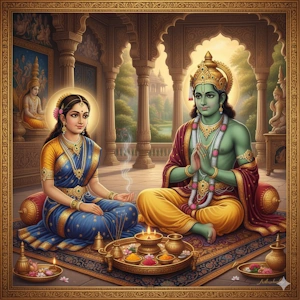
In the 5th Sarga of Ayodhya Kanda, the city prepares for joy, but time prepares for something else. Dasharatha sets the coronation in motion. Vasistha performs the sacred rites. Rama begins his vow with Sita. Ayodhya glows, unaware. Beneath the chants and garlands, destiny tightens its grip — silent, swift, and unseen.
Dasharatha’s heart, now lightened by resolve, turned to sacred order.
He spoke to Vasishta with care:
'The coronation is at dawn tomorrow — let all be prepared.
Let Rama be made ready.'
'O sage of blazing penance,' Dasharatha said,
'Let Rama enter sacred restraint this very day —
a fast, a vow, with Sita beside him.
For blessings to crown the crown,
let dharma guide his night.'
Vasistha agreed.
He, the seer of the Vedas,
rose without delay.
Not through a servant, not through a messenger —
he himself set out to Rama’s door.
To initiate Rama, the knower of mantras,
into the sacred fast —
Vasistha mounted a chariot fit for gods,
his vows strong, his purpose clear,
his presence like Agni cloaked in calm.
The sage arrived at Rama’s palace —
white as moonlit clouds, majestic like a silent thunderhead.
Crossing three grand enclosures in his chariot,
he entered — not like a guest,
but like dharma itself coming home.
Rama heard that the great sage had arrived.
He rose at once — swift, yet filled with reverence.
A noble guest had come, but more than that —
dharma, in human form, stood at his gates.
He stepped out with eagerness, hands folded,
to welcome one worthy of worship.
He approached Vasistha’s chariot — not with pride, but with purpose.
And with his own hands, like a son to a father,
he helped the sage descend.
There was no pomp, no display —
just sacred affection in action.
Vasistha saw Rama, humility glowing from his eyes.
He smiled, spoke kindly,
blessed him with warmth that felt like sunlight.
And then, with words sweet and sacred,
he said — 'O Rama...'
'Your father’s heart is full, O Rama.
He is joyful beyond measure,
for tomorrow, you shall receive the kingdom.
But tonight, observe the sacred vow.
Fast with Sita by your side.
Let purity be your first ornament.'
'At sunrise, you shall be crowned Yuvaraja.
Your father, like King Nahusha of old,
gifts you this throne — not as duty,
but as delight.
Such is the joy in Dasharatha’s heart,
as he places the world in your hands.'
Having spoken the king’s command, Vasistha began the sacred rite.
With Sita beside him, Rama entered the vrata —
pure in body, still in mind.
The fast wasn’t just ritual — it was a quiet embrace of dharma.
With mantras echoing softly,
the prince and princess stepped into sanctity together.
Rama, ever humble, worshipped the sage with flawless devotion.
Vasistha, pleased by such grace,
blessed him, gave leave, and departed.
It felt as if light was bidding farewell to fire.
Then Rama, ever gentle, sat among his friends —
those who spoke with love, laughed without malice.
He honoured them all before retiring.
Grace was not just in his words —
it moved in his every gesture.
Rama’s palace bloomed with joy.
Men and women filled it, eyes lit with delight.
It shone like a lotus-lake in spring —
with buzzing swans and open petals,
each heart intoxicated with devotion.
As Vasistha stepped out from Rama’s radiant home,
he beheld the streets —
thick with people, throbbing with joy.
Like a river swelling toward the ocean,
Ayodhya surged forward —
its people drawn by love, not command.
Every royal road in Ayodhya overflowed with eager hearts.
Not one or two — but waves and waves of people,
gathered in tight throngs,
each face lifted with wonder.
It was not a crowd — it was a celebration waiting to happen.
The sound of the streets was no less than a sea.
Laughter, whispers, joyous cries — all merged
like wave upon wave crashing in harmony.
Ayodhya’s heart roared gently that day —
not with force, but with festive rhythm.
Streets glistened with water and sandalwood.
Garlands hung from door to door like nature’s blessings.
Banners danced on rooftops,
and Ayodhya stood not like a city —
but like a bride, adorned for divine union.
Men, women, children — all eyes looked east.
Not just at the sky, but at time itself.
As if they wished to pull the sun upward faster —
just so they could see Rama crowned.
The people’s longing was the city's breath.
That day, the people were Ayodhya’s finest ornament.
More than jewels, more than silks —
their joy lit the city.
Every heart was restless — not with fear,
but with eagerness to witness
the great coronation-festival of Rama.
Through streets packed like ripened fields,
Vasistha moved — not hastily,
but with the calm majesty of a river cutting through crowds.
People parted as if dharma itself was walking.
Slowly, gently, the royal priest made his way
to the palace — heart of the kingdom.
The palace stood high, like the white peak of a heavenly cloud.
Climbing its steps with quiet authority,
Vasistha entered the royal court.
Like Brihaspati approaching Indra,
the guru met the king —
not with formality, but with timeless reverence.
The king saw him and at once stood.
Dasharatha left his throne — not out of custom,
but from the overflow of respect.
He asked, 'Is it done?'
And Vasistha, like fire answering its spark, said, 'Yes. All is prepared.'
With Vasistha’s nod, Dasharatha stepped away from the court.
He left the noise and the praise behind.
Like a lion returning to its mountain cave,
the king entered his inner chambers —
his face calm, but a storm yet unknown
waiting behind the silence.
The king entered the palace —
where noble women adorned in finery moved like living grace,
where silks shimmered and lamps glowed.
That residence, gleaming like Indra’s own abode,
stood not as a house, but as a heaven on earth.
Dasharatha stepped in — radiant, composed —
like the moon rising into a sky full of stars,
lighting the space not with fire,
but with serene majesty.
- Dharma before glory:
Dasharatha doesn’t rush Rama to the throne. He insists on upavasa, self-discipline, and sacred preparation. The message is clear — even joy must be sanctified through restraint. No greatness without inner readiness. - Leadership is service:
Rama, the heir to the throne, personally receives the sage, bows, assists him down, and observes the vrata. He acts not like a ruler, but like a servant of dharma. A true leader walks low before walking high. - Honor flows from character, not titles:
Vasistha is honored not because of his position, but because of who he is. The entire sabha rises for him — showing that character earns reverence, not power. - Fate is not always visible:
Everything looks perfect — yet the reader senses a hidden twist approaching. The sarga teaches us to stay humble even in success. Destiny can turn when we least expect it.
As the rites conclude and the city swells with celebration, everything appears perfect. Rama is ready, the people rejoice, and the palace dazzles like heaven. Yet beneath this harmony, a shadow gathers. The king walks into silence. The crown waits. And fate, though still unseen, is already at the gate.
- Why does King Dasharatha insist that Rama observe a fast and sacred restraint instead of simply celebrating the night before his coronation?
Dasharatha understands that worldly power must be rooted in spiritual discipline. By ordering the upavasa or sacred fast, he ensures that Rama approaches the throne not with a sense of entitlement or ego, but with a purified mind and body. This principle teaches that before one can rule others, one must first demonstrate total mastery over oneself. The restraint is a bridge between the mortal desire for status and the divine responsibility of dharma. - What is the significance of the Sage Vasistha choosing to go to Rama’s palace personally rather than sending a messenger?
Vasistha’s personal journey highlights the weight of the moment and the humility inherent in true wisdom. Despite being the royal preceptor, he does not stand on ceremony. His direct involvement signifies that the spiritual initiation of a leader is a task so sacred it cannot be delegated. It also mirrors the mutual respect between knowledge and power; the King’s authority honors the Sage’s wisdom by seeking it, and the Sage honors the future King’s character by delivering the initiation in person. - How does Rama’s physical reception of Vasistha redefine the traditional concept of a royal heir?
Rama does not wait for Vasistha to enter his chambers; he rushes to the gate and manually assists the sage down from the chariot. This act reveals that Rama’s greatness lies in his role as a son and a disciple first. It suggests that a true leader is never too high to serve those who guide him. His "noble haste" shows that his devotion to dharma is more instinctive than his awareness of his own upcoming majesty. - Vasistha’s presence is described as being like Agni (fire) cloaked in calm. What does this metaphor tell us about the nature of a spiritual guide?
Agni represents the transformative power of truth and ritual. By describing Vasistha this way, the text suggests that while the sage appears peaceful and silent, he carries the intense, purifying energy of the Vedas. This "cloaked fire" is what ignites the sanctity of the coronation. It reminds us that the most powerful influences in a kingdom are often those that are the most composed and self-controlled. - What is the hidden meaning behind the city of Ayodhya being compared to a bride adorned for a union?
The metaphor of the bride suggests that the relationship between a city and its ruler is one of sacred love and commitment, not just administration. Ayodhya is "marrying" its future, and its beauty is an external expression of its internal hope. However, there is a haunting quality to this image; just as a bride faces a total transformation of her life, Ayodhya is on the verge of a massive, unforeseen shift in its destiny. - Why does the text emphasize that Sita must fast alongside Rama during the night of restraint?
This highlights the concept of Sahadharmachari, where the husband and wife are seen as a single spiritual unit. Sita’s participation indicates that the burden and the blessing of the throne are shared. Her presence in the vow signifies that the leadership of Ayodhya is not just a masculine endeavor of power, but a balanced union of grace and strength. It reinforces that dharma is most stable when supported by a partnership of equal devotion. - In the midst of the immense joy, the text mentions that destiny is tightening its grip. What does this suggest about the relationship between human effort and fate?
It illustrates the "Kala" or the invisible hand of Time. While Dasharatha, Vasistha, and Rama perform every rite perfectly according to the law, a separate, cosmic momentum is already moving in the opposite direction. This teaches the reader that even the most righteous actions are subject to a higher, often mysterious, cosmic order. Success in dharma is not measured by the outcome, but by the purity of the preparation. - What is the psychological significance of Dasharatha leaving the public court to enter his inner chambers like a lion returning to a cave?
The "lion" imagery suggests that Dasharatha has fulfilled his ultimate duty as a protector by securing the succession. His retreat into the inner chambers marks the transition from the King (the public figure) back to the man (the father). It is a moment of profound relief and perceived victory. Ironically, this inner chamber, which he enters for peace, is exactly where the shadow of his past promises will soon catch up to him. - How does the reaction of the citizens of Ayodhya serve as a critique of modern leadership?
The citizens do not gather because they are commanded to, but because they are "drawn by love." The text notes that the city "roared gently," suggesting a collective heartbeat of genuine affection. This implies that true authority is not maintained through fear or propaganda, but through the cultivation of a character that makes the people feel like their ruler’s joy is their own. The people’s restlessness to see the sun rise is a testament to Rama’s pre-existing merit. - What is the "overlooked" spiritual lesson in Rama spending his final night as a commoner in prayer rather than in a feast?
The hidden lesson is the value of "Sandhya" or the transition period. Most people focus on the destination (the crown), but the Sarga focuses on the eve (the preparation). It suggests that the "night before" a great life event is the true test of character. By choosing silence, prayer, and fasting, Rama honors the weight of the responsibility he is about to inherit. It teaches us that to receive a great gift from the world, one must first offer a sacrifice of the senses to the divine.





English
Ramayana
Click on any topic to open
7
30
Astrology
Bhagavad Gita
Bhagavatam
Bharat Matha
Devi
Devi Mahatmyam
Ganapathy
Garuda Puranam
Glory of Venkatesha
Hanuman
Kathopanishad
Mahabharatam
Mantra Shastra
Mystique
Practical Wisdom
Purana Stories
Radhe Radhe
Ramayana
Rare Topics
Rigveda Explained
Rituals
Sages and Saints
Shiva
Spiritual books
Sri Suktam
Story of Sri Yantra
Temples
Vedas
Vishnu Sahasranama
Yoga Vasishta
26
17
10
0


