The Most Misread Demon in the Puranas
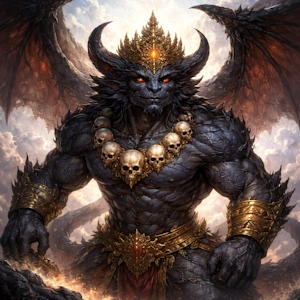
In the Rigveda, Vritra appears as a great demon, a serpent or dragon who blocked all the rivers of the world. Indra, king of the gods, slew him with his thunderbolt weapon, the Vajra. The rivers were released, life returned to Earth. On the surface it looks like a simple good-vs-evil story.
But the Puranas and the Mahabharata go much deeper.
The shocking backstory
In the Shanti Parva of the Mahabharata and in the Bhagavata Purana, Vritra is revealed to be Chitraketu — a great king and devout sage who had attained enormous spiritual power.
Chitraketu once encountered the goddess Parvati and Shiva together, and made an offhand remark that could be read as disrespectful. Parvati cursed him to be born as a demon. He accepted the curse without anger, which itself showed the depth of his spiritual maturity.
He was reborn as Vritra, the so-called demon.
The real nature of Vritra
Here is where the story becomes extraordinary.
Even as a demon, Vritra was a pure devotee of Vishnu. He had no hatred, no malice, no desire for conquest in the usual demonic sense. He was calm, self-aware, and deeply philosophical. The Bhagavata Purana gives Vritra long speeches in which he speaks about the nature of death, devotion, and liberation.
In one passage, Vritra tells Indra that he does not fear death. He says that dying in battle while keeping the mind fixed on Vishnu is the highest blessing a warrior can receive. These are not the words of a villain. They are the words of a realized soul wearing a demon's body.
The political problem — Indra's guilt
Now comes the most uncomfortable part of the story.
Indra could not kill Vritra with ordinary weapons. He needed the Vajra made from the bones of the sage Dadhichi. Dadhichi willingly gave up his life so that his bones could be used for this purpose. The weapon was made. Indra struck Vritra.
But Vritra was a brahmin-born soul. Killing a brahmin is one of the gravest sins in the Puranic framework, called brahmahatya. Indra was immediately afflicted with this sin. The sin took a visible form and chased him. He had to hide, perform severe penances, and seek forgiveness.
The gods had used Indra to kill a soul who was, by spiritual nature, above them. And they paid a price for it.
What this story is really about
The Vritra episode raises a question that the text leaves deliberately open: who was actually the demon here?
Vritra was a pure devotee who accepted his situation with grace and met death with devotion.
Indra was the king of heaven who had earlier committed sins, lost his power, regained it through political maneuvering, and then killed a spiritually superior being — and had to flee from the consequences.
The Puranas use Vritra to challenge the simple idea that position equals virtue. A being labeled a demon can be more noble than a king of heaven.
Why Vritra is extraordinary
Most characters in the Puranas are either clearly good or clearly evil. Vritra sits in neither camp. He is a brahmin soul inside a demon's body. He is a devotee of Vishnu fighting against Vishnu's own devotee Indra. He accepts a curse he did not deserve, and he accepts death he did not fear.
The story does not resolve this tension. It holds it.
Vritra's final moments are described with the same reverence given to great sages who leave the body in meditation. He does not rage. He does not beg. He fixes his mind on Vishnu and meets the Vajra. The Bhagavata Purana treats his death as a moment of liberation, not defeat.
And then the story turns immediately to Indra, who is now running from the sin of brahmahatya. The one who won the battle is fleeing in shame. The one who lost it is free.
That reversal is the real point of the story. The Puranas are telling you that the outcome visible to the world and the outcome happening at the level of the soul are two completely different things. Indra is celebrated in the three worlds. Vritra is liberated from them. The text quietly asks you which of the two actually won.
- Question: If Vritra was a pure devotee, why did he take the form of a demon at all?
Answer: Because the curse of Parvati had to play out. In the Puranic framework, a curse is not a punishment that destroys the soul. It is a condition that the soul passes through. Chitraketu had accumulated such inner strength that even inside a demon's body, his inner nature remained untouched. The outer form changed. The inner self did not. This is precisely what makes his story remarkable. The Puranas are showing you that the soul is not defined by the body it inhabits or the name others give it.
- Question: Why did Chitraketu make a remark against Parvati in the first place? Was he not spiritually advanced enough to know better?
Answer: He was spiritually advanced, and that was part of the problem. At a certain stage of spiritual growth, a person can develop a subtle pride in their own understanding. Chitraketu had received direct knowledge from Narada and had experienced the grief of losing his son, which opened him to deeper truths. But somewhere in that journey, a quiet confidence in his own perspective crept in. His remark to Parvati came from that place. The curse was not arbitrary. It was the exact correction needed to burn away the last layer of pride. His graceful acceptance of the curse showed he understood this immediately.
- Question: Dadhichi gave his bones to make the Vajra. Vritra was killed by that Vajra. Does that mean Dadhichi's sacrifice was used against a devotee?
Answer: Yes, and the Puranas do not hide this. What looks like a clean story of sacrifice and heroism contains a deeply uncomfortable truth. A sage gave his life. His bones became a weapon. That weapon was used to kill a soul who was spiritually purer than the one who wielded it. The Puranas are not naive about this. They record it honestly, which is why Indra immediately suffers the consequences. The story is not saying the sacrifice was wrong. It is saying that even noble acts can be used within systems that are not entirely just, and that the cosmos keeps precise accounts regardless of how the event is framed publicly.
- Question: What exactly is brahmahatya and why did it pursue Indra so severely?
Answer: Brahmahatya is the consequence of killing a brahmin. In the Puranic and Vedic worldview, a brahmin is not simply a caste designation. It refers to a being whose primary orientation in life is toward knowledge, truth, and the sacred. To destroy such a being is considered an act that disrupts the fabric of dharma in a deep way. In Vritra's case, the consequence was amplified because he was not merely brahmin by birth. He was brahmin by inner nature even while wearing the form of a demon. Indra had killed the substance, not just the appearance. The sin was therefore not a technicality. It was real, and it chased Indra because the cosmos recognised what had actually happened regardless of what the official narrative said.
- Question: Indra is the king of heaven. How could someone so powerful be running in fear after winning a battle?
Answer: This is one of the central teachings hidden inside the story. In the Puranic worldview, external power and inner purity are two entirely separate things. Indra's position as king of heaven is a result of accumulated merit from previous lives. It is a position, not a permanent state of being. It can be lost. It has been lost multiple times in Puranic accounts. Vritra on the other hand had something Indra did not. He had a stable inner orientation that no curse, no rebirth, and no battle could disturb. The story places these two side by side deliberately. One has the throne. The other has the self. The throne requires constant defence. The self, once truly found, requires none.
- Question: The Rigveda presents Vritra as a straightforward demon. The Puranas present him as a liberated soul. Which version is true?
Answer: Both are true at different levels of the same tradition. The Rigveda is recording the event from the perspective of the world. From that view, there was a being blocking the rivers, there was a battle, and Indra won. That is the outer event. The Puranas are recording what was happening at the level of the soul during the same event. The same story is being told twice, at two different depths. This layered approach is characteristic of how the Indian tradition handles its own texts. The surface reading is not false. It is simply incomplete. The deeper texts do not contradict the earlier ones. They add the dimension that the earlier ones did not address.
- Question: Vritra spoke long philosophical passages before dying. Is this realistic or is it a literary device?
Answer: In the Puranic tradition, the speeches given by characters at critical moments are not meant to be taken as real-time conversation. They are the tradition's way of recording what the inner state of that being truly was. When Vritra speaks about death, liberation, and devotion before the final blow, the text is showing you the quality of consciousness he carried into that moment. It is the Puranic method of revealing the soul's condition directly to the reader. Whether or not a demon literally gave a philosophical lecture on a battlefield is the wrong question. The right question is what that speech tells you about the nature of the being involved. And what it tells you is that Vritra entered death the way a yogi enters meditation.
- Question: If Vritra was destined to be liberated, what was the point of Indra's role? Was Indra just a tool?
Answer: In one sense, yes. Indra was the instrument through which Vritra's final liberation was delivered. But this does not reduce Indra to a passive role. He made choices, accumulated consequences, and had to reckon with them. Both souls were moving along their own trajectories and their meeting point produced results for both. Vritra got liberation. Indra got brahmahatya. Neither outcome was incidental. The Puranas show repeatedly that even when a being is used as an instrument by larger forces, their own inner state at the time of the action determines what they receive in return. Indra acted from political necessity and fear. That is exactly what he got back.
- Question: Is there any significance to the fact that the rivers were blocked and then released in this story?
Answer: The rivers being blocked is not merely a physical or ecological metaphor. In the deeper symbolic reading, the rivers represent the flow of life, nourishment, and cosmic order. When Vritra blocked them, the world was in a state of stagnation. But this stagnation was not caused by malice on Vritra's part. It was a condition that arose so that a specific chain of events could unfold, culminating in Dadhichi's sacrifice, Indra's battle, and Vritra's liberation. The releasing of the rivers at the end signals the restoration of flow at every level, including the liberation of the soul that had been temporarily confined in a demon's form. The outer event and the inner event resolved simultaneously.
- Question: What does Vritra's story say about the relationship between suffering and spiritual depth?
Answer: It says that suffering accepted with understanding does not diminish the soul. It refines it. Chitraketu lost his son before any of this happened. That grief cracked him open and made him receptive to the teachings of Narada. Then he was cursed. Then he was reborn as a demon. Then he was killed by a weapon made from a dead sage's bones. At every stage, the situation was objectively terrible. At every stage, his inner orientation held. The Puranas are not saying that suffering is good or that it should be sought. They are saying that a soul with genuine inner stability can move through any condition without being fundamentally broken by it. Vritra is the proof of that claim placed inside a story rather than stated as a principle.
Objections and Replies
- Objection: This is mythology. Vritra never existed. There is no reason to take moral lessons from a fictional demon.
Reply: The question of whether Vritra existed as a historical figure is separate from the question of whether the story carries meaning. Every culture uses narrative to transmit moral and philosophical understanding. The Puranas are a structured philosophical tradition expressed through story. The insights about power, guilt, inner purity, and liberation exist independently of whether the characters were literal beings. Dismissing the content because the container is mythological is like dismissing geometry because it was written on papyrus.
- Objection: The story is contradictory. The Rigveda says Vritra is evil. The Puranas say he is a saint. A tradition that contradicts itself cannot be trusted.
Reply: This is not contradiction. It is layering. Different texts in the tradition address different depths of the same event. The Rigveda records the external event. The Puranas record the internal reality of the same event. A medical textbook and a philosophical text about the nature of consciousness are both describing human beings. They do not contradict each other. They describe different levels of the same subject. The Indian tradition was built with this layering as a deliberate feature, not a flaw.
- Objection: If Parvati cursed an innocent man for a minor remark, she is not a goddess worth respecting. This story makes the divine look petty.
Reply: The story is not asking you to evaluate Parvati's character in isolation. In the Puranic framework, a curse given by a being of her stature is a precise instrument, not an emotional reaction. Chitraketu needed exactly this experience to complete his journey. Parvati, in this reading, is not acting from personal offence. She is the mechanism through which the next stage of his evolution arrives. The fact that it looks like punishment from the outside is part of the teaching. What appears as the worst thing that could happen to a person is sometimes the exact thing that sets them free.
- Objection: The idea that Indra suffered brahmahatya for killing a demon is absurd. Indra was doing his duty. A king who defends his people should not be punished.
Reply: The story does not say Indra was wrong to fight. It says the cosmos registers what actually happened regardless of the framing. Vritra was, at the level of his soul, a brahmin and a devotee. That is the fact the cosmos responded to. The Puranas are making a precise point here. Duty and consequence are two different tracks. You can be doing what your role requires and still accumulate consequences from the deeper nature of your actions. Indra fulfilled his role as king of the gods. The consequence came from the deeper truth of what he killed, not from the act of fighting itself.
- Objection: This story glorifies passive acceptance of injustice. Chitraketu was wrongly cursed and he just accepted it. That is not wisdom. That is helplessness dressed up as virtue.
Reply: Acceptance in the Puranic sense is not the same as resignation or helplessness. Chitraketu accepted the curse because he understood its function in his own journey. He was not suppressing anger out of fear. He was responding from a place of understanding that was deeper than the immediate situation. There is a significant difference between a person who accepts injustice because they have no choice and a person who accepts a difficult condition because they can see further than the condition itself. The text makes this distinction clear through the quality of his response, which was calm, articulate, and free of bitterness.
- Objection: If liberation was Vritra's destiny anyway, then nothing he did actually mattered. The whole story is just fate playing out.
Reply: The story does not present a predetermined script. Chitraketu's liberation was not guaranteed from the start. It was the result of how he responded to every difficulty placed in front of him. He could have responded to his son's death with bitterness. He could have responded to Parvati's curse with rage. He could have spent his life as Vritra in hatred and violence. At each point he chose differently. His final liberation was the accumulated result of those choices made under pressure. Destiny in the Puranic framework is not a fixed path. It is the direction a soul has built through repeated choices.
- Objection: The story asks us to sympathise with a being who blocked rivers and caused suffering to living creatures. That cannot be justified philosophically.
Reply: The story does not ask you to approve of the blocking of rivers. It asks you to look at the whole person, not just the role they occupied in a particular event. In the Puranic telling, Vritra was placed in that role by cosmic forces larger than himself. His individual consciousness was not the source of malice. The same tradition that presents him blocking rivers also presents him speaking with the clarity of a sage before his death. The tradition is holding both things together and asking you to develop a more complete way of seeing a being than simply judging them by the worst role they ever played.
- Objection: Stories like this are used to justify caste hierarchy. Brahmahatya as a concept elevates one group of people above others and that is a social harm.
Reply: This is a legitimate concern about how the concept has been applied socially throughout history. However, the story itself is working against that hierarchy in a subtle way. The whole point of Vritra's story is that brahmin nature is an inner quality, not a birth category. Vritra was born a demon in that life and is still treated by the text as a brahmin at the level of his soul. The text is explicitly saying that the label you are born with does not determine your actual nature. If anything, the Vritra story, read carefully, undermines the rigid birth-based interpretation rather than supporting it.
- Objection: The Puranas were written by human beings at specific points in history. The Vritra story is a later reinterpretation added to make the tradition look more sophisticated than it was originally.
Reply: It is accurate that the Puranas were composed and compiled over long periods of time by different contributors. But the presence of multiple layers of interpretation is not evidence of retrofitting or intellectual dishonesty. Every living philosophical tradition develops its own understanding over time. The question is whether the later interpretations are internally consistent and philosophically coherent. The Vritra story as presented in the Bhagavata Purana is both. Whether it was composed earlier or later does not change the quality of the ideas it contains.
- Objection: Why should anyone today care about a story involving gods, demons, and cosmic weapons? This has no relevance to actual human life.
Reply: Remove the names and the supernatural elements and what remains is a story about a powerful institution eliminating someone who posed no genuine threat, suffering consequences it did not expect, while the one who was eliminated left with more dignity than the one who remained. That pattern appears in every century and in every society. The Puranic version gives that pattern a cosmic scale and a precise philosophical analysis. The names are ancient. The dynamics are not.





English
Purana Stories
Click on any topic to open
7
30
Astrology
Bhagavad Gita
Bhagavatam
Bharat Matha
Devi
Devi Mahatmyam
Ganapathy
Garuda Puranam
Glory of Venkatesha
Hanuman
Kathopanishad
Mahabharatam
Mantra Shastra
Mystique
Practical Wisdom
Purana Stories
Radhe Radhe
Ramayana
Rare Topics
Rigveda Explained
Rituals
Sages and Saints
Shiva
Spiritual books
Sri Suktam
Story of Sri Yantra
Temples
Vedas
Vishnu Sahasranama
Yoga Vasishta
26
17
10
0


