The Hidden Yoga in Ganapati Upasana

Once… the great Brahma — the lotus-born creator — descended from his heavenly realm and walked toward Pulaha's ashram.
Sage Pulaha and the other rishis saw him coming… and at once, their hearts bowed before their heads did. They prostrated. Reverently. Silently. Like rivers merging into the ocean.
Pulaha, full of deep devotion, washed Brahma’s feet with sacred love.
He pressed them gently — not as a servant, but as a son serving his eternal source.
He didn’t speak yet. He just worshipped… till his own self dissolved in bhakti.
Then, with folded hands and eyes full of longing, Pulaha asked a question — not of the lips, but from the fire in his heart:
'O Lord of Lords, Why is it that beings suffer endlessly?
Why do some get bound in pleasures, while a few rare ones rise to moksha and become one with Brahman?
What’s the secret behind this? Please reveal it.'
Brahma, the cosmic grandsire, heard his child’s humble cry.
The Lord was pleased.
He looked upon Pulaha — who stood there with hands joined, heart surrendered — and He smiled.
He spoke… not with mere words, but with the weight of timeless Truth.
Shall I continue with the next few verses in the same style?
Brahma spoke —
‘O my dear child, listen with your heart.
What you’ve asked is supreme.
This knowledge burns away all sins.
It lights up the path of peace — the path few dare to tread.’
‘When people ignore Vighnaraja — the Lord of Beginnings —
they fall into sorrow.
Wherever they are born, suffering follows.
Obstacles bind them like shadows in every world.’
‘Every pain that strikes… every wound that burns…
is nothing but the shape of a Vighna — an obstruction, a veil, a test.
There’s no doubt in this.
The horrors of naraka — the dark fruit of wicked action —
are all part of this same net of obstacles.’
‘Even karma done with desire — aiming for heaven —
gives pleasures, yes.
But even those are steeped in sorrow, hidden in gold wrappers.
Know this with conviction, my son —
Heaven too is soaked in dualities —
pain and pleasure dance together there.’
‘Look — where there’s male and female, attraction and illusion follow.
That too is a Vighna.
Even the gods in heaven are afraid —
fear of daityas, fear of fall, fear of death.’
‘Their joy stands on the edge of trembling.
They fight to stay free of fear — but fear remains, till ego dies.
He who kills that fear…
He alone finds the Shanti beyond all heavens.’
This entire cosmos, my son —
is not a static wonder.
It is always in flux — birth and death, rise and fall.
Bound in the dance of the three gunas,
it suffers, it trembles —
because Vighna swallows even the cosmic rhythm.
Do not think moksha is for those who sit idle.
Inaction is not freedom.
He who does not strive… will not rise.
Even the path to liberation is filled with invisible hurdles —
yes, Vighnas there too. Be alert. Be intense.
The soul — dehi —
gets trapped in four bodies —
gross, subtle, causal, and supra-causal.
Each body pulls him deeper into bondage.
But… with sadhana, with fire,
he can burn through all four and rise free as space.
Wherever there is moha, there is a fall.
Even if the soul is noble, even if praised by the world —
if he is deluded, he is fallen.
And moha? That’s the hidden Vighna
that wears the mask of beauty, love, or ‘my truth’.
To think 'I am this body’ or even 'I am the soul inside this body' —
is still a trap of imagination.
Even the thought of Brahman becomes a lie
when it comes wrapped in duality —
because truth split in two is no truth at all.
Through Nirvikalpa Yoga,
when all thought dissolves,
the yogi rests in his own glory —
beyond effort, beyond imagination.
But even this state… if described or divided —
becomes touched by Vighna.
Because where there is division, there is disturbance.
True Sankhya is rooted in Brahman-awareness.
Here, there is no conflict, no opposition.
But if one leans even slightly into non-self-based knowledge,
it pulls him away from his own Self.
And when that happens,
even if the act seems wise…
it is not true Sankhya.
What is not grounded in the Self —
even if born from great effort —
is still touched by Vighna,
because it leads you outward, not inward.
Even that is a blocker, a misstep.
Yet understand —
Brahman as seen in Sankhya is the seed of all rising.
It holds both seeded and seedless truth —
with form, and beyond form.
This dual view…
is respected, yes —
but never accepted by the one who is fully awake.
Because for the true yogi,
truth is not planted.
It blooms on its own, when all else falls.
They never cling to even the idea of “truth with seed” —
they go beyond even that…
into the space where even Sankhya bows and becomes still.
What is Brahman?
It is Swananda — bliss that rises from within.
And what is Samadhi?
It is just the form that holds that bliss, like a lamp holds the flame.
In that state, one merges with one’s own essence —
no seeking, no separation — just oneness in its purest shape.
That union is not with some other.
It is a merging into the Self,
where there is no second thing.
There is nothing beyond that which knows itself —
no truth greater than self-experience.
But even this supreme union,
if seen as an object, if explained, if grasped —
becomes touched by Vighna.
Why?
Because the moment you speak of oneness,
you've already split it into two —
a speaker and a spoken.
That’s the Vighna. The crack. The break.
This is why, dear one,
even the highest yogic states —
if they come with conceptual threads,
are not accepted in the true path of peace.
Not because they are wrong…
but because they’re not final.
Wherever yoga is seen as separate,
as a technique, a method, a doing —
it loses its essence.
That’s not real Yoga.
That’s still on the edge of illusion.
In true yoga, there’s no ‘you doing it’.
There is just being. Just presence. Just quiet fire.
Wherever there is a thought of separation from Brahman,
there is non-yoga, not yoga.
That space is filled with Vighnas, my son —
blockers in disguise.
Even the tiniest idea that ‘I and Brahman are two’
is a flaw — a crack that steals your peace.
If you wish to find Shanti, the peace beyond thought,
then throw away both ideas —
‘I am joined’, ‘I am not joined’.
Both are still within mind’s cage.
When you go beyond both —
you are free of Vighnas.
Absolutely. Certainly. Without a doubt.
O wise one! Let go of the mind’s five-layered soil —
this field we call Chitta-Bhoomi.
Its layers are not your truth.
When you transcend this layered land,
you become Yoga itself — indivisible, eternal.
This five-layered mind —
what is it really?
Just Buddhi, clothed in Maya.
It expresses five powers, five illusions —
and in these, even success becomes delusion.
Even siddhi can trap you,
if moha holds its reins.
And now… listen carefully.
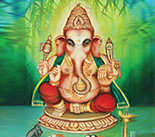
Even the image of Ganesha,
when seen through Maya’s dual lens,
falls into the realm of concept.
Yes, the Bimba, the form you worship,
must be honoured — but then let go.
Because Ganesha is not in the image —
He is in the formless Yoga within you.
Let go of the Bimba-bhavana.
Enter the real union.
Brahma said —
‘Long ago, O son, I had told you —
that Ganesha is your Kuladevata, your family’s sacred guardian.
And you… you worshipped Him with devotion, with love, with reverence —
not just as a form, but as the breath behind your breath.’
‘Because of that pure worship…
you have now become worthy.
Worthy of hearing this supreme secret.
The truth of Yoga that leads to full and perfect peace.
Few ask. Fewer understand. Fewer still receive.’
‘Now, O great sage,
worship Him daily — not as a statue, not as a symbol —
but as the eternal stillness within you.
With this understanding,
you shall become one with Ganesha Himself.
No doubt. No delay. No return.’
And saying this —
Brahma disappeared —
like the setting sun that leaves behind its golden warmth.
And Pulaha?
He stood there in silence.
No words. No thoughts. No desire.
He turned inward.
And in the fire of tapas,
he embraced the Yoga of Peace.
Thus ends the divine dialogue.
A worshipper became the wisdom.
A question became the answer.
And silence became Ganesha.
- Why does Brahma identify the neglect of Vighnaraja as the root of all human suffering?
Brahma explains that Vighnaraja is the Lord of Beginnings and the ruler of obstacles. When beings ignore this principle, they remain blind to the energetic blocks within themselves. Suffering is not a random occurrence but the physical and mental shape of a Vighna or obstruction. By neglecting the source that governs these blocks, a soul remains perpetually caught in the net of its own karmic shadows and repetitive pain. - What is the hidden danger of seeking heaven or pleasures as described by the Creator?
Brahma reveals a profound paradox that pleasures are often soaked in sorrow and hidden in gold wrappers. Even the joys of heaven are steeped in duality and fear, such as the fear of falling back to earth or the threat of celestial rivals. These pleasures are themselves Vighnas because they bind the soul to external conditions and the ego, preventing the discovery of the Shanti that exists beyond all heavens. - How does the text define the true nature of a Vighna beyond just an outward problem?
A Vighna is described as a veil or a test that manifests in every world. It is the very texture of the three gunas that makes the cosmos tremble. Most importantly, the text suggests that even noble thoughts, beauty, or one’s personal truth can be hidden Vighnas if they create moha or delusion. Anything that reinforces the idea of being a separate entity or a body is an internal obstacle to the Absolute. - Why is inaction rejected as a path to liberation in this discourse?
Brahma warns that inaction is not freedom. Moksha is not for those who sit idle because the path to liberation is filled with invisible hurdles that require an intense and alert spirit to overcome. One must possess a fire of sadhana to burn through the four bodies—gross, subtle, causal, and supra-causal. Striving is necessary to transcend the gravity of bondage. - What is the supreme deception regarding the realization of Brahman?
The most mysterious aspect revealed is that even the thought of Brahman becomes a lie if it is wrapped in duality. To think of Brahman as something separate from oneself that must be reached is a trap of the imagination. Truth split in two is no truth at all. Realization is not a conceptual achievement but a state of being where the speaker and the spoken disappear. - Why does Brahma speak critically of methods and techniques in the context of true Yoga?
He suggests that whenever yoga is seen as a technique, a method, or a doing, it loses its essence. This is because a method implies a doer—an ego that is performing an action to get a result. In true Yoga, there is no one doing it; there is only presence and quiet fire. Any sense of separation or technique is still on the edge of illusion and constitutes a Vighna. - What is the relationship between Vighnaraja and the concept of Nirvikalpa Yoga?
Nirvikalpa Yoga is the state where all thought and imagination dissolve, allowing the yogi to rest in their own glory. Vighnaraja represents the power that removes the final cracks of division. By understanding that Ganesha is not just an outer image but the formless Yoga within, the seeker moves from worshiping a symbol to becoming the stillness that the symbol represents. - What is the five-layered soil of the mind and why must it be transcended?
The Chitta-Bhoomi or the five-layered soil represents the various stages of the mind’s expression through Buddhi and Maya. Even if one finds success or siddhis within these layers, they can become traps of delusion. To become Yoga itself, one must move beyond this layered land into an indivisible state where the mind no longer filters reality into five-fold illusions. - Why is the transition from Bimba-bhavana to formless union considered a supreme secret?
Bimba-bhavana is the devotion to a form or image. While Brahma acknowledges Pulaha’s devotion to the form of Ganesha as a necessary foundation, he reveals that the ultimate secret is to let go of the image. The transition to the formless Yoga within is the final step where the worshipper becomes the worshipped. This is overlooked by many who remain stuck in the ritual without moving to the internal essence. - What is the final definition of Shanti or Peace according to the cosmic grandsire?
Shanti is the peace beyond thought that is reached only when the ideas of being joined or not being joined to the Divine are discarded. As long as the mind categorizes union, it remains in a cage. True Shanti is the absence of the crack of division. It is the state where the soul realizes there is nothing beyond that which knows itself, and in that self-experience, all Vighnas vanish forever.





English
Ganapathy
Click on any topic to open
7
30
Astrology
Bhagavad Gita
Bhagavatam
Bharat Matha
Devi
Devi Mahatmyam
Ganapathy
Garuda Puranam
Glory of Venkatesha
Hanuman
Kathopanishad
Mahabharatam
Mantra Shastra
Mystique
Practical Wisdom
Purana Stories
Radhe Radhe
Ramayana
Rare Topics
Rigveda Explained
Rituals
Sages and Saints
Shiva
Spiritual books
Sri Suktam
Story of Sri Yantra
Temples
Vedas
Vishnu Sahasranama
Yoga Vasishta
26
17
10
0


