The Five Arrows of Kamadeva
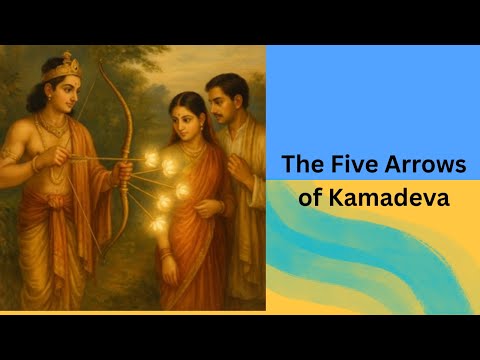
Today, we are stepping into one of the most fascinating corners of our Puranas: how Kamadeva, the god of love, uses his five arrows to awaken desire between a man and a woman. These arrows are not physical weapons. They are emotional triggers, psychological forces, and subtle movements of the mind. Each arrow works on a different layer of human nature, moving two people closer without either one fully realising what is happening.
Kamadeva carries a bow made of sugarcane and a string of buzzing bees. Why bees? Because desire always hums before it bites. And the arrows? Each one represents a distinct shift inside the mind. When Kamadeva shoots them, attraction rises from a spark to a storm.
The first arrow is Unmadan.
The arrow of excitement.
Kamadeva never starts with intensity. He begins with a simple nudge. A man and a woman see each other, and something small moves within the heart. A lightness. A slight rush. No one calls it love yet. It feels like a pleasant surprise, a gentle intoxication. This arrow wakes the emotional field. Without Unmadan, the mind stays neutral. With it, the mind begins to pay attention.
The second arrow is Shoshan.
The arrow that disturbs balance.
This one dries up the comfortable stillness we normally carry. Suddenly, the earlier calm does not feel enough. A person begins to feel a faint sense of dissatisfaction when the other is not around. Something feels missing. Something feels incomplete. This arrow creates the first small emptiness that seeks fulfillment. It is subtle, but it is powerful, because it makes the heart lean outward.
The third arrow is Tapan.
The heating arrow.
Here desire becomes more than curiosity. It becomes energy. A man or woman starts to think more intensely about the other. The face becomes warmer, the breath becomes shorter, and the mind becomes restless. You try to focus on work, but the thought returns. Again and again. This arrow makes longing uncomfortable. Without Tapan, desire does not mature. With it, desire becomes a fire that needs air.
The fourth arrow is Sammohan.
The arrow of enchantment.
This is where the real magic happens. Sammohan clouds the mind with a gentle fog. Suddenly the world fades a little, and one person begins to shine brighter than everyone else. Judgment softens. Flaws look like charms. You start imagining conversations, moments, futures. Sammohan removes resistance. It draws two people inward, into a shared emotional space. This is the arrow that makes the heart surrender.
The fifth and final arrow is Stambhan.
The arrow that freezes.
Once this arrow hits, everything else becomes secondary. The mind cannot pull away even if it wants to. You think of the person when you wake up, when you walk, when you sit with others, when you try to sleep. It is as if time pauses whenever your thoughts reach them. This arrow does not create movement, it stops it. It binds the mind on the desired one and the rest of the world loses urgency.
And when all five arrows have done their work, two hearts begin to move toward each other almost naturally, as if guided by an inner tide. No one feels forced. No one feels pushed. Kamadeva never compels. He simply activates what already exists within humans: the desire to connect, to be seen, to be cherished, to be understood.
In our scriptures, this process is not seen as sinful or low. It is seen as one of the engines of human life. Without these arrows, society would freeze. Relationships would not form. Families would not grow. Art, poetry, music, and devotion itself would lose their emotional fuel. Kamadeva’s work is subtle, but it is also sacred, because the harmony of creation depends on the attraction between two human beings.
So the next time you feel that small flutter in your heart, that restlessness, that strange urge to look twice, remember: somewhere, silently, the god of desire has drawn his sugarcane bow. And one of those five arrows has found its mark.
That is the dance of Kamadeva.
That is how desire begins.





English
Purana Stories
Click on any topic to open
7
30
Astrology
Bhagavad Gita
Bhagavatam
Bharat Matha
Devi
Devi Mahatmyam
Ganapathy
Garuda Puranam
Glory of Venkatesha
Hanuman
Kathopanishad
Mahabharatam
Mantra Shastra
Mystique
Practical Wisdom
Purana Stories
Radhe Radhe
Ramayana
Rare Topics
Rigveda Explained
Rituals
Sages and Saints
Shiva
Spiritual books
Sri Suktam
Story of Sri Yantra
Temples
Vedas
Vishnu Sahasranama
Yoga Vasishta
26
17
10
0


