The Awakening of Radha's Love
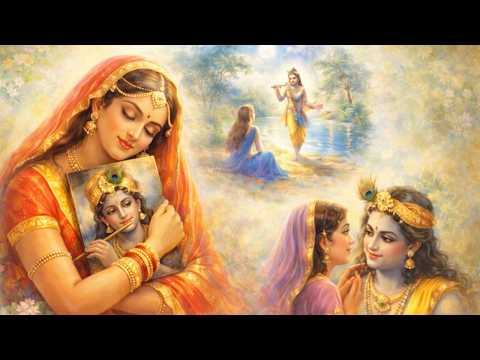
The story of Radha and Krishna begins not with a meeting, but with a feeling. In the heart of Braj, Shri Radha had heard stories of Krishna. She heard about his charm, his kindness, and the divine music of his flute. This created a deep curiosity, a spiritual pull towards someone she had not yet truly seen.
One day, Radha’s closest friends described Krishna's beauty to her in vivid detail. But Radha wanted more than just words. She asked them, 'First, please paint a portrait of him for me.'
Her friends created a beautiful painting of Krishna. When Radha looked at it, something profound happened. It was more than just a picture. For her, it was a window to the divine. Looking into the painted eyes of Krishna, a deep and powerful love awakened in her heart. She held the portrait close and drifted into a dream. In that dream, she saw Krishna himself, dancing for her by the Yamuna river. The dream felt more real than reality.
When she awoke, the world seemed empty without him. The feeling of separation was intense. Soon after, she caught a real glimpse of Krishna. The divine energy she felt was so overwhelming, so full of love and awe, that she fainted.
Seeing her friend in this state of deep spiritual longing, her companion Lalita went to find Krishna. She explained Radha’s condition, describing her intense love and the pain of her separation.
Krishna listened with a gentle, knowing smile. He then shared a beautiful secret.
He said, 'Please tell Radha that the love she feels for me is the same love I feel for her. We are not two separate people. We are one.'
To explain this, he used simple comparisons. He said, 'We are like milk and its whiteness. Can you separate them? We are like a flower and its fragrance. They are always together. Radha and I are two forms, but we are one soul, one energy.'
This is a powerful spiritual idea. It teaches that the Divine is not just a person you love from a distance. True devotion is realizing your connection is so deep that you are part of that same divine energy.
Krishna also gave a gentle warning. He explained that people who see a difference between him and Radha cannot understand true love. It’s like arguing whether the sun is more important than its light. The question itself is a misunderstanding because they are inseparable.
Lalita returned and shared Krishna’s profound message with Radha. When Radha heard that she and Krishna were truly one, her sadness washed away. It was replaced by a deep sense of peace and understanding.
This divine knowledge did not end her journey; it gave it a new beginning. Her love was no longer just a feeling of longing. It became a desire to act. She immediately asked her friends to teach her the right way to worship, the vows she could take, and the selfless actions she could perform to express this divine connection.
The story teaches us a beautiful lesson. Spiritual awakening often begins with a spark of curiosity or a deep feeling. But it grows into a profound understanding of oneness. And that understanding naturally leads us to express our love through our actions, turning our devotion into a way of life.
Question 1: Why does the story emphasize that Radha fell in love with Krishna before ever meeting him in person?
This highlights a profound spiritual principle that true love and divine connection are not dependent on physical presence. It suggests that the soul carries an ancient memory or an inherent pull toward the divine. Love begins as an internal awakening or a spiritual hunger that is triggered by hearing about the qualities of the divine, proving that the connection exists within the heart long before it manifests in the physical world.
Question 2: What is the deeper meaning behind Radha asking for a painted portrait of Krishna?
The portrait represents the bridge between the seen and the unseen. In spiritual practice, a physical form or image serves as a window to the infinite. Radha used the painting not as an end in itself, but as a tool to focus her entire consciousness. This reveals the secret that when devotion is pure, even a simple image can become a portal that allows a person to experience the actual energy and presence of the divine.
Why did Radha find her dream of Krishna to be more real than her waking reality?
Answer 3: This points to a mysterious side of spirituality where the internal experience is considered the ultimate truth. In the dream, her soul was free from the limitations of the physical body and social boundaries, allowing for a direct and unblocked union with Krishna. This teaches that the spiritual world is the foundation of existence, and our physical life is often just a shadow of that deeper, more vibrant spiritual reality.
Question 4: What is the significance of Radha fainting when she finally saw Krishna in person?
Fainting symbolizes the total surrender of the ego and the human intellect. When the limited human mind encounters the unlimited, overwhelming energy of the divine, it can no longer function in its usual way. It is a moment of spiritual ecstasy where the boundary between the self and the divine collapses. This suggests that to truly perceive the divine, the ordinary, logical mind must be momentarily set aside.
Question 5: What is the hidden secret in Krishna's statement that he and Radha are like milk and its whiteness?
This is a profound lesson in non-duality. You cannot remove the color white from milk and still have milk; the substance and its quality are one. This secret reveals that Radha is the expression and the beauty of Krishna himself. They are not two separate entities trying to reach each other, but a single existence appearing in two forms to experience the joy of relationship.
Question 6: How does the comparison of a flower and its fragrance explain their relationship?
This analogy explains how the divine operates in the world. Krishna is like the flower (the source), and Radha is like the fragrance (the spread of his essence). A flower without fragrance is incomplete, and fragrance cannot exist without a source. It teaches that the divine and the power of love are inseparable; one is the existence, and the other is the experience of that existence.
Question 7: Why does Krishna warn against seeing any difference between him and Radha?
The warning serves to protect the seeker from the trap of dualistic thinking. If a person views them as separate, they remain stuck in the world of labels and divisions. To understand true love, one must move past the idea of the lover and the beloved as two different people. The secret is that anyone who creates a hierarchy or a division between the two fails to capture the essence of the absolute unity that governs the universe.
Question 8: Why did the knowledge of being one with Krishna lead Radha toward selfless action rather than just silent meditation?
This reveals the principle that true spiritual realization is not passive. Once Radha understood she was one with the divine, her love transformed from a feeling of personal longing into a desire to serve. Deep understanding naturally overflows into action. It teaches that the highest form of devotion is expressed through how we live, the vows we keep, and the selfless way we interact with the world.
Question 9: What does the story teach about the nature of sadness and separation in a spiritual journey?
It teaches that the pain of separation is actually a tool for growth. Radha’s intense longing and sadness served as a fire that purified her heart, making her ready for the ultimate truth. The secret is that separation is an illusion created by a lack of knowledge. Once the truth of oneness is revealed, the sadness evaporates because the devotee realizes the beloved was never actually gone.
Question 10: What is the ultimate lesson regarding the beginning of a spiritual awakening?
The story shows that awakening often starts with a simple feeling or a spark of curiosity. However, that spark must be nurtured through focus, contemplation, and seeking the truth. The greatness of this principle lies in the fact that the journey ends where it began: in the realization that the seeker and the sought are one. Devotion is not a path to find someone else, but a path to realize that you are already part of the divine energy you admire.





English
Radhe Radhe
Click on any topic to open
7
30
Astrology
Bhagavad Gita
Bhagavatam
Bharat Matha
Devi
Devi Mahatmyam
Ganapathy
Garuda Puranam
Glory of Venkatesha
Hanuman
Kathopanishad
Mahabharatam
Mantra Shastra
Mystique
Practical Wisdom
Purana Stories
Radhe Radhe
Ramayana
Rare Topics
Rigveda Explained
Rituals
Sages and Saints
Shiva
Spiritual books
Sri Suktam
Story of Sri Yantra
Temples
Vedas
Vishnu Sahasranama
Yoga Vasishta
26
17
10
0


