The Ananda Called Sri Hari Never Ends

अक्षरः – स एव न क्षरतीति अक्षरः – He is the only one that does not come to an end. One who is not destroyed. The only one who is not destroyed. Kshara means destruction.
Why do we call alphabets as Akshara?
Because they are not destroyed, even after Pralaya they come back as Veda.
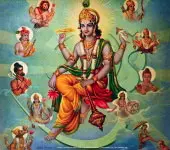
The Ananda that is Sri Hari, even after being perpetually consumed by the Jeevanmuktas, is only ever increasing, it is never depleting. Hence he is Akshara.
Akshara eva cha
ए व च -
ए represents the swaras starting from अ and ending with अः.
वकार represents all the vyapakaksharas from ya to ksha.
Cha represents the pancha vargeeya aksharas – kavarna, chavarga, tavarga, tavarga, pavarga.
There is another way of looking at it. The two Divya Namas Kshetrajna and Akshara are connected with Akshara using eva cha. Meaning Kshetrajna and Akshara are the same. They are not different.
Kshetrajna, the yogi, the Jeevatma aspiring to break the shackles of his body, is the same as Akshara, the Parmatama.
Kshetranjnah akshara eva cha.
Eva cha essentially represents the Upanishadic principle तत्त्वमसि ।
-
What does ‘indestructible’ actually mean here?
It means the core reality does not decay, fragment, or end. Forms change, names change, but the underlying conscious presence remains the same. -
If sounds and letters are called akshara, do they really survive cosmic cycles?
The specific utterances come and go, but the pattern, order, and capacity for sound and meaning persist. Law and structure outlast their temporary expressions. -
How can joy be consumed and yet increase?
True joy is non-rivalrous. Sharing it does not split it; attention aligns with its source, so it feels fuller the more it is known. -
If the knower of the body and the supreme reality are asserted as one, who am I right now?
You are consciousness aware of body and mind, not limited by them. Identity appears small when it clings to changing parts, and opens when it rests as the seer. -
Does knowing the body help in knowing the Self?
Yes. Precise awareness of breath, sensation, impulses, and thought shows they are observed objects, revealing the observing Self as distinct. -
Is this saying every person is the supreme reality without exceptions?
At the level of essence, yes. At the level of roles and abilities, there are differences, but these do not touch the underlying Self. -
If the Self is perfect, why is there ignorance and suffering?
Misidentification drives error. When awareness mistakes body-mind fluctuations for the Self, it inherits their limits and pains. -
Why do traditions give importance to sound and alphabetic order?
Sound encodes intelligence and law. Recitation trains attention to align with order, which clarifies thought and steadies awareness. -
What does ‘That thou art’ mean in plain words?
The reality you seek as highest is the very consciousness by which you seek. The destination is the seeker’s own ground. -
Is devotion compatible with this identity teaching?
Completely. Love focuses scattered attention on the highest; knowledge clarifies what is loved; both converge in one recognition. -
What practical changes follow from this view?
Less fear of loss, because essence is not at risk. More responsibility and ethics, because the same Self looks out through all. -
Can one be a yogi without intimate body knowledge?
No. Without somatic clarity, practice stays conceptual. Mastery of posture, breath, and sensation stabilizes the mind for insight. -
How do I test any of this instead of believing it blindly?
Adopt a clean life, steady attention practices, and honest self-inquiry. Verify that everything noticed changes, while the noticing itself is steady. -
What about death under this understanding?
Death is a change in appearance and functions, not a break in the aware presence. Fear reduces when identity shifts to the witness. -
Does this clash with science?
No. Science maps measurable processes; this examines the condition for any measurement to appear, namely awareness. -
If essence is already free, why bother with discipline?
Discipline removes obscurations. Polishing does not create the mirror; it reveals it. -
Is morality optional if one knows the Self?
No. Clear seeing naturally expresses as non-harm, truthfulness, and self-restraint. Ethics protect clarity and prevent backsliding.





English
Vishnu Sahasranama
Click on any topic to open
7
30
Astrology
Bhagavad Gita
Bhagavatam
Bharat Matha
Devi
Devi Mahatmyam
Ganapathy
Garuda Puranam
Glory of Venkatesha
Hanuman
Kathopanishad
Mahabharatam
Mantra Shastra
Mystique
Practical Wisdom
Purana Stories
Radhe Radhe
Ramayana
Rare Topics
Rigveda Explained
Rituals
Sages and Saints
Shiva
Spiritual books
Sri Suktam
Story of Sri Yantra
Temples
Vedas
Vishnu Sahasranama
Yoga Vasishta
26
17
10
0


