Sri Ramji Defends Vishwamitra's Yaga, Defeating Maricha and Subahu
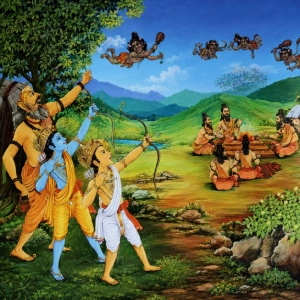
Vishwamitra was taking young Sri Ramji and Lakshmana to protect his yaga from demons. On the way, Sri Ramji killed the demoness Thataka.
In appreciation of his valor, after receiving the divine weapons from Sage Vishwamitra, Sri Ramji, Lakshmana, and the sage resumed their journey.
While walking, Sri Ramji said, 'Sage, thanks to you, I now know how to use these weapons. Even the gods can’t defeat me now.'
Then Sri Ramji asked, 'Sage, what is that place near the mountain with all the trees? I really want to know. Whose ashram is it?'
'That’s the place where the demons disturb and kill the Tapaswis, right? I want to know everything about this place, where I will have to fight them.'
Sage Vishwamitra answered, 'This ashrama belonged to Vamana. He did penance here for many years. That’s why it is called Siddhashrama.'
'I am also devoted to Lord Vamana, so I use this place too. Demons come here to cause me trouble, but you will defeat them.'
The sage took Sri Ramji and Lakshmana by the hands and led them into the ashrama. The sages (disciples of Vishwamitra) there were happy to see Vishwamitra and worshiped him. They welcomed Sri Ramji and Lakshmana as well.
Vishwamitra was greatly relieved and confident now that Sri Ramji was with him. Vishwamitra had been facing trouble from the demons who would disturb his yaga, and despite his immense power, he could not do anything because, under the vow for the yaga, he could not resort to aggression. With Sri Ramji's arrival, especially after Ram had demonstrated his strength by killing Thataka, Vishwamitra’s confidence grew.
After resting, Sri Ramji and Lakshmana woke up early in the morning, did their prayers, and bowed to the sage.
They asked Vishwamitra, 'Sage, please start the yaga today.'
Vishwamitra began the yaga with full control and focus.
Then they asked, 'When will we have to protect the yaga from the demons?' The other sages were happy and said, 'Vishwamitra has started the yaga and will remain silent. You two must protect it for six nights.'
Sri Ramji and Lakshmana carefully guarded the ashrama and didn’t sleep for six nights. On the sixth day, Sri Ramji told Lakshmana, 'Stay alert and be ready.'
Just then, the fire in the homa kunda lit up, and the chanting of mantras began. Suddenly, a loud noise came from the sky. The demons Maricha and Subahu were rushing toward the yaga vedi. They started raining blood everywhere.
Sri Ramji quickly got up and said to Lakshmana, 'Look, the demons are here. I will drive them away.' Sri Ramji aimed his bow at Maricha and shot him far away into the sea. Then he hit Subahu, killing him instantly. Sri Ramji used his arrows to defeat the rest of the demons who had accompanied Maricha and Subahu.
After defeating the demons, Sri Ramji made the sages very happy. They praised him. After the yaga was done, Vishwamitra said, 'Sri Ramji, you have made me proud and fulfilled my wishes.'
Then, they all did their evening prayers together.
Learnings
- Divine Power and Skills: Sri Ramji gained divine weapons from Sage Vishwamitra and learned how to use them. This shows his unmatched strength and readiness for battle.
- Protector of Dharma: Sri Ramji defended the yaga from demons for six nights without rest, showcasing his dedication to protecting righteousness and his role as a protector of good.
- Grit and Perseverance: It reflects the importance of staying committed to a task, even under challenging circumstances, which parallels modern concepts of grit and perseverance in achieving goals.
- Compassion and Duty: Sri Ramji fulfilled his duty by helping Sage Vishwamitra, defeating the demons without hesitation. This highlights his sense of responsibility and compassion toward sages and the divine order.
- Inspiring Leader: Effective leaders not only possess strength but also inspire confidence in others. His actions reassured Vishwamitra and the other sages, just as strong leadership today fosters trust and safety within a group or community.
- Why couldn't Sage Vishwamitra, despite his immense power, defeat the demons himself?
Vishwamitra was under a strict vow for the duration of his yaga, which required him to maintain complete spiritual purity, peace, and unwavering focus. Resorting to anger, aggression, or violence would break the spiritual conditions of the ritual, rendering his penance fruitless. Therefore, he needed a righteous warrior to physically protect the space so he could uphold the spiritual sanctity of the sacrifice. - What is the deeper significance of Vishwamitra granting divine weapons to Sri Ramji before they reached the ashrama?
This act highlights the critical principle of mentorship and preparation. It shows that even individuals with immense natural potential require the right guidance, knowledge, and tools to face monumental challenges. By equipping Sri Ramji early, the sage ensured his student was fully prepared for the specific threats ahead, demonstrating that true capability requires both strength and proper training. - Why does the narrative emphasize that the location, Siddhashrama, formerly belonged to Lord Vamana?
Connecting the location to Lord Vamana establishes a continuous, multi-generational lineage of divine presence and righteousness at that specific site. It reveals the hidden aspect that the battle to uphold Dharma is an ongoing cosmic duty. Sri Ramji is not just fighting an isolated battle; he is stepping into a historical continuum, protecting a legacy built by previous divine figures. - During the final attack, Sri Ramji killed Subahu but only shot Maricha far away into the sea. What does this distinct treatment reveal about his character?
This action reveals Sri Ramji's supreme control, precision, and lack of blind rage. Instead of causing unnecessary destruction, he measured his response to neutralize the threat according to the situation. Removing Maricha effectively secured the yaga, while Subahu's immediate destruction was required. It demonstrates that a true protector uses force with discernment, not just for the sake of violence. - How does the six-day watch illustrate the principle of grit and perseverance?
Sri Ramji and Lakshmana guarded the ashrama continuously for six days and nights without a moment of sleep. This extreme vigilance highlights that protecting a noble cause requires immense physical endurance and unwavering discipline. It teaches that one cannot drop their guard until a mission is entirely completed, as the ultimate test often comes at the very end. - What was the specific nature of the demons' attack, and what does it represent in the broader context of facing challenges?
The demons did not just attack physically; they rained blood from the sky over the sacred fire to defile it. This represents a form of psychological warfare and spiritual pollution designed to break the sages' focus and destroy the purity of their work. It shows that destructive forces often target the morale, purity, and foundation of a noble endeavor, requiring defenders to be prepared for unconventional attacks. - How does the text demonstrate the principle of the symbiotic relationship between spiritual and physical strength?
The partnership between the sage and the warrior symbolizes the necessary balance required to maintain a functional society. Sage Vishwamitra provides the spiritual vision, knowledge, and cultural foundation, while Sri Ramji provides the physical protection necessary for that wisdom to thrive safely. Neither the sage nor the warrior can establish lasting peace without the other. - Immediately after realizing his new invincibility with the divine weapons, what did Sri Ramji do, and what does this say about true leadership?
Instead of becoming arrogant or seeking personal glory, Sri Ramji immediately asked about the history of the land and prepared himself for the exhausting duty of fighting the demons. This shows that a true leader views power strictly as a tool for service and responsibility. He anchored his new strength to his duty toward the sages, proving that character must always govern capability. - What is the psychological impact of Sri Ramji's presence on Sage Vishwamitra and his disciples?
Sri Ramji's presence transformed the ashrama's atmosphere from one of vulnerability to one of profound relief and confidence. By demonstrating his strength early on and taking calm, decisive action when the threat arrived, he became a shield for the community. This illustrates that a great leader fosters trust and emotional safety, allowing others to focus fully on their own duties without fear. - Why did the demons choose the very moment the homa kunda lit up and chanting began to launch their attack?
The demons waited for the climax of the yaga to strike because that is when the spiritual energy was highest, and the sages were most deeply absorbed and vulnerable. This highlights a mysterious and hidden truth about overcoming obstacles: opposing forces often strike exactly at the moment of breakthrough or completion. It serves as a reminder that the highest level of alertness is required right at the finish line.






English
Ramayana
Click on any topic to open
7
30
Astrology
Bhagavad Gita
Bhagavatam
Bharat Matha
Devi
Devi Mahatmyam
Ganapathy
Garuda Puranam
Glory of Venkatesha
Hanuman
Kathopanishad
Mahabharatam
Mantra Shastra
Mystique
Practical Wisdom
Purana Stories
Radhe Radhe
Ramayana
Rare Topics
Rigveda Explained
Rituals
Sages and Saints
Shiva
Spiritual books
Sri Suktam
Story of Sri Yantra
Temples
Vedas
Vishnu Sahasranama
Yoga Vasishta
26
17
10
0


