Sri Hari Is the Ultimate in Tolerance
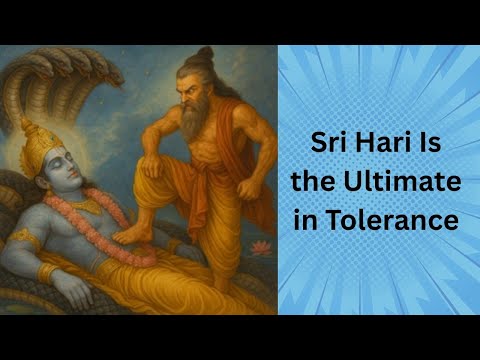
Bhrigu Maharshi went about testing who is the greatest among the Trimurthis. This was upon being urged by the other sages. He wanted to test tolerance and patience.
Bhrigu Maharshi went to Brahmaloka first. He entered Brahma’s court and seated himself upon a chair. Brahma felt offended. He was about to curse Bhrigu for showing disrespect to him. Devi Saraswati pacified him.
Bhrigu concluded that Brahma, who had no control over his anger, cannot be the greatest. Bhrigu left, saying that thereafter no one will worship Brahma.
Then he reached Kailasa. When Shiva saw Bhrigu, he welcomed him and approached him. Bhrigu said: 'Don’t touch me.' Shiva got offended. He took his trishula and began throwing it at Bhrigu. Parvati somehow managed to stop him.
Bhrigu left, concluding that even Shiva can’t be the greatest; he also has no control over his anger. Bhrigu proclaimed that Shiva will be worshipped only as a Linga thereafter.
Then he went to Vaikuntha. Vishnu, instead of being engaged in the sustenance of the universe, was fast asleep. That was Bhagawan’s leela. Who was testing whom, we don’t know.
Bhrigu gave one strong kick to Bhagawan on his chest. Bhagawan woke up and asked, 'Oh, did it hurt your leg? I am strong, I can take your kick. But your leg — does it hurt?'
Bhrigu realized that Sri Hari was the epitome of tolerance and declared that he was the greatest among Trimurtis.
Bhagawan has so much respect for Bhrigu Maharshi that he carries Bhrigu’s footprint upon his chest. That is why Sri Hari says in Gita: महर्षीणां भृगुरहम्.
Among yajnas, I am Japayajna. Among the sthavaras — beings that do not move — I am Himalaya. And among words, speech — I am Omkara.
प्रणवाद्यास्त्रयो वेदाः प्रणवे पर्यवस्थिताः
वाङ्मयं प्रणवं सर्वं तस्मात्प्रणवमभ्यसेत्
The three Vedas — this is not to the exclusion of Atharva Veda. 'Three Vedas' means the three formats in which Vedas exist — Richa (poetry), Yajus (prose), and Sama (songs). The entire Atharva Veda is in Richas. So even when it is said 'three Vedas', what is actually meant is four Vedas.
The Vedas begin with Pranava — Omkara.
The Vedas are founded on, and rest in, Omkara.
This entire vāngmaya — the corpus of speech — is Pranava only.
So perform abhyasa of Omkara. Chant Omkara.
That is the greatness of Omkara.
Omkara is Brahma.
Brahma is Sri Hari.
सर्वं खल्विदं ब्रह्म तज्जलानिति शान्त उपासीत
All this is Brahma.
तज्जलानिति — Tat Ja, Tat La, Tat Ana
-
तज्जत्वात् – Because it is born of That
-
तल्लयत्वात् – Because it dissolves into That
-
तदनत्वात् – Because it lives through That
All these emerge from Brahma, stay and operate in Brahma, and go back to Brahma. That Brahma is Sri Hari. Know that, and worship him peacefully.
बद्धवैराणि भूतानि द्वेषं कुर्वन्ति चेत्ततः
शोच्यान्यहोऽतिमोहेन व्याप्तानीति मनीषिणाम्
Those who hate each other, those who fight each other — they can only be pitied for their ignorance and foolishness. The ignorance that this is this and that is that. Absence of knowledge that सर्वं खल्विदं ब्रह्म — all this is Brahman.
When the realization dawns that you are not different from me, that we have derived our bodies from the same pool of panchabhutas — which themselves don’t even exist separately — then the illusion drops.
The individual is just a non-existent focal point around which these panchabhutas move for some time. The breath that I inhale and exhale now goes into you next. The water I bathe in today evaporates, becomes a cloud, rains, and becomes the water for you to bathe tomorrow.
When you fly across borders — borders of states, borders of countries — can you actually make out when you’ve stopped being in one and entered another? Like crossing from Karnataka into Maharashtra, or from India into Nepal?
The land is continuous.
The sky is continuous.
The land doesn’t know whether it is Indian or Nepalese land.
The sky doesn’t know it belongs to India or Nepal.
We have made all this.





English
Vishnu Sahasranama
Click on any topic to open
7
30
Astrology
Bhagavad Gita
Bhagavatam
Bharat Matha
Devi
Devi Mahatmyam
Ganapathy
Garuda Puranam
Glory of Venkatesha
Hanuman
Kathopanishad
Mahabharatam
Mantra Shastra
Mystique
Practical Wisdom
Purana Stories
Radhe Radhe
Ramayana
Rare Topics
Rigveda Explained
Rituals
Sages and Saints
Shiva
Spiritual books
Sri Suktam
Story of Sri Yantra
Temples
Vedas
Vishnu Sahasranama
Yoga Vasishta
26
17
10
0


