Sri Hari Is the Support of the World
भूतभृत् – सत्त्वगुणमधिष्ठाय भूतानि बिभर्ति, पालयति, धारयति, पोषयतीति भूतभृत्.
He bears, sustains, protects, nourishes assuming Sattva Guna. With these two names, Vishnu’s roles as creator, sustainer, and annihilator — all three — are mentioned.
Bhutakrit and Bhutabhrith together denote all the three aspects of Sri Hari as creator, as sustainer, and as eliminator. How can he be the creator, sustainer, and eliminator at the same time? Don’t they conflict with each other? We see this in day-to-day life.
Look at a farmer.
He sows – he is the creator.
He waters and nourishes his plant – he is the sustainer.
At the end, he harvests, destroys the plants – he is the eliminator. All in one.
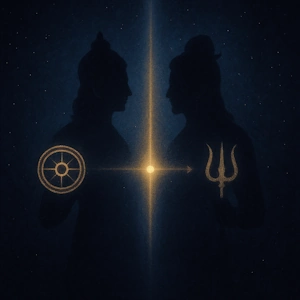
People say, Vishnu is greater than Shiva or Shiva is greater than Vishnu. Sometimes, simple questions can solve this puzzle. If Vishnu is greater than Shiva, then how can Shiva ever eliminate the universe that is sustained and protected by Vishnu? Shiva is eliminator. If he is greater than Vishnu, then why is he not able to eliminate Vishnu?
These competitions are childish. In fact, Vishnu and Shiva are the same — different roles played by the same divinity in its endless leela. So also is Brahma.
One Chaturyuga or one sequence of Krita, Treta, Dwapara, and Kali Yuga comprises 4.32 million years. A thousand such Chaturyugas make one day of Brahma, and another thousand would make his night. That means 8,640 million human years is Brahma's one day. Three hundred sixty such days is one year for Brahma, and Brahma's longevity is one hundred such years. This is called a Mahakalpa, and this is the time it takes for Sri Hari to inhale or exhale once. When he inhales, millions of universes come out of the pores of his skin, and when he exhales, they are withdrawn back into them.
इष्टापूर्तं बहुधा जातं जायमानं विश्वं बिभर्ति भुवनस्य नाभिः।
How does he support the world? Support does not mean only physical support. Support means whatever makes the universe go on, both as a physical entity and dynamically. He gives physical support to the universe, and also, by causing action, prompting action, and giving their results through the cause–effect series, he makes the universe — the dynamic universe — continue.
So, he is called the Nabhi of the universe. Nabhi is like the centre of the wheel.
रथस्यारेषु नेमिरर्पितो नाभावरा अर्पिता एवमेवैता भूतमात्राः प्रज्ञामात्रास्वर्पिताः प्रज्ञामात्राः प्राणेऽर्पिताः।
The outer rim of the wheel is supported by the spokes. The spokes are supported by the inner rim, the centre of which is the nave or Nabhi of the wheel. In the same way, the Bhutamatras — the elements — are supported by consciousness, and consciousness is supported by Prana, the life force.
-
How can one power handle creation, preservation, and destruction without conflict?
They are phases of one continuous process, coordinated by a single source. No clash, just timing. -
What keeps these roles from colliding with each other?
An underlying cosmic order coordinates them, like steps in a well-run system. -
If the divine is one, why so many names and forms?
Different names point to different functions and moods of the same reality, so people can relate more easily. -
Why use everyday analogies to explain cosmic work?
Simple parallels make complex truths clear and memorable. -
What do enormous cosmic timescales mean for us?
They show our smallness, teach humility, and push us to focus on right action now. -
What does the image of the divine breathing universes in and out really convey?
Creation and dissolution happen in recurring cycles, effortlessly sustained by the source. -
What is meant by calling the source the navel of the universe?
It is the central hub that connects, nourishes, and holds the whole system together. -
How does the universe receive support beyond the physical?
Through laws, order, and cause–effect links that keep everything moving with meaning. -
How do elements, consciousness, and life force relate?
Elements depend on consciousness for meaning, and consciousness functions in living beings through life force. -
Why do people argue about which deity is greater?
Attachment to forms and groups hides the unity behind them. -
What should a person actually do with this understanding?
Choose clarity and goodness, act responsibly, and avoid rivalry about divine ranks. -
How should one view creation and destruction in daily life?
Treat them as natural transitions. Do your duty, accept change, and avoid clinging. -
Where do effort and grace meet?
You act with sincerity; outcomes flow through the larger order. Both matter. -
Can science and spirituality have a useful conversation here?
Yes. They address different angles of the same reality and can enrich each other when kept honest.





English
Vishnu Sahasranama
Click on any topic to open
7
30
Astrology
Bhagavad Gita
Bhagavatam
Bharat Matha
Devi
Devi Mahatmyam
Ganapathy
Garuda Puranam
Glory of Venkatesha
Hanuman
Kathopanishad
Mahabharatam
Mantra Shastra
Mystique
Practical Wisdom
Purana Stories
Radhe Radhe
Ramayana
Rare Topics
Rigveda Explained
Rituals
Sages and Saints
Shiva
Spiritual books
Sri Suktam
Story of Sri Yantra
Temples
Vedas
Vishnu Sahasranama
Yoga Vasishta
26
17
10
0


