Simple Ways To Progress Spiritually
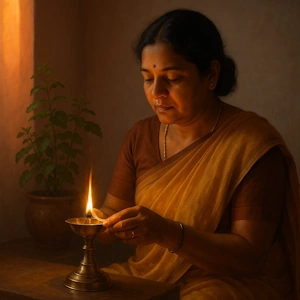
Don't be surprised that your mother, who does nothing other than lighting that lamp and offering that half cup of milk to Bhagavan every day, and murmurs a few stotras as she goes about her household chores, is far ahead of you spiritually.
This is our proven path. This is our established path. This is our traditional path. Nobody promises you anything. There is no instant salvation, no kundalini shooting up and blossoming in the thousand-petalled lotus in seven days, no out-of-body travel, no conversation with your guardian angel.
It is simple — what your mother and father do, what your grandparents used to do, what their parents used to do.
The simple ways: light a lamp, chant a shloka, go to a temple, do some charity, share with others, help somebody in need. The simple ways to progress spiritually.
They will not claim that they are maha yogis, or maharishis, or brahmarshis, or devarshis. Even they do not know that they are progressing; they are not aware. But it is happening, day after day, year after year, birth after birth.
I am not trying to talk ill about these movements. Socially, they are great movements. We are learning values, learning to be less selfish, learning to be good citizens through them. Had these movements not been there, we would have been as bad as any other consumerist nation in the world.
They are great movements. Great social movements. No doubt. But spiritually — no idea.
Many of these have metamorphosed themselves into social movements, taking up great causes such as protection of nature, literacy of the underprivileged, self-help groups, women empowerment. Really good causes and great work.
So, this is prakruti and the attachment you have with prakruti. The muktas go beyond this prakruti bandha. Then there is avidya — ignorance. The mukta has to be free from ignorance.
Ignorance is both lack of knowledge and wrong knowledge. Both can bind you. You want to go from point A to point B — you do not know the route; this is lack of knowledge. You have the wrong route map with you and you follow that; this is wrong knowledge. Both are avidya — ignorance.
-
Why do small daily rituals matter?
They train attention, soften ego, and anchor the mind in sattva. Regular contact with Bhagavan through simple acts steadily reshapes habits and priorities. -
Is intention more important than elaborate practice?
Yes. A clear, humble intention purifies faster than complex actions done for show. Inner alignment beats outer display. -
Does repetition really change anything?
Repetition rewires the mind. Like drops filling a pot, small acts done daily accumulate into stable inner quiet. -
How do I know if I am progressing?
Check for less anger, quicker recovery from hurt, more gratitude, and steady duty without drama. If these grow, you are moving. -
Are mystical experiences necessary?
No. Experiences can come and go; they are not the goal. A calmer mind and kinder conduct are solid milestones. -
What is the role of visiting a temple?
Temple darshan focuses the mind, uses sacred space to lift thought, and reminds you that life is larger than personal stories. -
Is chanting in Sanskrit required?
Not required. Chanting with attention in any language helps. Sound, rhythm, and meaning together tune the mind. -
How does charity help spiritual growth?
Giving loosens possessiveness and widens identity beyond the small self. It aligns action with dharma. -
Does social service equal spirituality?
Service is powerful, but motive matters. If done with attachment to name and praise, it binds; if done as worship, it frees. -
What is prakriti bandha?
It is the mind’s attachment to changing qualities of nature. When you cling to pleasure, status, or opinions, you get tied to their ups and downs. -
What is avidya exactly?
Twofold: not knowing what is true, and holding what is false as true. Both mislead choices and prolong restlessness. -
How do I work on avidya in practice?
Study good sources, think deeply, and test by living. Seek teachers who are ethical and steady, not flashy. -
Can family traditions be real sadhana?
Yes. If done with awareness, lighting a lamp, offering food, and sharing with others become daily yoga for the heart. -
What if I miss a day or feel lazy?
Do a shorter version without guilt. Consistency beats intensity. Start again the next moment. -
How do I avoid ego about being ‘spiritual’?
Keep the focus on improving conduct, not labels. Remember that grace, not personal cleverness, carries you. -
Is silence or meditation necessary?
Helpful, because silence shows the mind to itself. Even five quiet minutes a day begin to clear inner noise. -
How do I balance work, family, and sadhana?
Weave practice into routines: a short chant, mindful meals, honest work, and small acts of help. Make life itself the altar. -
What is a reliable measure at the end of a year?
Fewer regrets, more responsibility taken, less fear of loss, and a steady sense of companionship with Bhagavan. If these deepen, you are on track.






English
Vishnu Sahasranama
Click on any topic to open
7
30
Astrology
Bhagavad Gita
Bhagavatam
Bharat Matha
Devi
Devi Mahatmyam
Ganapathy
Garuda Puranam
Glory of Venkatesha
Hanuman
Kathopanishad
Mahabharatam
Mantra Shastra
Mystique
Practical Wisdom
Purana Stories
Radhe Radhe
Ramayana
Rare Topics
Rigveda Explained
Rituals
Sages and Saints
Shiva
Spiritual books
Sri Suktam
Story of Sri Yantra
Temples
Vedas
Vishnu Sahasranama
Yoga Vasishta
26
17
10
0


