Significance of Avahana or Invocation in Puja
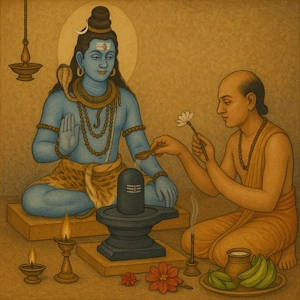
We have seen that if you have a Shivalinga at home, its puja should be done every day – without fail.
This is mandatory.
Even in temples, puja should happen every day.
But, our scriptures are also practical.
They are meant for Kaliyuga.
Vyasa Maharshi knew the compulsions of Kali Yuga.
In the earlier yugas – people were committed. Their priorities were different.
If a system is put in place, they would simply follow it 100 percent.
But Kaliyuga is different.
You can't have one rigid system in Kaliyuga.
The task is protection of dharma, preservation of dharma – not perfection.
Our scriptures are so practical, so flexible, that even in Dharma Shastra there is something called Apaddharma – a bare minimum set of rules that you should follow in case of compelling situations.
You cannot go below this.
In the same way, even for puja – puja of any devata – there are many options.
If everyone is told to follow a single method, say do pujas for 2 hours every day, then many will not be able to do it.
So a lot of things have been relaxed for Kaliyuga, which is what you will find in the Puranas.
If you see Vedic yajnas, they are very elaborate.
Some even last for months or years.
We know the yajna of Naimisharanya under Shaunaka Maharshi lasted for thousand years.
In Kaliyuga, we need brief procedures. Otherwise, dharma will not survive.
We saw that the simplest form of daily puja has six components:
Light a lamp, light an agarbatti, keep a cup of water near the God, apply sandal paste, offer a few flowers, and offer something in naivedya – even milk or fruits, or some dry fruits, whatever you can.
This is a simple but complete puja.
But don’t miss out on any of these.
Why these six steps? We have seen this in detail.
The audio is available under the Rituals section in the website. You can refer to that.
Shiva Purana also gives several options for the daily worship.
This is to convey the same principle only – that there are several ways. Choose whichever suits you.
What exactly is a puja?
A puja is basically hospitality.
You are treating the divinity as if a very important person is visiting your home.
In a standard puja, there are sixteen steps – called the Shodasha Upacharas.
Upachara means service – how you serve your guest. In this case, your guest is the divinity.
What do you do when a guest comes? You go to the door, welcome him and call him inside.
This is the first step in the puja, which is Avahanam – inviting the divinity.
Here, one point you should understand.
In any idol or linga, the presence of the divinity is always there.
But at the time of pujas, what you are doing is giving it a form.
You can visualize it like this:
Normally, the divine chaitanya is in a small spot at the heart of the idol.
When you do Avahana, it fills the idol.
The whole idol becomes filled with the chaitanya.
Every organ of the idol becomes active.
This is how you should see it.
After the puja is over, it will shrink back to the original form at the heart.
If you are familiar with Kundalini Yoga, you can visualize that the chaitanya is at the Muladhara and rises up when you are doing the puja.
So this is the purpose of Avahana – activating the idol, filling it with the divine energy.
Avahana is done in Kalasha also, on mandalas also – mandalas made of coloured powder.
These are for pujas performed only once.
Here, chaitanya comes only when you invite, during Avahana or invocation.
And after the puja, the chaitanya is sent back.
So this you should understand.
In the case of idols, the chaitanya is permanently present.
When you do Avahana, you are only activating that chaitanya and making it fill the idol or linga.
The technical term for this is Sakalikarana.
After puja, when you do Visarjana or Udvasana, the chaitanya doesn’t go from the idol or linga.
It will only shrink to either the heart or Muladhara.
This is called Nishkalikarana.
Sakalikaranam and Nishkalikaranam.
In the case of Kalasha, there is no chaitanya before the Avahana or invocation.
At the time of invocation, the chaitanya comes,
Stays in it during the puja,
And is sent back during Visarjan or Udvasana.
So after Visarjan or Udvasana, there is no chaitanya in the Kalasha or mandala.
We will continue to look at the significance of Shodasha Upachara Puja.





English
Shiva
Click on any topic to open
7
30
Astrology
Bhagavad Gita
Bhagavatam
Bharat Matha
Devi
Devi Mahatmyam
Ganapathy
Garuda Puranam
Glory of Venkatesha
Hanuman
Kathopanishad
Mahabharatam
Mantra Shastra
Mystique
Practical Wisdom
Purana Stories
Radhe Radhe
Ramayana
Rare Topics
Rigveda Explained
Rituals
Sages and Saints
Shiva
Spiritual books
Sri Suktam
Story of Sri Yantra
Temples
Vedas
Vishnu Sahasranama
Yoga Vasishta
26
17
10
0


