Shiva vs. Shankhachuda: Epic Battle of Good and Evil
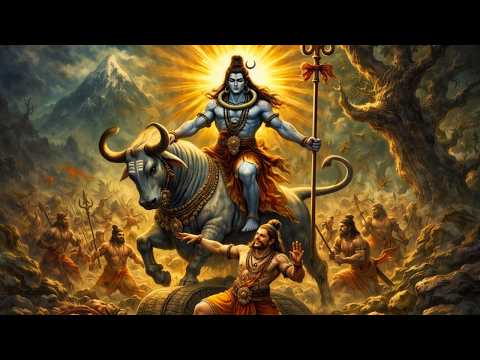
Devas and Asuras frequently engage in epic battles. They symbolize the eternal struggle between good and evil. At the center of this tale is Shankhachuda, a powerful Asura king renowned for his devotion to Lord Vishnu. He had immense prowess in battle. Shankhachuda was blessed with invincibility as long as his wife, Tulsi, remained chaste and his divine armor stayed intact.
Shankhachuda's formidable presence and his terrorizing of the Devas led them to seek assistance from Lord Shiva, the supreme destroyer. Known for his merciful nature yet immense power, Shiva took it upon himself to confront Shankhachuda. This story captures the intense and prolonged battle between Shiva and Shankhachuda, highlighting the complexities of divine intervention, the play of illusions, and the ultimate resolution of cosmic conflicts.
Shiva, with his fierce attendants, approached Shankhachuda on the battlefield. Shankhachuda, showing his respect, descended from his chariot, bowed to Lord Shiva, and then prepared himself for the epic battle.
The battle between Lord Shiva and Shankhachuda was intense and lasted a hundred years. Both combatants displayed incredible might and resilience. Sometimes, Shiva would rest on his bull, Nandi, while Shankhachuda would take a moment to catch his breath on his chariot. The battlefield was strewn with the bodies of fallen Asuras and Devas, but Lord Shiva revived the slain warriors from the Deva side, ensuring the battle continued.
Amidst the fierce combat, Lord Vishnu decided to intervene with a clever plan. Disguised as an old Brahmin, he approached Shankhachuda on the battlefield. 'O King, grant alms to me, a poor Brahmin. Promise to give me what I desire,' he said. Shankhachuda, ever generous and noble, agreed without hesitation.
The old Brahmin then revealed his request: 'I want your armor.' True to his word, Shankhachuda removed his divine armor and handed it over. Vishnu, now disguised as Shankhachuda and wearing his armor, went to Tulsi. Believing him to be her husband, Tulsi welcomed him, and thus, her chastity - Shankhachuda's ultimate protection - was unknowingly broken.
By breaking Tulsi's chastity, Sri Hari weakened Shankhachuda's protection, allowing Shiva to defeat him. This act, though painful, ultimately served the greater good by protecting the cosmos from Shankhachuda's chaos.
With Shankhachuda's protective armor and Tulsi's chastity gone, Lord Shiva saw his opportunity. He took the trident given by Vishnu, a weapon as bright as the sun and fierce as the flames of destruction. This trident was capable of destroying the entire universe.
Lord Shiva hurled the trident at Shankhachuda. Realizing the gravity of his situation, Shankhachuda abandoned his bow, sat in a yogic posture, and meditated on the lotus feet of Lord Vishnu with great devotion. The trident struck Shankhachuda, incinerating him along with his chariot.
But this was not the end for Shankhachuda. He transformed into a divine cowherd, adorned with jewels and holding a flute. He ascended a gem-studded chariot surrounded by millions of cowherds and attained Goloka.
In Goloka, Shankhachuda, known as Sudama, bowed at the feet of Lord Krishna and Radha. They welcomed him with joy.
From Shankhachuda's bones, a sacred conch shell was born. The conch, brought auspiciousness wherever it was heard. It became a symbol of divinity and prosperity, bringing peace and joy to all who used it.
Tulsi, who had been deeply devoted to Shankhachuda, was heartbroken but accepted her fate with grace. She was transformed into a sacred plant, now known as Tulsi. This plant is revered for its sanctity and role in rituals, symbolizing devotion, sacrifice, and purity.
After the defeat of Shankhachuda, Lord Shiva returned to his abode, Shivlok, with great happiness. The gods regained their kingdom and celebrated with joy. Drums resounded in heaven, and flowers showered continuously upon Lord Shiva as gods and sages praised him.
The story of Shankhachuda teaches us about the importance of trusting in a higher plan. It shows that even in the face of defeat, there is transformation and a return to divine grace. This story encourages us to stay devoted, fulfill our duties, and trust in the divine. It also teaches that sometimes difficult decisions are necessary to uphold righteousness and protect the greater good.





English
Purana Stories
Click on any topic to open
7
30
Astrology
Bhagavad Gita
Bhagavatam
Bharat Matha
Devi
Devi Mahatmyam
Ganapathy
Garuda Puranam
Glory of Venkatesha
Hanuman
Kathopanishad
Mahabharatam
Mantra Shastra
Mystique
Practical Wisdom
Purana Stories
Radhe Radhe
Ramayana
Rare Topics
Rigveda Explained
Rituals
Sages and Saints
Shiva
Spiritual books
Sri Suktam
Story of Sri Yantra
Temples
Vedas
Vishnu Sahasranama
Yoga Vasishta
26
17
10
0


