Shiva Becomes a Servant

Vidyapati, one of the prominent poets in Hindi literature, lived around six hundred years ago. He was a devotee of Shiva and composed numerous kirtans in praise of Shiva.
Pleased with Vidyapati's devotion, Shiva once disguised himself as a servant and approached Vidyapati seeking work. This servant was known as Ugna (Ugranath). Vidyapati, who was living in poverty, initially refused but later agreed to take Ugna in, offering him only two meals a day.
One day, while traveling, Vidyapati became extremely thirsty and asked Ugna for water. But where would one find water in the middle of a dense forest? Ugna walked a short distance away, gathered some water from the Ganga that flowed through his matted hair, and brought it to Vidyapati in a vessel. As soon as Vidyapati drank it, he recognized the taste of Ganga water. He realized that for the Ganga to be present in the middle of a forest, the person standing before him must be none other than Shiva himself. Overwhelmed, he immediately fell at the Lord's feet and begged for forgiveness.
Shiva, however, told him that since he had now been recognized, others would also come to know his true identity. He then got ready to go back to Kailasa. When Vidyapati pleaded with Shiva not to leave, the Lord said, ‘Then from now on, you must treat me only as a servant. If you ever reveal my divine identity again, I will leave.’
Vidyapati agreed, and things continued this way for some time.
Vidyapati’s wife was short-tempered. One day, in a fit of rage over some issue, she struck Ugna with a burning piece of firewood. Unable to bear this sight, Vidyapati exclaimed, ‘What great sin are you committing? He is none other than Bhagavan himself!’ The moment he said this, Shiva disappeared.
Heartbroken, Vidyapati wandered like a madman, searching for Bhagavan everywhere. Unable to see his devotee in such grief, Shiva reappeared before him and said, ‘Since I have been recognized, I can no longer remain with you. However, you can continue worshipping me in the form of a Shiva Linga.’
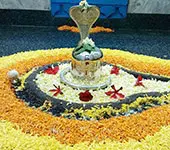
Saying this, Shiva manifested as a Shiva Linga, which Vidyapati worshipped for the rest of his life.
The famous Ugna Mahadev Temple is located in Darbhanga, Bihar.
- What does the name Ugna signify, and what does it reveal about the nature of Shiva in this story?
The name Ugna is derived from Ugranath. While Ugra represents Shiva's fierce, formidable, and cosmic form, the story shows him adopting this name while living as a humble, submissive servant. This reveals a profound spiritual paradox: the supreme, terrifying ruler of the cosmos becomes completely gentle and bound by love for his true devotee, showing that divine grace strips away all ego and hierarchy. - Why did Lord Shiva choose to test or reward Vidyapati by becoming a servant rather than granting him material wealth?
Vidyapati was living in poverty, yet Shiva did not offer him gold or kingdoms. By becoming a servant, Shiva highlighted that the ultimate reward of pure devotion is the constant presence of the divine, not material comfort. It also shows that God values the intimacy of companionship and shared daily struggles over grand, distant rituals. - What is the spiritual significance of the Ganga water appearing in the middle of a dense forest?
The forest represents the dry, difficult, and challenging phases of human life where resources and hope run out. The sudden appearance of Ganga water from Ugna's matted hair symbolizes that no matter how desolate or barren a devotee's external circumstances are, the divine source of life, purity, and liberation is always close at hand, carried secretly by God to quench the devotee's spiritual thirst. - Why did Shiva impose the strict condition that he would leave the moment his true identity was revealed to others?
Divine play, or Leela, requires a veil of mystery to function in the mortal world. If the world knew a servant was actually the Supreme Lord, the natural, earthly relationship of love and humility would be broken by public chaos, greed, and superficial worship. The condition preserved the sacred, private nature of the bond between the creator and the devotee. - How does the short-tempered nature of Vidyapati's wife serve as a catalyst in this divine narrative?
In spiritual stories, secondary characters often trigger the climax. The wife's anger and her act of striking Ugna with firewood represent the standard ignorance and harshness of the material world. This crisis was necessary to test Vidyapati's patience and ultimately force him to prioritize the honor of the divine over his vow of secrecy. - What hidden principle is illustrated by Vidyapati breaking his promise to Shiva when his wife struck Ugna?
Vidyapati broke his promise because his love and respect for God outweighed his fear of losing Him. He could bear his own poverty and hardships, but he could not bear to see the Supreme Lord being humiliated and physically struck. This reveals the principle that true devotion cannot remain silent or passive when the divine is disrespected, even if speaking out means facing personal loss. - Why did Shiva refuse to stay as a human servant after being exposed, but agreed to remain in the form of a Shiva Linga?
A human form is bound by the rules of social interaction and recognition, which were shattered once the secret was out. The Shiva Linga represents the formless, eternal, and universal aspect of Shiva. By transforming into a Linga, Shiva transitioned the relationship from a temporary physical companionship into a permanent, timeless spiritual anchor that could be shared by the entire community for generations. - What does Vidyapati's phase of wandering like a madman teach us about the path of devotion?
This phase illustrates Viraha, the intense pain of separation from the divine, which is considered the highest and most purifying stage in Bhakti literature. The madness and desperation demonstrate that once a soul tastes direct communion with God, the ordinary world becomes entirely meaningless, and the subsequent grief cleanses the ego completely. - What is the deeper, overlooked message regarding poverty and dignity in this story?
The story subtly addresses human dignity. Vidyapati was poor but initially refused free labor, offering Ugna two meals a day as a fair exchange. Shiva accepted this humble offering happily. This shows that God does not look for grand arrangements; he accepts whatever simple, honest livelihood a devotee can offer, emphasizing dignity in labor and humility in acceptance. - How does the Ugna Mahadev Temple in Darbhanga serve as a living testament to this story?
The temple stands as a physical reminder of the transition from private devotion to public faith. It regularizes an extraordinary spiritual event, ensuring that the spot where the divine served humanity out of sheer love is preserved. It shifts the focus from Shiva as a distant cosmic ruler to Shiva as a close, compassionate protector who walked among common people.





English
Shiva
Click on any topic to open
7
30
Astrology
Bhagavad Gita
Bhagavatam
Bharat Matha
Devi
Devi Mahatmyam
Ganapathy
Garuda Puranam
Glory of Venkatesha
Hanuman
Kathopanishad
Mahabharatam
Mantra Shastra
Mystique
Practical Wisdom
Purana Stories
Radhe Radhe
Ramayana
Rare Topics
Rigveda Explained
Rituals
Sages and Saints
Shiva
Spiritual books
Sri Suktam
Story of Sri Yantra
Temples
Vedas
Vishnu Sahasranama
Yoga Vasishta
26
17
10
0


