Shastras Guide Every Decision
What we are going to see now is common sense — which we expect people to have, but find missing in many, many cases.
Our acharyas understood the tricky nature of the mind — how the mind can get confused, how the mind can get carried away and end up making wrong choices or decisions. So, their method was to put SOP — Standard Operating Procedures — for each and everything.
For rituals, we have seen this. It starts with an achamana and then you have to follow a standard procedure till the end. Variations are not allowed. Shortcuts are not allowed. Modifications are not allowed. Because we may not realize why something is put in place.
For example, when a couple is doing a puja — in general, the wife sits on the right:
सर्वेषु धर्मकार्येषु पत्नी दक्षिणतो शुभा
But,
आशीर्वादेभिषेके च पादप्रक्षालने तथा शयने भोजने चैव पत्नी उत्तरतो भवेत्
While receiving blessings, when water from the holy kalasha is being sprinkled upon the couple after the puja, while washing the feet of noble people, while sleeping, while having food — in these cases, the wife should be on the left.
Why? Why these specific cases?
It may have some connection with the ida–pingala difference — the female nadi and the male nadi of the nervous system. Not sure. So much is not explained. If you go behind everything, it may not be that easy to find reasons.
The point is — follow and get benefited.
If you don’t follow, either you don’t get the benefit or if you violate these principles, the effect could be adverse also.
When the doctor prescribes a particular dosage of a medicine — half a tablet, three times a day — you don’t really venture to enquire: why half a tablet? Why not a quarter? Why not a full tablet? Why not everything together at one time?
The dosage is prescribed for valid reasons. A lot of thought has gone behind it.
Same is the case with dharmic prescriptions also. There is reason behind every single one of them. But to understand all that, you should have in-depth knowledge of dharma. Understand that they are not arbitrary.
Going back — acharyas very well understood how our mind functions. So, even with respect to the mind, they have laid down systems to follow.
For example, you want to do something. This is called chikeersha in Sanskrit, as per shastra.
Chikeersha means desire to do something — physical action particularly.
Nyaya Shastra and also Meemamsa Shastra say there are three factors behind chikeersha, or associated with chikeersha:
इष्टसाधनता – Attainment of a desirable objective
कृतिसाध्यता – Presence of means to attain the objective
बलवदनिष्ट अननुबन्धिता – Absence of strong adverse effects
This is common sense. But this works like a checklist.
Do we consider all these three before we get into anything?
Most of us don’t. And this is why most bad decisions are made.
Ishtasadhanata – Is the objective desirable? Is the goal desirable?
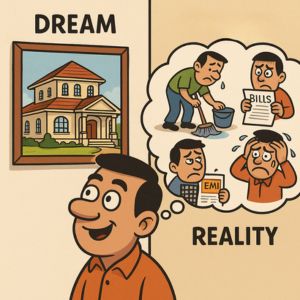
A big house — a big house is a sign of prosperity, a sign of achievement, a sense of achievement.
You want a big house to live comfortably. This is what you think.
But where you are going to buy or build this house — is manpower available on a daily basis who will clean up this house and keep it nice and beautiful?
Otherwise, you will have to do it yourself. What is your age? Are you physically fit to do this at least for the next few years to come?
If it is not maintained, your beautiful big house will soon become an eyesore.
The cost of maintenance — how much will a painting once in two, three, or five years cost?
And you’re bound tight to your repayment of EMIs — where will this money come from?
Do you think like this? If you think, then you are doing good. If you don’t, then you will have to.
So, Ishtasadhanata means — is what you are going to get desirable at all? Is it going to add to your problems?
Are you going for this house because the ad says: ‘Royal living, for the exclusive few’?
Are you getting carried away by those ads?
Is what you are going to do — is that suitable for you, particularly? This is to be seen.
Now KritiSadhyata – Do you have the means to achieve what you are going to do?
Everyone goes on adventure tours — does your body have the strength and stamina to do this?
You want to buy a Mercedes Benz — is your financial health good?
Have you considered all the hidden costs involved — like maintenance, insurance, interest cost?
Do you have the means or are you going to overstretch?
A second house is a good investment. As a concept — yes.
But what if you have to stay unemployed for some time — six months, one year, two years?
Where will this liability take you?
This assessment is KritiSadhyata — whether what you are going to do is achievable.
The third factor — बलवदनिष्ट अननुबन्धिता – Absence of strong adverse effects.
Anything and everything will have a negative side also.
When you are buying a car, your bank balance goes down. Or your liability increases.
That’s why here the adjective balavat is used — the adverse effect, whether it is big or strong — this you have to see. This has to be assessed.
The doctor does this.
A patient comes to him with a cardiac problem.
The medicine that he is going to give — it says that there is likelihood of kidney damage if you take that medicine.
But how much?
If ninety out of hundred people who take that medicine end up with damaged kidney, have to go for dialysis or kidney replacement — then no.
One or two cases out of hundred, minor short-term kidney related issues — yes.
Because the medicine is a life-saver. Its benefit is far more than the likelihood of this adverse effect.
This assessment should be done every time you contemplate doing something.
See, Sanatana Dharma is not just about devotion, doing rituals, or going to temples.
Sanatana Dharma helps you live intelligently — a fulfilling life.





English
Practical Wisdom
Click on any topic to open
7
30
Astrology
Bhagavad Gita
Bhagavatam
Bharat Matha
Devi
Devi Mahatmyam
Ganapathy
Garuda Puranam
Glory of Venkatesha
Hanuman
Kathopanishad
Mahabharatam
Mantra Shastra
Mystique
Practical Wisdom
Purana Stories
Radhe Radhe
Ramayana
Rare Topics
Rigveda Explained
Rituals
Sages and Saints
Shiva
Spiritual books
Sri Suktam
Story of Sri Yantra
Temples
Vedas
Vishnu Sahasranama
Yoga Vasishta
26
17
10
0


