Sharanagati Is A Very Natural Emotion - Example From Ramayana
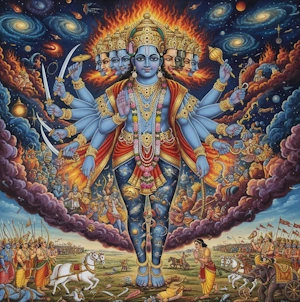
Today we will look at the meaning of the divyanama Bahushira and also see how sharanagati is a very natural emotion.
Bahushira – with a multitude of heads.
Sahasra sheersha purushah – Virat Purusha with thousand heads.
Thousand does not mean exactly a thousand.
Thousand means multitude.
Bhagawan has as many heads as that of all the beings that he has ever created.
Also in his vishwaroopa, he has many heads.
Every force of nature, power in nature is his head.
फणाश्च बहवॊ यस्य स वै बहुशिरा मतः.
Bahushira also points towards the 1000 hoods of Adishesha.
Shira also means the nerves.
It is Bhagawan's energy that is running through all the nerves in the body including the kundalini shakti.
Surrender or sharanagati is a shadanga yoga.
Like the Patanjali's ashtanga yoga this is a shadanga yoga, with six organs.
आनुकूल्यस्य संकल्पः प्रातिकूल्यस्य वर्जनम्। रक्षिष्यतीति विश्वासो गोप्तृत्वे वरणं तथा। आत्मनिक्षेप कार्पण्ये षड्विधा शरणागतिः।।
First, karpanaya - feeling helpless.
Accepting your incapability to progress on your own.
You can never advance on your own.
Bhagawan only has to hold your hand and take you ahead.
Goptrutva varanam - accepting Bhagawan as your protector, your only protector.
Rakshishyatiti vishwasa - complete faith in him no matter what, he will save you, he will protect you.
Aanukulysysa sankalpa - accepting everything that would support this stand.
Praatikulyasya varjanam - rejecting everything that would weaken this stand.
Aatmanikshepa - complete surrender to him.
Aatmanikshepa is similar to samadhi of ashtanga yoga.
Samadhi and atmanikshepa both lead to yogavastha.
There is an incident in Ramayana where all these six angas of sharanagati reflect in the most unexpected place.
This points towards the fact that sharanagati is not something very esoteric.
It is so natural and part of normal emotions.
The Rakshasis were harassing Seetha matha in the Ashoka vatika.
They told matha that we are going to eat you.
At that time Trijata, one of the Rakshasis told them.
Stop doing this.
I saw a dream in which Lanka is heading towards disaster.
This Seetha here is none other than Bhagawan Mahavishnu's wife.
Ramachandra is Mahavishnu.
Take refuge in her, अभियाचाम वैदेहीमेतद्धि मम रोचते otherwise along with the rakshasas of Lanka we will also get killed.
अपगच्छत नश्यध्वं सीतामाप्नोति राघवः।। घातयेत्परमामर्षी युष्मान्सार्थं हि राक्षसैः। Trijata has realized their helplessness.
Defeat at the hands of the lord is imminent.
Karpanya , the helplessness is expressed here.
There is no other way.
So who can be the protector? Seetha matha herself.
अभियाचाम वैदेही let's beg for her mercy, let us beg to her to be our protector - goptrutva varanam.
प्रणिपातप्रसन्ना हि मैथिली जनकात्मजा।। अलमेषा परित्रातुं राक्षस्यो महतो भयात्।
If we take refuge in her, she can protect us.
Rakshishyati iti vishwasa, that if she is pleased with us, she will protect us.
For that, what should they do?
Praatikulyasys varjanam - तदलं क्रूरवाक्यैश्च - stop being rude to her - सान्त्वमेवाभिधीयताम्.
Then aanukulyasaya sankalpa - be good to her.
And atmanikshepa is in the terms प्रणिपातप्रसन्ना.
Pranipata means falling at Seetha matha's feet, a gesture of surrender.
Sharanagati is not even a philosophical concept.
It is a natural emotion.
-
If Bhagawan has countless heads, what does that change in my daily life?
It destroys the illusion of isolation. When you chant the Sahasranama, you are aligning with the One who thinks through every head and feels through every heart. Decisions get cleaner because you stop acting as a lonely unit and start acting as a trustee of His will. -
How is surrender a natural emotion and not a dramatic spiritual performance?
You already surrender to sleep, gravity, hunger, and love. Sharanagati is the same honesty directed to Bhagawan: accepting that His intelligence runs this nervous system and this world. No theatrics. Just truth. -
What does sharanagati do to stress hormones and my body?
Regular nama japa slows breath, steadies pulse, and cuts the panic loop. Cortisol drops, digestion improves, and sleep deepens. The body stops bracing for imaginary battles because the mind has handed the battlefield to Bhagawan. -
How do I practice surrender without becoming passive or irresponsible?
You still do your duty. You just stop pretending you control outcomes. Plan, act, and report your work to Bhagawan through japa. That posture keeps effort sharp and ego light. -
What is the quickest daily way to live this truth when I wake up late, tense, and overloaded?
Sit, spine straight. Inhale for 4 counts, exhale for 6. Whisper 11 times: ‘Om Namo Narayanaya’. Then chant 1 verse of Vishnu Sahasranama with meaning. Start tasks only after that. -
How do I bring my family into this without forcing anyone?
Keep it gentle and consistent. Light a lamp once a day, chant 11 names together: ‘Kesava, Narayana, Madhava, Govinda, Vishnu, Madhusudana, Trivikrama, Vamana, Sridhara, Hrishikesha, Padmanabha’. Offer water. End with silent gratitude. Love does the convincing. -
What should I do when worry hijacks me midday?
Pause for 90 seconds. Close eyes. Touch the center of the chest lightly. Repeat 36 times: ‘Narayana’. Picture the worry as a small wave entering an ocean. Then take the next practical step only. -
How do I handle guilt over old mistakes while claiming surrender?
Confess to Bhagawan plainly during japa: what happened, what you learned, what you will now do differently. Then keep your word. Surrender without correction is laziness; surrender with correction is bhakti. -
What does it mean that His energy runs in every nerve?
Attention is a torch powered by Him. When you focus that torch on His names, scattered thoughts lose fuel. The nervous system follows attention; the mind follows the Name. -
How can I use the Sahasranama to make decisions that affect my family?
Write the options. Chant 3 verses of the Sahasranama, then sit in silence for 3 minutes. Choose the option that is truthful, lawful, least ego-driven, and most useful to the weak. That is surrender-informed clarity. -
What is the sign that my surrender is real and not a mood?
You stop bargaining. Your chant continues on good days and bad days. You act promptly, speak truthfully, and accept outcomes without drama. Peace becomes default, not reward. -
How do I prevent spiritual pride while practicing this daily?
Remember: the chanter, the chant, the breath, and the result are His gifts. End every session with ‘Govinda’ once, softly. Pride cannot stand in that light. -
What if a family member mocks my practice?
Do not argue. Protect the atmosphere. Keep practice short, steady, and cheerful. Serve them well. Let the steadiness of your peace do the talking. -
Give me a crisp starter routine that locks this into my day.
Morning: 11 ‘Om Namo Narayanaya’, 1 verse Sahasranama with meaning.
Midday reset: 36 ‘Narayana’.
Evening: 11 names as a family, 1 minute of silence.
Weekly: full Vishnu Sahasranama recitation once, with clear, unhurried pronunciation. -
What if I fail and skip?
Resume the same day. No self-bashing, no backlogs. Surrender is truthful continuity, not perfect attendance. -
What outcome should I expect if I stay with this for 90 days?
A quieter baseline, cleaner choices, steadier sleep, kinder speech, fewer panic spikes, and a natural pull toward dharma. That is how Bhagawan’s care feels in a human nervous system. -
Which names should I focus on for courage, restraint, and inner stability?
For courage: ‘Madhusudana’. For restraint: ‘Hrishikesha’. For stability: ‘Achyuta’. Chant each 108 times on the relevant day, or 11 times at all three junctions of the day. -
How do I connect this to service, not just personal calm?
After japa, do one concrete act of help without announcement. A surrendered heart naturally flows outward. That flow keeps the channel clean and the chant bright.
Isn't it contradictory to say Bhagavan has many heads? We only see one head in temple murtis.
When scriptures say 'thousand heads,' it is not about physical heads. It means countless expressions of his power. The sun, the wind, the rivers, the trees, the senses in every living being — each is a 'head.' A murti in the temple shows one form, but in truth, he is manifest as all.
If 'thousand' does not mean a number, then why use the word at all?
Because language needs limits. Ancient seers used 'thousand' to signify 'too many to count.' It is poetic shorthand. Just like saying 'oceans of stars' does not mean water and salt, but vastness.
How can nerves in the body be connected to Bhagavan? Nerves are biology, not divinity.
Biology itself is an arrangement of energy. Every impulse in the nervous system is electricity, motion, intelligence at work. Where does that energy come from? From the same source that spins planets and keeps the sun burning. Calling it Bhagavan only acknowledges the origin.
Sharanagati sounds like weakness. Why should a thinking person surrender instead of standing on their own?
It is not weakness. It is clarity. We accept limits in every field — no one flies by flapping their arms, they accept gravity and use technology. Sharanagati is the same: accepting that progress in truth and liberation is not by ego-strain but by aligning with the greater intelligence that sustains us.
But why call helplessness (karpanya) a spiritual step? Isn't it defeatist?
Because helplessness here is not despair but honesty. The mind admits, 'I cannot control everything.' That acceptance opens the door to a deeper power. Denying helplessness is illusion; acknowledging it is the beginning of real strength.
In the Ramayana example, why would Rakshasis who were cruel suddenly talk of surrender? Isn't that fear, not devotion?
Exactly — and that is the point. Sharanagati is natural. Even enemies, when cornered, instinctively seek protection from a higher power. Fear may spark it, but the structure — helplessness, faith, protection-seeking — follows the same six steps. It shows sharanagati is woven into human response, not just saintly practice.
Why compare Atmanikshepa to Samadhi? One is surrender, the other is meditation.
Both end in dissolving the individual ego. In Samadhi, the mind merges with pure awareness. In Atmanikshepa, the self is placed completely in Bhagavan's hands. Different routes, same destination — freedom from the 'I' that resists unity..





English
Vishnu Sahasranama
Click on any topic to open
7
30
Astrology
Bhagavad Gita
Bhagavatam
Bharat Matha
Devi
Devi Mahatmyam
Ganapathy
Garuda Puranam
Glory of Venkatesha
Hanuman
Kathopanishad
Mahabharatam
Mantra Shastra
Mystique
Practical Wisdom
Purana Stories
Radhe Radhe
Ramayana
Rare Topics
Rigveda Explained
Rituals
Sages and Saints
Shiva
Spiritual books
Sri Suktam
Story of Sri Yantra
Temples
Vedas
Vishnu Sahasranama
Yoga Vasishta
26
17
10
0


