Sharanagati Is a Concept Developed From the Vedas
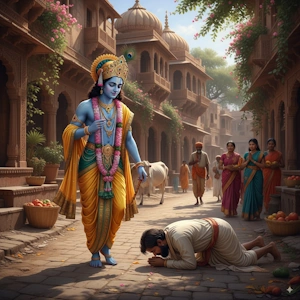
Today we will discuss the meaning of the divya nama samatma and also look at some aspects of sharanagati.
samatma –
वसुर्वसुमनाः सत्यः समात्मा संमितः समः
सम आत्मा मनो यस्य – his mind is even, flat, not perturbed by passion or hatred.
रागद्वेषादिभिरदूषितः.
सर्वभूतेषु सम एक आत्मा – the one and only soul present in all beings alike sama, that is Sri Hari.
He is impartial hence he is samatma.
समोऽहं सर्वभूतेषु.
His bhavana is the same towards everyone irrespective of whether he is a devotee or not, he is virtuous or not. Then what is the use of being his devotee? That is for you, then you can reach him faster. He does not show any partiality. For him a Vaishnava, a Shaiva, a Shakta, an atheist, a rationalist, a murderer, they are all the same. No preferences.
The distance from Mumbai to Bengaluru is the same whether you are going by a bullock cart, a cycle, a car, or a bus. But if what you have is a car then you can reach in 24 hours. If what you have is a bullock cart then you will reach after a few weeks. This is the difference. You should develop noble qualities because then you can reach him faster.
Some people think that sharanagati is a concept of bhakti, a recent concept in sanatana dharma. No, it is not like that. Of course the system of bhakti came to prominence after Bhagavata, but Bhagavata is the essence of the Vedas. Bhagavata is the fruit of the tree that is Veda. So reference to sharanagati has to be there in the Veda as well.
In sharanagati we acknowledge our incapacity to know Bhagawan, to attain Bhagawan without his help. You cannot study and understand Bhagawan like an object. This is what Veda also says. Rigveda Mandala 10 Sukta 4 Richa 4 – we do not have the capacity to know you, know your ways. After understanding this the devotee seeks the Lord's help and guidance.
The ability of Bhagawan to guide, to lead is also there in the Veda. Rigveda 3rd Mandala 20th Sukta –
अग्निर्नेता भग इव क्षितीनां दैवीनां देव ऋतुपा ऋतावा.
And what kind of path that Bhagawan leads us through? Supathaa, the right path, the noble path.
अग्ने नय सुपथा राये – Yajurveda.
Bhagawan is capable of taking us out of troubles, troubles that are the results of our own bad deeds. Rigveda Mandala 10 Sukta 133.
And after sharanagati you become his and he becomes yours, this is expressed in the 8th Mandala 92nd Sukta of Rigveda – you are ours, we are yours.
Serving the Lord's lotus feet is most important in sharanagati. Rigveda Mandala 6 Sukta 29 –
पादा दुव – पादयोः परिचरणम्.
Mandala 3 Sukta 14 – taking the Lord's divine names, nama sankeertana.
The relationship between the devotee and Bhagawan – Rigveda Mandala 1 Sukta 75 – he is the most reliable bandhu, most lovable and friendly.
Rigveda Mandala 7 Sukta 7 says he is dependable as far as his capacity is concerned because nobody can obstruct his wish and will. Veda calls him. In sharanagati it is complete and exclusive surrender to Bhagawan. As Gita puts it –
मामेव ये प्रपद्यन्ते मायामेतां तरन्ति ते
सर्वधर्मान्परित्यज्य मामेकं शरणं व्रज।
Those terms eva and ekam stand for exclusivity. In Rigveda Mandala 8 Sukta 66 Richa 18 also gives the same concept – other than you there is no one. He provides relief at the right place and time, like a fountain in the middle of a desert.
Rigveda Mandala 10 Sukta 4 – he is that boat which can take you across samsara sagara. The 63rd Sukta of the same Mandala.
And we have to lean on him, take his help like how the elderly people are completely dependent on a walking stick. Without the stick they will not be able to move an inch. This is what Veda says, vide Richa 20 Sukta 45 Mandala 8 of Rigveda. And you have to keep on taking his name, keep on offering namaskaras to him – bhooyishtante.
The term sharana, surrender, comes in Shvetashvataropanishad –
यो ब्रह्माणं विदधाति पूर्वं
यो वै वेदांश्च प्रहिणोति तस्मै।
तं ह देवमात्मबुद्धिप्रकाशं
मुमुक्षुर्वै शरणमहं प्रपद्ये.
Again in Chhandogya, 2nd Adhyaya 22nd Khanda –
इन्द्रं शरणं प्रपन्नोऽभूवं
प्रजापतिं शरणं प्रपन्नोऽभूवं
मृत्युं शरणं प्रपन्नोऽभूवं.
Chhandogya in the next Khanda says –
ब्रह्मसꣳस्थोऽमृतत्वमेति.
Be in him, be completely in him, you will attain immortality. But with absolute focus, like an arrow heading for its target –
प्रणवो धनुः शरो ह्यात्मा ब्रह्म तल्लक्ष्यमुच्यते।
अप्रमत्तेन वेद्धव्यं शरवत् तन्मयो भवेत्.
So the concept of surrender to the Lord, sharanagati, is based on Vedic principles.
-
If he is equal to all, why would my chanting change anything?
Because chanting changes you. Nama japa clears raga-dvesha in the mind, so you align faster with his grace. The sun is impartial; opening the window is on you. Sahasranama is that window. -
How does sharanagati look in daily life, not just in words?
Set a fixed sankalpa: 108 names at dawn, 108 at dusk. Keep a clean place, sit straight, breathe steady, chant clearly. End with a brief mental offering: ‘I place my will, outcomes, and fear at your feet.’ -
What is the logical link between chanting and better decision-making?
Repeated nama creates a stable attention loop. Stability reduces cognitive noise, so signal stands out. You judge facts, not moods. Right judgment reduces avoidable mistakes, which looks like ‘grace’ to observers. -
Can nama japa have effects on physical health without making big claims?
Yes. Slow vocal chanting regulates breath, lowers pace, and relaxes facial and throat muscles. That settles the stress response and improves sleep quality over time. A calm body obeys a calm mind. -
How do I keep family harmony while each person has different views?
Keep the mandir neutral and the routine short. Do a 10-minute family sankeertana on Sundays: one round of Vishnu Sahasranama archana, then silence for two minutes. No debates, no corrections, only shared presence. -
What should I do when life hits hard and faith swings hour to hour?
Shrink the practice, do not skip it. One mala of ‘Om Namo Narayanaya’ in slow rhythm. Consistency beats intensity. The rope holds even when the climber is tired. -
Is it okay to chant for specific outcomes like recovery or clarity?
Yes, but tie the knot correctly: first surrender, then pray. Structure: ‘I accept your will; I seek health and clarity; guide me to right effort.’ This keeps desire within dharma and removes desperation. -
How do I measure progress without turning bhakti into a scoreboard?
Use markers of inner order: quicker recovery from anger, shorter envy episodes, fewer harsh words at home, steadier sleep, and a natural pull toward satvik food. If these rise, your japa is working. -
What if guilt from past actions blocks my mind during chanting?
Place it in the mantra cycle. On every exhale, add a soft mental line: ‘I return to you.’ Do daily restitution in action: speak truthfully, keep promises, and serve at home. Grace needs a channel; conduct is the channel. -
How do I handle distraction and intrusive thoughts?
Do nama in bead-triads: three names with one soft tap on the bead, slight pause, then next triad. The tiny cadence anchors attention. When the mind runs, do not scold it; bring it back to the next triad. -
What if my work schedule is brutal and I miss the ideal time?
Keep a ‘minimum viable sankalpa’: 12 names before first screen, 12 names before lunch, 12 names before sleep. On better days, expand. The thread must never break. -
How can a beginner enter Sahasranama without feeling overwhelmed?
Start with a 12-name spine: Kesava, Narayana, Madhava, Govinda, Vishnu, Madhusudana, Trivikrama, Vamana, Sridhara, Hrishikesha, Padmanabha, Damodara. Chant them slowly, then add one new name per week. -
How does chanting reduce family arguments in practice, not theory?
It inserts a gap between trigger and reply. In that gap, harsh words lose force. Make a rule: if voices rise, all pause for 60 seconds of soft ‘Narayana’ japa. Resume only after. You will notice cleaner conversations. -
Can I integrate nama with walking or house chores without losing sanctity?
Yes. Keep tongue soft, breath steady, posture upright. Do not rush or mumble. Sacredness is in attention and sincerity, not in posture alone. Moving japa keeps restlessness from hijacking you. -
What do I do when I feel nothing during japa?
Keep the appointment. Feeling is weather; commitment is climate. The work is to show up. Names work beneath sensation, like roots working beneath soil. -
Is there a way to connect nama with seva without making it performative?
Tie each completed mala to one quiet act: cook without complaint, call a neglected elder, teach a child one verse. Nama fills the inner vessel; seva pours it out. Flow prevents stagnation. -
How do I close the day so the mind does not carry residue into sleep?
Last five minutes: chant ‘Vishnu’ on exhale, mentally place the day’s best and worst at his feet, and end with one slow prostration. Sleep becomes surrender, not escape. -
What is the safeguard against pride when practice stabilizes?
Remember this line: the names are the doers, I am the carried one. Offer any success back to the source. Pride bends the boat; humility keeps it afloat. -
If I can do only one thing from all this, what should it be?
Fix one non-negotiable slot for Vishnu Sahasranama or Nama japa daily, however small. Guard it fiercely. That single habit becomes the spine on which bhakti, health, and relationships quietly align.
If Bhagawan treats everyone equally, why should anyone bother to be a devotee?
Because equality means the same opportunity, not the same outcome. Just as a road exists equally for all, but the one with a car reaches faster than the one walking. Devotion is like having a faster vehicle.
You say Bhagawan guides us, but where is the proof of this guidance?
The Vedas state Agni as neta, the leader who takes beings on the right path. History and personal lives show that those who surrender experience clarity, strength, and direction far beyond their own effort. That is evidence of guidance.
How can surrender to Bhagawan remove troubles that are actually the results of one’s own deeds?
Troubles come from karma, but just like a judge can reduce a sentence out of mercy, Bhagawan can lessen or redirect the force of karma. The Rigveda declares he can lead through supathaa — the right path — even when we are entangled in difficulties.
If sharanagati is truly Vedic, why don’t we see the word explicitly in the earliest hymns?
We do. The Rigveda and Upanishads use terms like sharana and prapadya. For example, Shvetashvatara says मुमुक्षुर्वै शरणमहं प्रपद्ये — the seeker of liberation takes refuge. These are not later inventions but embedded in the oldest texts.
Isn’t sharanagati just psychological comfort — like leaning on a crutch because one is weak?
No, it is deeper. A crutch cannot walk by itself. But Bhagawan is described as the supathaa, the very path itself, and the boat that takes across samsara. This means surrender is not mere comfort, it is plugging into an actual power that acts.
If Bhagawan is impartial, why does he seem to respond only to bhaktas and not to atheists?
He responds equally. Just as the sun shines equally but only those who come out of a closed room feel its warmth, the bhakta is open to receive. The atheist, by denial, shuts the door. The difference is in receptivity, not in Bhagawan’s side.
Why should chanting or nama sankeertana make any difference to reaching Bhagawan?
Because vibration matters. The Veda prescribes sound as the bridge between the finite and infinite. Just as a radio tunes to a station through the right frequency, the mind tunes to Bhagawan through his names. It is a law of resonance, not blind belief.





English
Vishnu Sahasranama
Click on any topic to open
7
30
Astrology
Bhagavad Gita
Bhagavatam
Bharat Matha
Devi
Devi Mahatmyam
Ganapathy
Garuda Puranam
Glory of Venkatesha
Hanuman
Kathopanishad
Mahabharatam
Mantra Shastra
Mystique
Practical Wisdom
Purana Stories
Radhe Radhe
Ramayana
Rare Topics
Rigveda Explained
Rituals
Sages and Saints
Shiva
Spiritual books
Sri Suktam
Story of Sri Yantra
Temples
Vedas
Vishnu Sahasranama
Yoga Vasishta
26
17
10
0


