Seeing Your Own Dead Body
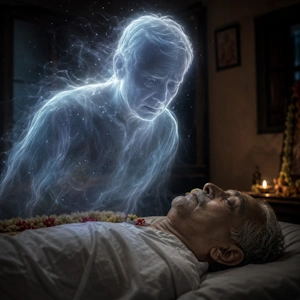
One of the most shocking descriptions in the departure process is this.
The being sees its own body after death.
Now pause and understand what that means.
For your entire life,
you said this body is me.
You protected it.
Decorated it.
Fed it.
Built identity around it.
Now suddenly,
you are outside it.
And the body is lying there separately.
Still.
Silent.
Unresponsive.
This creates a massive shock.
Not because the body changed.
Because identity broke.
Now understand this clearly.
The deepest attachment in human life
is not to money.
Not to family.
Not even to status.
It is to the body.
Everything else is experienced through it.
So when separation happens,
the first collapse is psychological.
The mind cannot immediately process
that it is no longer the body.
Now see the strange part.
The being is still aware.
It sees relatives crying.
Calling its name.
Touching the body.
But there is no response.
Not because awareness ended.
Because connection ended.
This is where the real shock begins.
You are present.
But unreachable.
You can see the body.
But you cannot enter it again.
Now understand why this matters.
Most people live without questioning identity.
They assume body and self are the same.
Death breaks that illusion instantly.
Not philosophically.
Experientially.
Now see another layer.
The body that was once called
my face
my hands
my life
is now being spoken about differently.
Take the body.
Move the body.
Prepare the body.
Even language changes immediately.
This is very revealing.
The person and the body
are no longer treated as the same thing.
Now understand the deeper point.
This moment is painful
because attachment remains active.
The being still identifies with the old form.
It still wants continuity.
But continuity through that body
is over.
This creates resistance.
And resistance creates suffering.
Now see the hidden principle.
Death does not create detachment.
It forces it.
Real detachment must happen earlier.
Consciously.
Otherwise separation becomes shock.
Now bring this into practical life.
People spend decades strengthening body identity.
Appearance.
Comfort.
Status.
Pleasure.
But almost no time understanding
who is experiencing through the body.
That imbalance becomes visible at death.
Now understand something important.
Seeing one’s own body after death
is not shown to create fear.
It is shown to destroy confusion.
You are not the body.
The body is a vehicle.
Necessary.
Important.
But temporary.
Now see the final point.
The shock comes because the mind says
this cannot be happening to me.
But the system says
you were never the body to begin with.
That collision between illusion and reality
creates the intensity of the moment.
Simple.
Direct.
Unavoidable.
At Vedadhara, this is the clarity we try to bring.
Not fear of death.
Understanding of identity.
Because once you understand
what you truly are not,
life itself changes.
You become less trapped
by temporary forms.
Share this with someone
who thinks body and self are the same thing.
Question: Why is seeing one’s own body after death described as so shocking
Answer:
Because the person spent an entire lifetime thinking
this body is me.
The body was treated as identity.
Suddenly, separation happens.
The being is still aware.
But the body no longer responds.
That creates shock.
Not because the body changed.
Because identity broke.
The mind cannot immediately accept
that it exists separately from the body.
That collision creates intensity.
Question: Why does the departed remain attached to the old body even after leaving it
Answer:
Because attachment does not end instantly.
The habits of identification continue.
The being still thinks
my body
my family
my life.
That momentum remains active.
So even after separation,
there is psychological attachment.
This is why confusion and resistance are described.
The physical connection ended.
But emotional identification is still present.
Question: Why do the texts describe this moment so vividly
Answer:
Not to create fear.
To destroy confusion.
Most people live without questioning
who they really are.
Body identity becomes absolute.
Death exposes its limitation instantly.
That is why the description is strong.
It forces clarity.
It reminds the person
that detachment should happen consciously during life.
Not forcefully at death.
Objection: This sounds imaginary because dead people cannot see their own body
Reply:
The description is not talking about physical eyesight.
It is talking about awareness continuing
after separation from the body.
The texts describe consciousness
as operating through the body during life.
Not being created by the body itself.
So after separation,
awareness continues at a subtler level.
That is the principle being described here.





English
Garuda Puranam
Click on any topic to open
7
30
Astrology
Bhagavad Gita
Bhagavatam
Bharat Matha
Devi
Devi Mahatmyam
Ganapathy
Garuda Puranam
Glory of Venkatesha
Hanuman
Kathopanishad
Mahabharatam
Mantra Shastra
Mystique
Practical Wisdom
Purana Stories
Radhe Radhe
Ramayana
Rare Topics
Rigveda Explained
Rituals
Sages and Saints
Shiva
Spiritual books
Sri Suktam
Story of Sri Yantra
Temples
Vedas
Vishnu Sahasranama
Yoga Vasishta
26
17
10
0


