Sahadeva Speaks: The Silent Brother’s Dharma
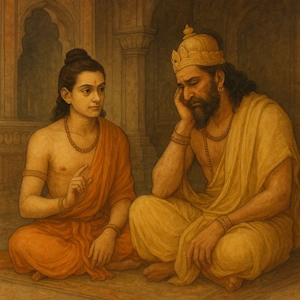
After the Kurukshetra war, Yudhishthira is broken by guilt and refuses kingship. In Shanti Parva, his brothers try to restore his will. In Chapter 13, Sahadeva offers deep philosophical insight—urging detachment, dharma, and the path of past kings—to console and realign his grieving elder brother.
Sahadeva speaks with sharp clarity:
Giving up outer things doesn't bring true success.
Even giving up the body may not lead to liberation.
Real renunciation is deeper.
If one clings to the body after giving up wealth,
Let their joy and dharma go to our enemies.
We don't want such shallow detachment.
But if one rules the earth without attachment to the body,
Let that joy and dharma come to us.
That’s the path of true noble souls.
‘Mine’ means death.
‘Not mine’ leads to Brahman, the eternal.
Attachment binds. Letting go frees.
Brahman and death both live in the self.
They guide life unseen.
Choice lies within: freedom or bondage.
If the self is truly indestructible,
then killing the body doesn’t mean killing the being.
There’s no himsa in what’s eternal.
But if soul and body rise and fall together,
then when the body dies, the self dies too—
and all karma becomes meaningless.
So leave extreme views aside.
Walk the middle path—
the way of the wise ones of the past.
Even Manu and the ancient emperors walked this same path.
If it were false,
why would such great souls choose it?
Through many Yugas—Satya, Treta, and beyond—
kings lived by this noble way.
They ruled well, and the earth rejoiced under their care.
Even if a king rules the entire earth,
with all beings under his command—
if he doesn’t live wisely,
what’s the use of his life?
Or if he lives alone in a forest, eating roots and fruits—
but still clings to possessions—
he’s already sitting at death’s door.
See the truth, O King—
all beings, within and without, act by their nature.
Those who grasp this truth
are freed from the deepest fear.
You are my father, my mother,
my brother, and my guide.
Please forgive these words—
they rise not from ego, but from pain.
Whether what I said is true or mistaken,
know this, O King—
I spoke it from love and devotion.
Thus ends Chapter 13 of the Shanti Parva — Yudhishthiram prati Sahadeva-vachanam — where the wise Sahadeva, soft-spoken yet sharp, offers a voice of reason to his shattered brother. Through dharma, detachment, and ancient wisdom, he lights a small flame in Yudhishthira's heart, urging him back to righteous kingship.
- What is the core paradox of renunciation that Sahadeva highlights to Yudhishthira?
Sahadeva reveals that true renunciation is an internal state rather than an external act. A person can strip away all worldly possessions, abandon their kingdom, and retreat to a forest, yet still be deeply bound by attachment if their mind clings to the idea of ownership or their physical body. Conversely, a king can rule the entire earth, command vast wealth, and manage an empire, yet remain completely liberated if he acts without the sense of personal possession. The paradox is that outer poverty can mask deep attachment, while outer royalty can coexist with perfect spiritual freedom. - How does Sahadeva redefine the concepts of life and death through the words mine and not mine?
In this teaching, life and death are removed from their biological definitions and placed in a psychological and spiritual context. Sahadeva states that the internal feeling of mine, which represents attachment, ego, and possessiveness, is the true definition of death because it binds the soul to the finite, decaying world. On the other hand, the realization of not mine represents complete detachment and leads directly to Brahman, the eternal reality. Therefore, spiritual death or liberation is determined entirely by the internal choice of attachment or letting go. - What are the two opposing metaphysical views of the soul that Sahadeva presents, and how do they both lead to the same conclusion regarding Yudhishthira's guilt?
Sahadeva addresses Yudhishthira's guilt by examining the nature of existence from two distinct philosophical angles. First, if the soul is indestructible and eternal, then the killing of bodies in the war did not truly destroy the essential being of anyone; therefore, ultimate violence or himsa against the eternal is impossible. Second, if the soul and body are completely identical and perish together, then death is simply the natural end of a physical process, making individual karma and lingering guilt meaningless after death. By showing that neither perspective justifies paralyzing grief, Sahadeva urges his brother to move past extreme intellectual positions and perform his duty. - What is the hidden psychological danger of a king abandoning his throne out of guilt, according to Sahadeva's warning?
The hidden danger is the cultivation of a false, shallow detachment. Sahadeva warns that if a king abandons his royal duties while his mind remains attached to his identity, his body, or the subtle pride of being a renunciant, he achieves neither worldly success nor spiritual liberation. This incomplete renunciation is viewed as an act of weakness rather than wisdom, which ultimately benefits the enemies of righteousness by leaving the throne vacant and causing the collapse of societal order. - Why does Sahadeva invoke the memory of ancient emperors like Manu and the cycles of past Yugas?
Sahadeva uses the examples of Manu and ancient rulers to prove that righteous governance is a time-tested, divinely sanctioned path to liberation. By referencing the Satya and Treta Yugas, he demonstrates that the middle path—ruling the earth with an attitude of detachment—is not a convenient compromise invented for Yudhishthira's comfort, but a cosmic blueprint followed by the wisest beings in history. This reference refutes Yudhishthira's belief that kingship is inherently sinful and cannot lead to spiritual perfection. - What is the mysterious meaning behind the statement that Brahman and death both live within the self?
This statement reveals that the ultimate forces of bondage and liberation do not exist in external realms or distant heavens, but are co-resident potentials within human consciousness. Death, representing the delusion of limitation and ego, operates silently from within when a person chooses attachment. Simultaneously, Brahman, representing infinite freedom and truth, is also present as the underlying reality of the self. They guide life unseen because every thought and action is shaped by which of these two inner forces a person aligns with. - How does understanding that all beings act by their nature free a leader from the deepest fear?
When a leader realizes that the universe and all its beings operate according to their inherent nature, or Prakriti, they stop taking cosmic events and human conflicts personally. Yudhishthira's fear and grief stem from the belief that he is the sole, personal author of a terrible destruction. By realizing that the war and its outcomes were the result of massive cosmic forces and the playing out of individual natures, the king can let go of personal anxiety, accept the present reality, and govern without fear of future consequences. - What distinguishes a wise ruler from a foolish one when both command the exact same material wealth and territory?
The sole distinction lies in wisdom and internal alignment. A foolish ruler may possess the entire earth and have all living beings under his command, but if he lacks wisdom and lives in the delusion of ownership, his life is entirely useless and spent at the doorstep of spiritual death. A wise ruler looks at the exact same kingdom and sees it not as a possession to be enjoyed by the ego, but as a field of duty to be nurtured with care and detachment, turning governance into a form of selfless service. - Why does Sahadeva conclude his profound philosophical discourse with an intense expression of personal humility and emotion?
Sahadeva shifts from sharp, objective philosophy to personal emotion to show that his words do not come from intellectual arrogance or a desire to lecture his elder brother. By addressing Yudhishthira as his father, mother, brother, and guide, Sahadeva honors the traditional hierarchy and acknowledges the pain of seeing his leader shattered. This emotional vulnerability ensures that the sharp truths he spoke are received not as a harsh critique, but as a medicine offered purely out of love, devotion, and a desire to heal. - What is the ultimate middle path that Sahadeva offers as a solution to Yudhishthira's crisis?
The middle path is the integration of action and contemplation, often known as Karma Yoga. It rejects the extreme of worldly greed, where a king rules out of selfishness, and it equally rejects the extreme of total withdrawal, where a king flees his duties out of guilt. The middle path demands that Yudhishthira accept the crown, protect the people, and manage the kingdom with total dedication, while internally remaining as detached and peaceful as a hermit living in the forest.





English
Mahabharatam
Click on any topic to open
7
30
Astrology
Bhagavad Gita
Bhagavatam
Bharat Matha
Devi
Devi Mahatmyam
Ganapathy
Garuda Puranam
Glory of Venkatesha
Hanuman
Kathopanishad
Mahabharatam
Mantra Shastra
Mystique
Practical Wisdom
Purana Stories
Radhe Radhe
Ramayana
Rare Topics
Rigveda Explained
Rituals
Sages and Saints
Shiva
Spiritual books
Sri Suktam
Story of Sri Yantra
Temples
Vedas
Vishnu Sahasranama
Yoga Vasishta
26
17
10
0


