Sage Kalabheethi
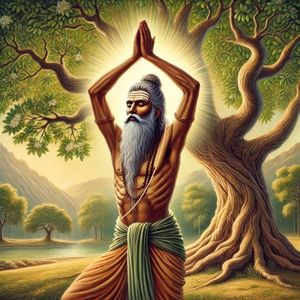
In the sacred city of Kashi, there lived a renowned sage named Manti. Known for his devotion to Lord Shiva, Manti was powerful, wise, and celebrated among his peers. Despite his spiritual accomplishments, his heart carried a deep sorrow - he had no son to carry forward his lineage. This void in his life drove him to seek the blessings of Lord Shiva.
Determined to obtain a son, Maharshi Manti embarked on a century-long penance. For one hundred years, he worshiped Lord Shiva with unwavering dedication, fasting and meditating in solitude. Finally, his devotion bore fruit. Lord Shiva appeared before the sage, his divine presence radiating compassion.
The Lord said, 'I am pleased with your penance. You will have a son who will be wise, virtuous, and a redeemer of your lineage. This child will bring glory to your family.'
With Lord Shiva's blessing, Manti’s wife soon conceived. The couple rejoiced, confident that their prayers had been answered. However, as time passed, their joy turned to worry. Four years went by, and the child had yet to emerge from the womb. Fearful and confused, Manti addressed the unborn child.
'O dear one,' he pleaded, 'even ordinary children bring happiness to their parents. You, blessed by Lord Shiva, should bring us joy, yet you remain in the womb, causing us distress. Why do you hesitate to be born? The human form is a rare and precious gift, offering the opportunity to attain Dharma, Artha, Kama, and Moksha. Even gods long for a human birth to perform noble deeds. Why do you dishonor this gift? Come forth, my child, and fulfill your destiny.'
The child responded from within the womb: ‘O revered father! I fully understand that.Attaining human birth is indeed a rare fortune, for it is only in this form that one has the right to perform virtuous deeds. However, I am deeply afraid of the path of time (Kala Marga). A being traversing the path of time, whether residing in heaven or hell, finds no true happiness anywhere. This path inevitably leads to karma, and karma results in bondage. Liberation can only be achieved through the path of light (Archir Marga). If I could be assured that I would follow the Archir Marga instead of the Kala Marga in this world, I would emerge from the womb immediately.’
Growing increasingly anxious after this response, Manti turned to his eternal protector, Lord Shiva. With folded hands, he prayed fervently:
'O Lord of Lords, O sustainer of the universe, I seek your refuge. Just as you granted me this child, I pray to you to help him come into the world. Without your grace, who else can fulfill this task?'
Moved by the sage’s devotion, Lord Shiva sent eight divine powers, known as Vibhutis, to the child in the womb. Four of these were sattvic (pure) powers: Dharma (Righteousness), Jnana (Knowledge), Vairagya (Detachment), and Aishwarya (Prosperity). They approached the unborn child and said, 'O great soul, we will always dwell in your intellect and guide you. You have nothing to fear.'
The remaining four were tamasic (impure) powers: Adharma (Unrighteousness), Ajnana (Ignorance), Avairagya (Attachment), and Anishwarya (Lack of Prosperity). They assured the child, 'We will remain far from you. You will never be troubled by us.'
Encouraged by these divine assurances, the child finally emerged from the womb. However, he shivered and cried, still fearful. Seeing this, the divine powers told Manti, 'Your son is frightened by the path of time (Kala). Hence, his name shall be Kalabheethi, meaning ‘one who fears time.’'
Kalabheethi grew up with remarkable intelligence and virtues. Manti ensured that all his samskaras were performed at the appropriate times according to the scriptures. Kalabheethi was deeply devoted to Lord Shiva. He chanted sacred mantras and embarked on pilgrimages to various Shiva tirthas.
During one such pilgrimage, Kalabheethi came across a vilva tree, sacred to Lord Shiva. As he approached the tree, a profound sense of peace enveloped him. Recognizing the sanctity of the place, he decided to meditate beneath the tree. He began chanting Rudra mantras with intense focus, eventually completing one lakh chants. Through this penance, his senses and mind merged into a state of unity, and he experienced supreme bliss (Ananda), a joy beyond description.
'This bliss,' Kalabheethi thought, 'is unlike anything I have felt at other holy places, such as Kashi or Kedarnath. My mind feels pure, like the waters of the Ganga, and my heart is filled with thoughts of Dharma. Truly, the sanctity of this place is extraordinary. I will meditate here and abandon the pursuit of other tirthas.'
Determined, Kalabheethi resolved to perform an arduous penance. Standing on one toe beneath the bilva tree, he vowed to abstain from water for one hundred years. His unwavering dedication attracted the attention of Lord Shiva, who decided to test him.
At the end of one hundred years, a man appeared, carrying a pot of water. Bowing before Kalabheethi, he said, 'O sage, please accept this water.'
Kalabheethi, however, was cautious. 'Before I accept this water, tell me about your caste, conduct, and beliefs. I cannot take food or drink from an unknown person.'
The man replied, 'I do not know my parents. I have no caste or religious practices. Dharma and Achara (conduct) are of no concern to me.'
Hearing this, Kalabheethi refused the water. 'My guru taught me that accepting food or drink from someone whose purity is unknown leads to spiritual downfall. I cannot betray my principles, even if you offer me the purest water.'
The man laughed. 'O sage, you are either naive or ignorant. Do you not know that Lord Shiva is omnipresent? He exists in every particle of this universe. How can you speak of purity and impurity when everything is Shiva’s creation?'
Kalabheethi replied calmly, 'What you say is true - Shiva is omnipresent. However, distinctions of purity arise due to the nature of objects. Just as fire makes air warm, or water cools it, so too are humans distinguished by their actions and conduct. If such differences did not exist, the scriptures would be meaningless. I will not compromise my principles.'
The man dug a large pit and poured the water into it, creating a clear pool. 'Look,' he said, 'this water is now untouched by me. Will you still refuse it?'
Kalabheethi remained firm. 'Though the pool appears pure, I cannot ignore what I have seen. My resolve is unshakable.'
Hearing this, the man suddenly disappeared, revealing himself to be Lord Shiva in disguise. At that moment, a magnificent Shiva Lingam emerged from the ground beneath the bilva tree, radiating light in all directions. Apsaras danced, gandharvas sang, and devas showered celestial flowers as the sages chanted victory cries.
Overwhelmed with devotion, Kalabheethi praised Lord Shiva with heartfelt hymns. He acknowledged the Lord as Mahakala, the ultimate destroyer of time and liberator of souls.
Pleased, Lord Shiva spoke: 'O sage, I am deeply impressed by your steadfastness. This Lingam shall be known as Mahakala, and I will reside here eternally. Anyone who worships here will attain immense spiritual merit. The mere sight of this Lingam will equal the merit of a lakh mantra chants. Those who bathe here and perform rituals for their ancestors will ensure their liberation. Ask for any boon, and it shall be granted.'
Kalabheethi bowed and said, 'O Lord, may this place become a source of eternal blessings for all devotees. Let those who worship here attain both prosperity and liberation.'
Lord Shiva granted all his wishes. From that day, the place became known as Mahakala Tirtha, a sacred site where devotees receive Lord Shiva’s endless grace.
Lessons-
1. Unwavering Faith and Devotion Lead to Divine Blessings
- Manti's century-long penance and Kalabheethi's steadfast adherence to his principles demonstrate the power of unwavering faith and devotion to Lord Shiva.
- True devotion requires perseverance and dedication. Those who remain steadfast in their faith, even during challenges, are rewarded with divine grace and blessings.
2. Adherence to Dharma is Supreme
- Kalabheethi's refusal to compromise his principles, even when tested by Lord Shiva in disguise, highlights the importance of following dharma (righteousness) and maintaining purity in actions.
- Upholding dharma, guided by scriptural wisdom and moral integrity, is essential for spiritual growth and self-respect. One must stand firm in their values, regardless of external pressures.
3. Sacred Places and Actions Multiply Spiritual Merit
- The emergence of the Mahakala Lingam and Lord Shiva's declaration of its power show that certain places hold immense spiritual significance.
- Worshipping at sacred sites and performing virtuous deeds in pure, sanctified environments amplify spiritual rewards. These acts not only benefit the devotee but also bring peace and liberation to their ancestors.
- Why did the child remain in the womb for four years despite being a blessing from Lord Shiva?
The childs delay was not due to a physical ailment but a profound spiritual realization. He possessed divine wisdom from birth and feared the Kala Marga, or the path of time. He understood that entering the physical world usually leads to the cycle of karma and bondage. His hesitation highlights a hidden truth: that even a blessed life is seen as a risk by a soul that prioritizes eternal liberation over worldly existence. - What is the fundamental difference between Kala Marga and Archir Marga as described by the unborn child?
Kala Marga represents the path of time, where a soul is bound by its actions and must experience the results in heaven or hell, eventually returning to the cycle of rebirth. In contrast, Archir Marga is the path of light and wisdom that leads directly to Moksha, or ultimate liberation. The childs dialogue reveals that human birth is only truly valuable if it serves as a bridge to Archir Marga, rather than just another loop in the wheel of time. - How do the eight Vibhutis sent by Lord Shiva represent the internal psychological battle of a human being?
The eight powers represent the duality of the human intellect. The four Sattvic powers (Dharma, Jnana, Vairagya, and Aishwarya) are the internal guides that lead to spiritual height, while the four Tamasic powers (Adharma, Ajnana, Avairagya, and Anishwarya) represent the shadows that cause downfall. By having the Tamasic powers promise to stay away, Lord Shiva essentially granted the child a "pure intellect" (Shuddha Buddhi), which is a rare divine intervention allowing a soul to live in the world without being corrupted by it. - What is the hidden significance of the name Kalabheethi?
While the name literally means one who fears time, it carries a deeper, paradoxical meaning. In Vedic philosophy, fearing time is the beginning of wisdom because it acknowledges the transience of life. By acknowledging this fear, Kalabheethi became immune to the distractions of the temporal world, eventually leading him to worship Mahakala, the one who is the master of time itself. Thus, his fear was the catalyst for his ultimate fearlessness. - Why did Kalabheethi find more peace under a specific Vilva tree than in famous sacred cities like Kashi?
This aspect of the story suggests that while established Tirthas (pilgrimage sites) are holy, personal spiritual breakthrough often happens in a place of focused, solitary penance. The Vilva tree is a living form of Shiva. The peace he felt was a sign of "Sthala Mahatmyam" (the greatness of the place), indicating that the sanctity of a location is often awakened or revealed by the intensity of a seekers meditation. - What was the true nature of the test Lord Shiva posed by appearing as an unknown man with water?
The test was not about thirst, but about the integrity of Achara (conduct) and Viveka (discernment). By appearing as a man without caste or conduct, Shiva was testing whether Kalabheethi would abandon his disciplined principles for the sake of logic or physical need. It highlights that for a seeker, the source of sustenance is as important as the sustenance itself, as the energy of the provider affects the mind of the receiver. - How did Kalabheethi counter the argument that Shiva is omnipresent and therefore purity does not matter?
Kalabheethi provided a sophisticated philosophical defense: while the essence of the Divine is everywhere, the manifestation differs based on Gunas (qualities). He used the analogy of fire and water affecting the air. This teaches a hidden lesson: Advaita (oneness) is a state of realization, but until one reaches that state, one must respect the rules of Dharma and purity to keep the mind steady. Using "God is everywhere" as an excuse to break discipline is portrayed here as a spiritual trap. - What is the mystery behind the Mahakala Lingam emerging from the spot where the water was poured?
The pit of water that the mysterious man created became a symbolic Tirtha. When Kalabheethi refused the water out of devotion to his principles, he proved he valued the Law of God more than the Gift of God. This total surrender to Dharma caused the ground to break and the Mahakala Lingam to manifest. It suggests that the Divine is hidden right beneath our feet, waiting for us to prove our steadfastness before it reveals its light. - Why is Lord Shiva called Mahakala in this specific context?
Mahakala is the Great Time or the Ender of Time. Since Kalabheethi began his journey in fear of time (Kala), Shiva manifested as the master of that fear. By worshipping Mahakala, the devotee transcends the limitations of past, present, and future. The transition from Kalabheethi (fear of time) to Mahakala (victory over time) represents the complete spiritual journey of a human soul. - What does this story teach about the concept of lineage and the role of a son?
The story begins with Manti wanting a son to carry forward his lineage. However, Kalabheethi did something much greater than just continuing a family name; he established a Tirtha that would liberate thousands of lineages. This teaches that the true purpose of a "virtuous son" is not just biological continuity, but the performance of such high spiritual acts that the entire ancestry is elevated to a higher realm.





English
Sages and Saints
Click on any topic to open
7
30
Astrology
Bhagavad Gita
Bhagavatam
Bharat Matha
Devi
Devi Mahatmyam
Ganapathy
Garuda Puranam
Glory of Venkatesha
Hanuman
Kathopanishad
Mahabharatam
Mantra Shastra
Mystique
Practical Wisdom
Purana Stories
Radhe Radhe
Ramayana
Rare Topics
Rigveda Explained
Rituals
Sages and Saints
Shiva
Spiritual books
Sri Suktam
Story of Sri Yantra
Temples
Vedas
Vishnu Sahasranama
Yoga Vasishta
26
17
10
0


