Rituals Don’t Work Without This
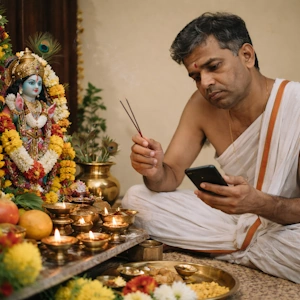
Divine satisfaction is not achieved by completing a ritual.
It is achieved by completing a connection.
The external act is only a framework.
It gives structure.
It gives direction.
But it does not carry the result on its own.
The real movement happens through bhava.
Bhava means the state of the mind while performing the act.
Not emotion for display.
Not forced seriousness.
A clear, steady recognition of what is being done and why it is being done.
When the act is done mechanically, the steps may be correct.
The materials may be proper.
The sequence may be perfect.
Still, the process remains incomplete.
Because there is no alignment between action and intention.
When bhava is present, even a simple act becomes effective.
A small offering, done with full awareness, travels further than a large arrangement done without attention.
The system responds to clarity, not scale.
Bhava ensures that the act is not reduced to habit.
It keeps the performer connected to the purpose.
It prevents the process from becoming empty repetition.
This is why sincerity is emphasized.
Not as a moral instruction.
But as a functional requirement.
Without it, the act loses its ability to carry meaning.
There is also another layer.
Bhava creates internal order.
The mind becomes quiet, focused, and respectful.
This state itself becomes part of the offering.
It stabilizes the individual while the act is being performed.
So the result is not one-sided.
It is not only about what is offered outward.
It is also about what is corrected inward.
That is why satisfaction is not in the materials.
It is in the alignment.
When bhava is right, the act completes itself.






English
Rituals
Click on any topic to open


