Pujas Done at the Place of Another Person May Not Benefit You
These days, land prices have gone up. If you are in the cities, then apartments and flats have gone beyond the reach of the common man.
If you take a place like Mumbai — an apartment of 500 or 600 sq. feet can cost you anywhere between 50 lakhs to 5 crores depending on the location. Even in towns, land prices have gone beyond the reach of most.
Low-cost housing should be a priority because Vastu Shastra says having one’s own house is very important from a religious and spiritual perspective.
Youngsters have started coming to a stand wherein they have started preferring rented houses. Take Mumbai — even if you go for an apartment costing 50 lakhs, your EMI will work out to 50,000 per month. Plus, with the uncertainty of the job market, a loan is something that you will have to service for 15, 20 or even 25 years — most of your career.
Your bank is the biggest beneficiary of your home-buying venture. In many cases, it will look like you are slogging for the bank to repay your loan. Even after 3 or 4 years of repayment of EMIs, if you look at the principal amount that you have borrowed, you will see that it has hardly changed.
But you can get a rented house for half that cost or even one-fourth that cost.
But in spite of all this, you should try to acquire a house of your own — a home of your own.
Because shastra says:
परगेहकृताः सर्वाः श्रौतस्मार्तक्रियाः शुभाः
निष्फलाः स्युर्यतस्तासां भूमीशः फलमश्नुते
Any punya karma done in another person’s house will not yield any benefit. They will be nishphala. The benefits, the results, would go to the owner of the house.
Now, there are a few clarifications needed here.
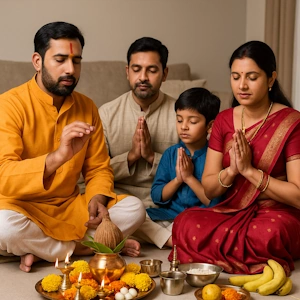
This is when you are making use of the place for free — say your brother’s or friend’s house, you are staying there for free, not paying him anything as rent. You do a puja there — even your daily puja, not necessarily an elaborate one — your brother or friend is going to get benefitted, not you.
The situation will be slightly better if you are in a rented place.
Because — if you see the concept of shreyodanam in pujas, you see this mostly in North India, where a certain Kalpa Sutra is followed. Whenever you get a puja done through a purohit, initially you engage him to do the puja on your behalf by doing a procedure called acharya varanam.
He does the pujas, he is chanting the mantras, he is doing the worship. Then the punya would also come to him only.
So at the end of the puja, you offer him dakshina, and in turn, he would take an areca nut or coconut and declare that — whatever punya I have acquired through the performance of this puja, I am handing over to you in exchange for this money that you are paying me. Then the supari or coconut is handed over to the couple on whose behalf he has done the puja.
This is a clear procedure. Rituals work based on the clarity of the procedure.
That is why we do sankalpa at the beginning — that this particular ritual is being done by this particular person for this particular result. It is specified. You can also do this mentally at the beginning of the ritual. It is equally effective.
Pronouncing the sankalpa at the beginning loudly is for the benefit of the purohits who are doing it for you. They are coming from somewhere. They don’t know what your problems are, what your needs are, why you are doing this puja.
Your family priest may know — you may have shared it with him — but there may be other priests also. They have to understand what they are going to do.
A doctor is going to do a surgery. He may call in some other doctors for help. There will be staff — nurses, OT staff. Before the surgery starts, there will be a communication that this is what we are going to do — appendix removal, liver surgery, whatever it is. Else one of them will try to cut open the abdomen whereas another one will start something else.
The purpose of sankalpa is this.
In elaborate procedures — say 10,000 ahutis with Mrityunjaya mantra — all the participating priests should know what they are going to do. So many of them will keep count, they will keep track, coordinate among themselves.
Gotra of the yajamana is pronounced. There are some procedures like shraddha where the person who is fed in the place of the forefathers should not belong to the same gotra as the performer. It is for the clarity of such things that sankalpa is primarily pronounced.
Many of us even don’t know how to pray, what to pray, what to ask for. So when you do a formal sankalpa, you are compelled to think and ask for something that is very important and your immediate requirement.
You may have ten problems, you may have hundred needs. So, you do one puja and ask for everything, then the punya that you accrue through the pujas will get distributed among all of them — you will hardly feel any difference.
So let’s say you in terms of quantity acquire hundred punya by doing a puja. You have hundred problems and needs. If you don’t specify, then it will go to all hundred — one-one each. You will hardly see any difference in any of them.
But you can say — all hundred should go towards this particular problem or requirement. This clarity should be there.
You should tell your purohit also, that this is what you are doing it for — so that you have clarity, also he can say this in sankalpa.
So if you are doing a Mrityunjaya Homa because of a health problem, say only that in the sankalpa.
Don’t say that you want dharma, artha, kama, moksha — everything under the sun. Nothing will come out of it.
If you are doing it for a particular person — don’t take other names — other sons, daughters-in-law, daughters, their husbands, their neighbours. Don’t do this. It won’t work. Be specific.
You have to channelize the punya to what you want. Then only it will work.
If your purohit cannot do, you do it mentally. It will be equally effective. It is between the divinity and you.
Some people think unless you pronounce the gotra correctly or nakshatra correctly, it won’t work. That is not the idea. Sankalpa is for your own clarity and for the priests who are doing it.
Some people do sankalpa during nitya puja also. Then why is this done? It is for your own clarity.
There is one more component of sankalpa — desha-kala sankeertanam — praising the place where the ritual is being conducted, praising the time when the ritual is conducted.
For us, everything in a ritual is divine. Everything that is put to divine use is divine. Everything that facilitates a worship is divine. That is why we worship the bell, shankha, asana before puja. The place — it gives us space to do the worship. The time — the time contributes to the success of the rituals. That’s why we praise them.
If you don’t know the details such as tithi, nakshatra — just say:
Tithir Vishnu...
You are equating all of them to Sri Hari. What better praise is possible?
I said rented house is slightly better — because then at least you are paying for it. There is a consideration involved. So you will get some benefit.
Or you should put it in the rent agreement itself: the results of all the pujas done in this house will only go to the tenant during the period of occupation. Otherwise, how will the landlord know?
The priest is consciously handing over the result of the puja to the yajamana after taking dakshina.
Ideally, always work towards having your own home if you are spiritually inclined.
Until then, pray at the temple, do your rituals at temples. They are public places, meant for this purpose. You will only get the benefit of what you are doing there. It won’t go to anyone else. It is meant to be that way.
Or go to your parents’ home and do there. This is for men — not for women after marriage.






English
Rituals
Click on any topic to open
7
30
Astrology
Bhagavad Gita
Bhagavatam
Bharat Matha
Devi
Devi Mahatmyam
Ganapathy
Garuda Puranam
Glory of Venkatesha
Hanuman
Kathopanishad
Mahabharatam
Mantra Shastra
Mystique
Practical Wisdom
Purana Stories
Radhe Radhe
Ramayana
Rare Topics
Rigveda Explained
Rituals
Sages and Saints
Shiva
Spiritual books
Sri Suktam
Story of Sri Yantra
Temples
Vedas
Vishnu Sahasranama
Yoga Vasishta
26
17
10
0


