Power Need not Corrupt
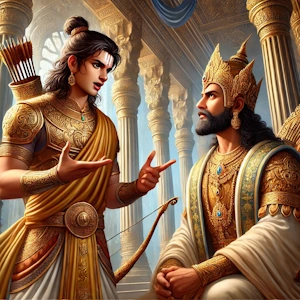
In Shanti Parva, Chapter 7, Yudhishthira is devastated by the Kurukshetra War's aftermath, grappling with guilt over the immense loss of life. The revelation of Karna’s identity deepens his sorrow, making victory feel hollow. Rejecting Kshatriya dharma, he condemns war as senseless destruction driven by greed. He mourns not only for his kin but for an entire lost generation. Blaming Duryodhana and Dhritarashtra, he also acknowledges the Pandavas' own failings. Overcome with despair, he seeks renunciation, believing true peace lies beyond kingship. His anguish remains a timeless reflection on the moral cost of war and the pursuit of inner peace.
Then, Arjuna responds to Yudhishthira's crisis with a fierce, almost defiant urgency - like someone who feels unjustly accused and refuses to back down. He reminds his elder brother that they have just fought and conquered through their own righteous duty (dharma). To forsake the kingdom now, he warns, is to call all their efforts - and the sacrifices of countless warriors - a colossal waste.
Arjuna believes that material prosperity, though not the ultimate goal in life, is a powerful tool for good. He says, 'Yes, the war was brutal, but through it, we reclaimed what was rightly ours and fulfilled our duty as kshatriyas. Why, then, give it all up to wander as a beggar? How will you perform great sacrifices or protect our people without the resources of a kingdom?'
In his view, a king who abandons his throne also abandons his sacred responsibilities: to safeguard his subjects, sustain religious rites, and uphold order. Arjuna insists that wealth - when used ethically - enables spiritual growth, charitable deeds, and fulfillment of one's duties. He points out that even the gods had to fight their kin for their rightful place in heaven, implying that sometimes conflict is unavoidable when righteousness is at stake.
Arjuna cites examples of ancient rulers - Dilipa, Nahusha, Ambarisha - who were all custodians of the earth in their time. Just as water in a vast ocean spreads in all directions, so does wealth flow from a worthy royal lineage to uplift society. By refusing his crown, Yudhishthira would not only neglect the hard-won prosperity that can sustain countless subjects, but also fail to honor the cosmic order that demands rulers lead and maintain dharma in the world.
Arjuna's tone is part rebuke, part plea. He reminds Yudhishthira that the Pandavas have an obligation to pay respect to the gods and ancestors through grand sacrifices - rituals that require resources. 'If you walk away now,' Arjuna seems to say, 'you not only set aside your own fortune and fame; you also lose the chance to serve humanity on a grand scale. Poverty might sound saintly in theory, but in practice, it can destroy one's capacity to do good in the world.'
Moreover, Arjuna contends that one cannot simply erase the blood spilled on the battlefield by running off to the forest. 'We have responsibilities,' he insists, 'and we must see them through. The world needs us to rule wisely, to mend what we have broken, and to prove that we can govern with justice and compassion, not just with the sword.'
At its heart, Arjuna's speech is a call for balance. He does not dismiss the value of renunciation - he acknowledges that saints and sages live on little, focusing on spiritual evolution. But for a king fresh from a war that reshaped an entire kingdom, a sudden withdrawal from worldly life would be, in Arjuna's eyes, a refusal to shoulder the burdens that fate has placed upon him.
He reminds Yudhishthira - and, by extension, all of us - that worldly success, if aligned with moral principles, need not be a hindrance to spiritual growth. Rather, it can be the very platform from which one serves a greater good. 'Power need not corrupt,' Arjuna insists, 'when guided by virtue. Wealth need not degrade, when used to uplift others. And victory, however bitterly earned, can still serve the cause of justice if we remain humble and steadfast in our duties.'
In the end, Arjuna's words challenge us to reflect on the tension between worldly responsibilities and spiritual aspirations. His counsel urges us not to abandon our spheres of influence but to transform them - using our resources, skills, and positions for the welfare of others. It is a passionate statement that, yes, the battlefield is cruel, but the work of restoration, protection, and moral leadership is where true heroism must begin.
- Shanti Parva, Chapter 8





English
Mahabharatam
Click on any topic to open
7
30
Astrology
Bhagavad Gita
Bhagavatam
Bharat Matha
Devi
Devi Mahatmyam
Ganapathy
Garuda Puranam
Glory of Venkatesha
Hanuman
Kathopanishad
Mahabharatam
Mantra Shastra
Mystique
Practical Wisdom
Purana Stories
Radhe Radhe
Ramayana
Rare Topics
Rigveda Explained
Rituals
Sages and Saints
Shiva
Spiritual books
Sri Suktam
Story of Sri Yantra
Temples
Vedas
Vishnu Sahasranama
Yoga Vasishta
26
17
10
0


