Performing Yaga Is Progressing From Worldly Life To Divine State
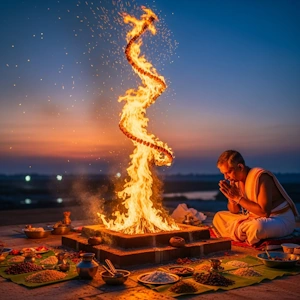
Today we will look at a mantra from Shatapatha Brahmanam.
व्रतमुपैष्यन् । अन्तरेणाहवनीयं च गार्हपत्यं च प्राङ्तिष्ठन्नप उपस्पृशति तद्यदप उपस्पृशत्यमेध्यो वै पुरुषो यदनृतं वदति तेन पूतिरन्तरतो मेध्या वा आपो मेध्यो भूत्वा व्रतमुपायानीति पवित्रं वा आपः पवित्रपूतो व्रतमुपायानीति तस्माद्वा अप उपस्पृशति
Brahmana granthas are about the procedure of doing yajnas.
Here, this mantra is about how the person who is going to perform a yajna called ishti tomorrow — what he has to do today.
There are two ishtis — one done in connection with amavasya called darsheshti (darsha means amavasya), and one connected to purnima — darsheshti and purnamaseshti.
Together they are called darshapurnamasa.
They are paired because the procedure for both is almost the same, with only slight differences.
Why is yaga done?
To attain heaven.
To evolve into a higher level.
To become a deva.
When you keep on doing yagas, you are actually constructing a new body yourself — organ by organ — which you can use after your life on earth.
Those who do yagas systematically — their atma can get into this body which is waiting for them and reach swarga through a path called devayana.
A normal person, after death, gets a body created using the pindas that his family offers him during the first ten days of the death rites.
This body is called ativahika sharira.
His atma would get into this body and go wherever it is to go, depending on his karma during his lifetime.
But those who do yagas — they are assured of swarga because their whole life is dedicated towards that.
They live to evolve themselves into a higher level.
Like how a student plans his education based on the goal of a good career — he does graduation, post-graduation, PhD — the whole effort that he puts from KG class to PG is towards that goal.
So from the state of ignorance which a child is, by the time he finishes his PG, he has converted himself into someone completely different.
That is how he becomes eligible for a career.
Those who do yagas — they also do the same thing.
Over a period of 30 or 40 years, they convert themselves, make themselves eligible for entry into swarga.
What position you get in swarga depends on how much you have done.
Indra did 100 big yajnas, so he got the position of the king of swarga.
There also, hierarchy exists.
Tomorrow’s ishti — you have to observe vrata from today.
What is this vrata?
Hereafter, till the time tomorrow’s ishti or yaga is over, you will focus your body, speech, and mind only on the ishti.
Everything else you leave outside.
You will not do anything other than what is required for the yaga.
You will not talk about anything else.
You will not think about anything else.
Unless this vrata is observed, the yaga is not going to give result.
There are very interesting concepts embedded into the procedure for getting into this vrata.
There are three agni kundas in the yaga vedi.
Out of these, one in the west is called garhapatya,
One in the east is called ahavaniya,
And one in between, on the southern side, is called dakshinagni.
The agni that the yajamana ignites when he decides to become an agnihotri and strive towards attaining a place in swarga is kept unextinguished.
He has to perform homa in this agni in the morning and evening. This is called agnihotra.
This agni is kept in the garhapatya kunda.
Garhapatya is connected to the term gruhapati — lord of the house.
Who is the lord of the house?
The yajamana.
But Agni is his lord.
So gruhapati can be Agni also.
This is where a constant day-to-day relationship between the yajamana and Agni is maintained.
Ahavaniya is where, on occasions such as ishtis and other yagas, offerings are made to devas.
Agni is essentially the carrier of offerings to devas.
You can only give to Agni.
You cannot give directly to devas.
Agni will hand over to them as per your request.
You tell Agni, ‘Please hand over this to Indra,’ — he will do that.
At the time of such yagas, Agni from the garhapatya kunda is transferred to the kunda in the front — the ahavaniya kunda.
Garhapatya is also associated with worldly life —
Because other than the morning and evening agnihotra, the yajamana at other times has to take care of his worldly responsibilities, such as maintaining his family.
Ahavaniya is pure swarga.
So here, when the yajamana sips water to purify himself before starting the vrata, he stands between the garhapatya and ahavaniya kunda.
At this time, there is agni only in the garhapatya kunda.
Why is he standing between the two?
Because he is telling himself — I am progressing towards my destination which is swarga.
I am not stuck with my worldly life alone.
I am progressing towards my destination.
I am continuously being released from the pressures of worldly life and progressing towards swarga.
There is another meaning to this.
If it is pure divinity that he wants, then he can do achamana standing near ahavaniya kunda also.
He doesn’t do that — he is in between.
That means he is not yet completely ready to give up on worldly life — like in sanyasa.
As long as he is in the human body here, he wants worldly comforts also.
Not like pampering himself —
Essentials like food, shelter, clothes.
They live a simple life.
But lack of these will become a pressure and distract him from his goal.
So he should get blessing for that as well.
It is a combination of both —
Blessing for what is required here,
And progress to a state in which there are no such compulsions —
Which is what he is going to achieve through the performance of ishti tomorrow.
-
Why is the yajamana asked to begin vrata from the previous day itself?
Because a yaga is not an event of a few hours, it is a mental transformation. The previous day is meant to withdraw the mind from ordinary concerns so that body, speech and thought become one-pointed. Without this inner alignment, the outer offering becomes mechanical and fruitless. -
What exactly is meant by vrata in this context?
Vrata here is discipline of the whole personality. From the moment he takes it, the yajamana speaks only what is connected to the yaga, thinks only of the devas, and acts only in ways that support the ritual. It is a temporary but intense way of living like a deva while still in a human body. -
Why are there three agni kundas instead of one?
Each fire represents a different dimension of life. Garhapatya is the domestic, daily foundation. Ahavaniya is the gateway to the divine world. Dakshinagni relates to protective and transitional functions. The three together mirror human existence moving from household life toward higher realms. -
What is the symbolism of standing between garhapatya and ahavaniya while doing achamana?
It is a declaration of direction. The yajamana says to himself, I am not trapped only in worldly duties, nor have I renounced everything. I stand in movement from ordinary life toward swarga. The posture itself becomes a silent prayer of progress. -
If the goal is swarga, why not stand directly near ahavaniya?
Because he is still a householder with real needs. Food, shelter and basic comforts cannot be denied while living in this body. The Brahmana accepts this honestly and integrates both worlds instead of pretending to be beyond them. -
How do repeated yagas build a new body for the performer?
Every offering, mantra and discipline is seen as constructing subtle organs fit for a higher plane. Over decades, the yajamana reshapes himself, just as long education reshapes a child into a professional. Spiritual evolution is treated as a practical project. -
What is the difference between the body gained by ordinary people after death and that of a yajamana?
Ordinary people receive an ativahika body created through post-death rites performed by family. The yajamana, through lifelong yagas, prepares his own vehicle in advance and is guided through the devayana path directly to swarga. -
Why is Agni called both the lord of the house and the carrier to devas?
In daily agnihotra, Agni lives with the yajamana like a family member, hence lord of the house. In special yagas, the same Agni becomes the messenger who delivers offerings to Indra and other devas. One principle connects the human and divine worlds. -
Is swarga only a reward place, or a level of evolution?
It is primarily an evolutionary stage. The text sees swarga as a higher mode of existence where one functions like a deva. Hierarchy there depends on how much inner construction the person has achieved through disciplined yagas. -
What is the deeper lesson behind this whole procedure?
The Brahmana teaches that spiritual growth is not accidental. It requires planning, discipline and steady direction, just like education for a career. The ritual is a framework to train the mind to rise from ordinary living toward a luminous, orderly and divine state.





English
Vedas
Click on any topic to open
7
30
Astrology
Bhagavad Gita
Bhagavatam
Bharat Matha
Devi
Devi Mahatmyam
Ganapathy
Garuda Puranam
Glory of Venkatesha
Hanuman
Kathopanishad
Mahabharatam
Mantra Shastra
Mystique
Practical Wisdom
Purana Stories
Radhe Radhe
Ramayana
Rare Topics
Rigveda Explained
Rituals
Sages and Saints
Shiva
Spiritual books
Sri Suktam
Story of Sri Yantra
Temples
Vedas
Vishnu Sahasranama
Yoga Vasishta
26
17
10
0


